Peugeot Rifter I Spare Wheel and Tyre Repair Kit
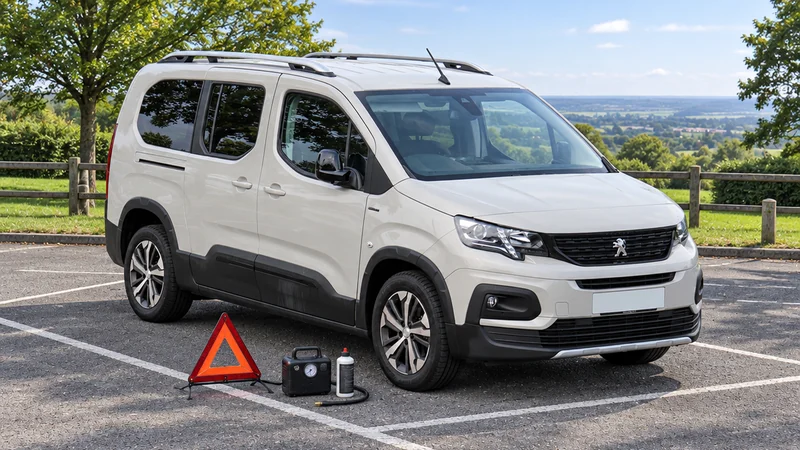
Hello and welcome. In this post, we'll look at what to do when you get a flat tyre on your Peugeot Rifter. We cover where the tools are kept, how to use the temporary puncture repair kit and how to fi
Starting, driving and parking your Peugeot Rifter (2018-2025): electric parking brake, hill start assist, gearboxes, drive selector and Stop & Start.
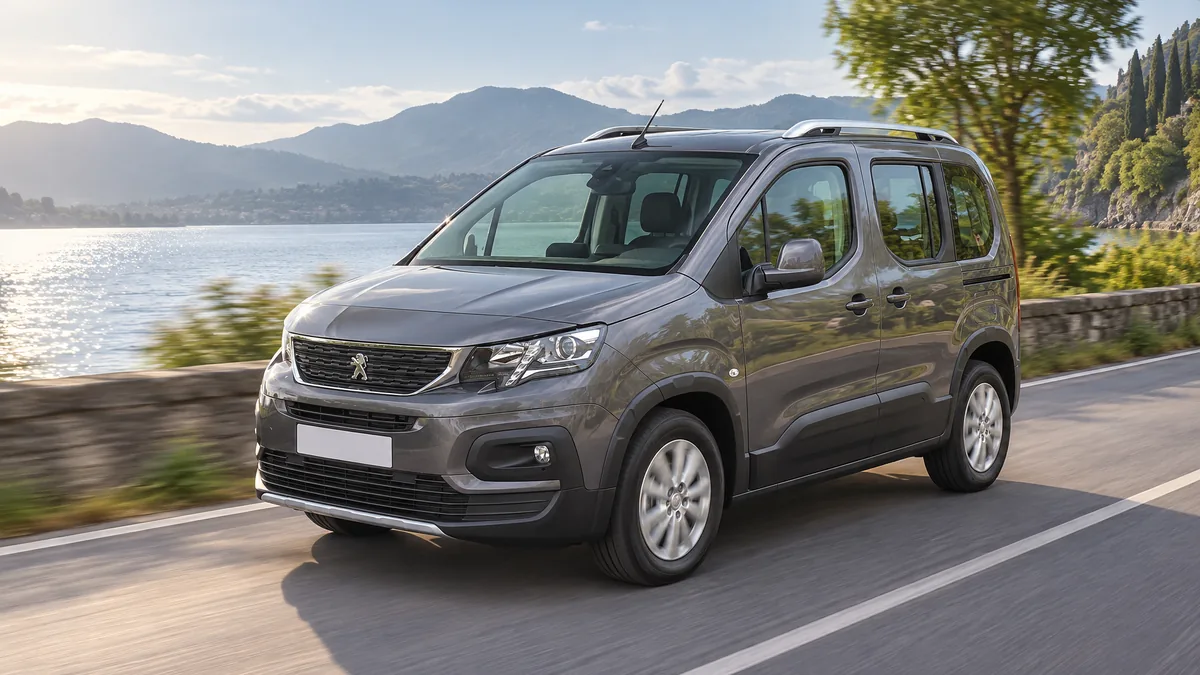
Hello and welcome. In this post, we'll look at starting, the gearbox and Stop & Start on the Peugeot Rifter I (2018-2025). It also covers driving recommendations, including what to do on flooded roads. It covers the Peugeot Rifter I (2018-2025), including vehicles produced from 01/11/2021. Some features depend on the version or equipment fitted, so you may not find all of them on your Rifter. Some features depend on the version or equipment fitted, so you may not find all of them on your Rifter.
Avoid it if you can. If you must, the water must be no deeper than 15 cm, Stop & Start must be off, and you should not exceed 6 mph (10 km/h) or stop the engine.
Scroll the table sideways.
| Section | In short |
|---|---|
| Driving recommendations | Safe driving habits, fire risks and flooded roads |
| Starting/switching off the engine | How to start and stop with a key or keyless |
| Electric parking brake | Applying, releasing and automatic mode of the brake |
| Hill start assist | Holds the car briefly for hill starts |
| Automatic gearbox (Type 1) | Using the 8-speed gear selector and paddles |
| Automatic gearbox (Type 2) | Using the 8-speed push selector and paddles |
| Drive selector (Electric) | Electric drive selector, regenerative braking and modes |
| Stop & Start (Petrol or Diesel) | How Stop & Start works and when it won't |
Here are some basic rules for driving your Rifter safely.
Important safety warnings:
On flooded roads: avoid it where you can, because water can seriously damage the engine, gearbox and electrical systems. If you really have to drive through a flooded section:
If you are unsure about the state of your car afterwards, contact a PEUGEOT dealer or a qualified workshop.
Noise (Electric): the electric Rifter is very quiet, so take extra care and always check around the car when manoeuvring. Up to 19 mph (30 km/h), the pedestrian horn warns other road users that you are there. During charging, the cooling fan comes on to cool the on-board charger and the traction battery.
Before starting, the parking brake must be applied. With a manual gearbox, put the gear lever in neutral and fully depress the clutch pedal, keeping it down until the engine starts. With an automatic gearbox, put the selector in position P and press the brake pedal.
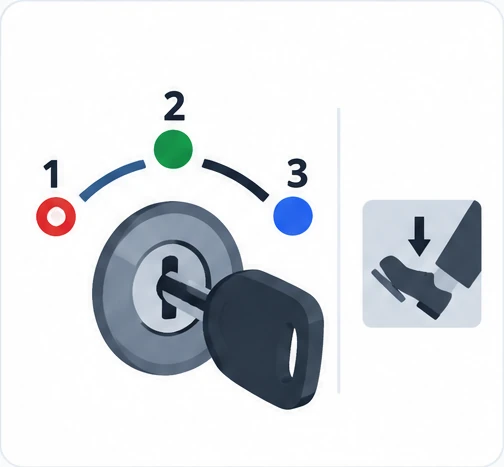
The ignition switch has three positions: 1 Stop, 2 Ignition on and 3 Starting.
Starting with the key or remote control key:
Starting with Keyless Entry and Start:
On Diesel models, when the temperature is below zero, the engine only starts once the pre-heating lamp goes off. If the lamp comes on after you press START/STOP, keep the brake or clutch pedal down until it goes off, without pressing the button again, until the engine starts and runs. If the remote control leaves the recognition zone, a message appears and you need to bring it back into the zone to start. If a starting condition is not met, a message tells you, and sometimes you must turn the steering wheel while pressing START/STOP to help unlock the steering column.
Weather and warm-up advice:
If the engine does not start straight away, switch off the ignition and wait a few seconds before trying again. If it still does not start after several attempts, stop trying, as you could damage the starter motor and the engine, and contact a PEUGEOT dealer or a qualified workshop.
Switching off: bring the car to a stop with the engine idling. Ideally put a manual gearbox in neutral, or select P on an automatic gearbox.
With Keyless Entry and Start, press START/STOP with the remote control in the recognition zone. With a manual gearbox the engine stops and the steering column locks. With the EAT8 gearbox the engine stops. The engine will not stop if the car is still moving.
Never switch off the ignition before the car has completely stopped. With the engine off, the braking and steering assistance also switch off, so you could lose control. Always take the remote control with you when you leave the car, even briefly, and avoid hanging heavy objects on the key, as they can cause a fault in the ignition switch.
Key left in the ignition: if the key is at position 1 (Stop) when you open the driver's door, a message and an audible signal remind you. If it is left at position 2 (Ignition on), the ignition switches off automatically after one hour. To switch it back on, turn the key to position 1, then back to position 2.
To avoid the pedals jamming, only use mats that suit the existing fixings, always use those fixings, and never lay one mat on top of another.
In automatic mode, the electric parking brake applies when you switch off the engine and releases when you move off. Automatic mode is on by default, but it can be deactivated in certain situations. With the engine running, you can pull the control briefly to apply the brake, or push it briefly while pressing the brake pedal to release it.
Indicator lamp: the lamp on the instrument panel and on the control comes on with the message "Parking brake applied", and goes off with the message "Parking brake released". It flashes when you manually ask to apply or release the brake.
Manual release, with the ignition on or the engine running:
If you do not press the brake pedal, the parking brake stays on and a message appears.
Manual application: with the car stationary, briefly pull the control. The control lamp flashes to confirm the request.
Automatic release: make sure the engine is running and the driver's door is closed. The brake then releases gradually as you move off.
With an automatic gearbox or drive selector, if the brake does not release automatically, check that the front doors are properly closed. When stationary with the engine running, do not press the accelerator unnecessarily, as this could release the parking brake.
Automatic application: with the car stationary, the brake applies automatically when you switch off the engine. It does not apply automatically if the engine stalls or goes into STOP mode with Stop & Start. In automatic mode, you can still apply or release the brake by hand at any time. To hold the car still with the engine running, briefly pull the control.
Safety warnings:
Hill start assist holds your Rifter still for approximately 2 seconds on a hill start, while you move your foot from the brake to the accelerator. It only works when the car is completely stationary with your foot on the brake, certain slope conditions are met and the driver's door is closed.
Do not get out of the car while hill start assist is holding it. If someone needs to get out with the engine running, apply the parking brake manually and check that the parking brake lamp and the P lamp on the control are on steadily. You cannot switch hill start assist off, but applying the parking brake interrupts it.
If there is a malfunction, warning lamps come on with a message. Have it checked by a PEUGEOT dealer or a qualified workshop.
This 8-speed automatic gearbox lets you choose automatic operation or sequential manual gear changes. Even in automatic mode, you can change gear with the steering-mounted paddles, for example when overtaking. Keep your foot on the brake pedal when moving the selector.
Scroll the table sideways.
| Position | Meaning |
|---|---|
| P | Park |
| R | Reverse |
| N | Neutral (can be used in traffic jams or a car wash tunnel) |
| D | Drive, automatic operation |
| M | Manual, sequential gear changes |
Pull the right-hand "+" or left-hand "-" paddle towards you to change up or down. The paddles cannot select neutral or engage or disengage reverse. The instrument panel shows the selected gear and lamp, and a "-" symbol if a value is invalid. If "Foot on the brake" appears, press the brake pedal firmly.
Moving off:
On a steep slope with a loaded car, press the brake, select D, release the parking brake (unless in automatic mode), then release the brake pedal. If P shows on the instrument panel but the selector is elsewhere, move it to P to start the engine. If you select N by mistake while driving, let the engine return to idle, then select D.
Automatic operation (D): the gearbox picks the best gear for your driving style, the road and the load. Press the accelerator fully (kick-down) for maximum acceleration. It also changes down when braking for engine braking, and will not change up if you release the accelerator sharply. You can take temporary control with the paddles, and after a few seconds without input it returns to automatic.
Creeping: with the engine idling, the parking brake released and D, M or R selected, the car creeps forward as soon as you lift off the brake, even without the accelerator.
Manual operation (M): with the selector in D, press button M for 6-speed sequential changes. The button lamp comes on, and M and the gears appear on the instrument panel. Press M again to return to automatic.
Safety warnings:
This 8-speed automatic gearbox uses a push selector, with a manual mode using the paddles behind the steering wheel.
Scroll the table sideways.
| Position | Meaning |
|---|---|
| P | Auto Park: press this button to park, the front wheels are blocked |
| R | Reverse |
| N | Neutral: to free-wheel and move the car with the ignition off |
| D | Automatic mode |
| M | Manual mode (Petrol/Diesel): press this button, then change gear with the paddles |
In mode N, with your foot on the brake, push the selector without passing the point of resistance: forwards selects R, backwards selects D. Let go fully after each push so the selector returns to its starting position.
Going straight between D and R:
Depending on equipment, in M or D you can pull the "+" or "-" paddle towards you and release it to change up or down. The paddles cannot select neutral or engage or disengage reverse. The instrument panel shows P, R, N, D1.8 or M1.8, and stays on for a few seconds after you switch off the ignition.
Only appropriate mode changes are accepted, and a message tells you if you need to press the brake pedal to change mode. In automatic mode, kick-down gives maximum acceleration, and the paddles let you choose a gear temporarily if speed and engine speed allow.
Safety warnings:
The electric Rifter uses a pulse drive selector with regenerative braking. It manages traction according to your driving style, the road and the load, and with regenerative braking on, it also manages engine braking when you lift off the accelerator.
Scroll the table sideways.
| Position | Meaning |
|---|---|
| P | Park: the front wheels are locked and the button lights up |
| R | Reverse, with your foot on the brake pedal |
| N | Neutral: to free-wheel the car with the ignition off |
| D | Drive, automatic forward gear |
| B | Brake: regenerative braking, the button lights up |
When you switch on the ignition, the instrument panel shows P, R, N, D or B. Push the selector forwards (N or R) or backwards (N or D) once or twice, passing the point of resistance if needed. For example, to go from P to R with your foot on the brake, push forwards twice without passing the point of resistance, or once past it.
Brake function: from D or R, press button B to switch it on or off. B replaces D/R on the instrument panel. The car slows more quickly when you release the accelerator, and the recovered energy partly recharges the traction battery, increasing your range. The setting is not saved when you switch off the ignition.
With the brake pedal: pressing the pedal also recovers some energy to recharge the traction battery and reduces brake pad wear. The pedal may feel different from a car without regenerative braking.
Driving modes: pressing the driving mode control shows the modes on the instrument panel (on Petrol or Diesel, it activates Eco mode and its lamp comes on). On the electric version, you cannot select a mode until the READY indicator lamp is displayed.
Stop & Start puts the engine into standby (STOP mode) when the car is stationary, for example at red lights or in traffic jams, and restarts it (START mode) as soon as you want to move off. It is mainly for town driving, to cut fuel use, emissions and noise when stationary, and it does not affect the car's functions, including braking.
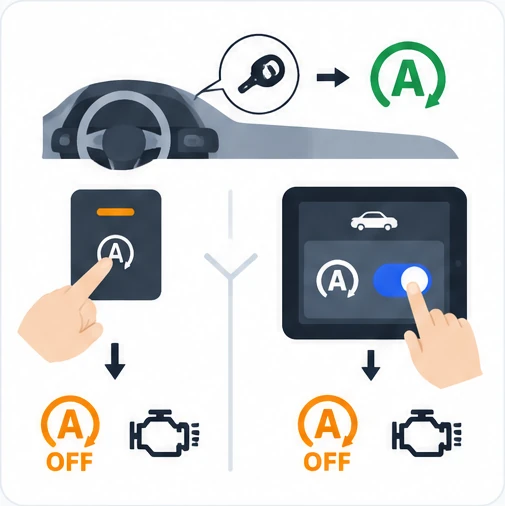
Always deactivate Stop & Start before working under the bonnet, so the engine cannot restart and injure you. also strongly recommends deactivating it before driving into a flooded area.
Deactivation/Activation: press the Stop & Start button (the lamp is on when the system is off), or use the Vehicle/Driving menu on the touch screen. If you deactivate it in STOP mode, the engine restarts immediately. The system switches back on every time you start the engine.
Main conditions for operation:
Going into STOP mode:
A time counter adds up the time spent in standby during the journey and resets each time you switch on the ignition.
When the engine will not go into standby: besides the conditions above not being met, it stays running on a steep slope (up or down), if you have not exceeded 6 mph (10 km/h) since the last engine start, if the electric parking brake is applied or being applied, if it is needed to keep the cabin comfortable, or if demisting is on. In these cases, the indicator lamp flashes for a few seconds, then goes off.
Avoid it where you can. If you must, the water must be no deeper than 15 cm, Stop & Start must be off, and you should not exceed 6 mph (10 km/h) or stop the engine.
The engine must be running and the driver's door closed for automatic release. With an automatic gearbox or drive selector, also check that both front doors are properly closed.
It will not work if a condition is not met, such as the driver's seat belt being unfastened, or if you are on a steep slope, have not passed 6 mph (10 km/h) since starting, or demisting is on. The indicator lamp flashes for a few seconds in these cases.
No, it cannot be deactivated. Applying the parking brake to hold the car does interrupt it.
Knowing how your Rifter starts, holds itself on a hill and handles gear changes makes everyday driving easier and safer. Keep this guide handy. If in doubt, ask a PEUGEOT dealer or a qualified workshop.
If a lamp comes on while you are driving, check our guides to Peugeot Rifter red warning lights, Peugeot Rifter orange warning lights and Peugeot Rifter green and blue indicator lamps.
Don't forget to follow us on Instagram for more Peugeot guides!
This is an independent guide, not an official Peugeot publication. If in doubt, contact a PEUGEOT dealer or a qualified workshop before carrying out any work.
Related guides: Peugeot Rifter model guides.
Cover adapted from a photograph by Vauxford — Wikimedia Commons, CC BY-SA 4.0 (AI edited).
Hello and welcome. In this post, we'll look at what to do when you get a flat tyre on your Peugeot Rifter. We cover where the tools are kept, how to use the temporary puncture repair kit and how to fi
Hello and welcome. In this post, we'll look at how to change the bulbs on the Peugeot Rifter I (2018-2025). It covers the safety precautions, the different types of bulb fitted, and the steps for the
Hello and welcome. In this post, we'll look at where the 12 V battery is, and how to jump start or charge it on the Peugeot Rifter I (2018-2025). It covers where to find the battery, how to start the