What Do Peugeot 208 Warning Lights Mean? Service and Gauge Guide
Peugeot 208 service, oil level, coolant, AdBlue and SCR indicators explained, plus the e-208 power, charge and thermal comfort gauges.
Most of the information on a Peugeot 208's instrument panel isn't a warning at all. The service spanner, oil level reading, temperature gauge and, on diesels, the AdBlue range readout are there to tell you how the car is doing before anything goes wrong. On the e-208 there's another set of gauges for power, battery charge and how much energy the heating is using.
This guide explains each of these readouts, what is normal, and when you need to act. It covers the second-generation 208 and e-208 (2019 on), using the official Peugeot 208 owner's handbook as our reference. For the coloured warning lamps, see our separate red and orange warning guides.
Service Indicator

Here we cover indicators such as AdBlue, oil level and servicing. If you're seeing other types of warning on the instrument panel, we've covered them all separately, so make sure you also read our guides to Peugeot 208 orange warnings, Peugeot 208 red warnings and Peugeot 208 green and blue indicators.
The service indicator on the Peugeot 208 tells you that the car's routine service is due or coming up. It expresses the service interval in distance (kilometres or miles) and time (months or days), and it is triggered by whichever limit is reached first. A message appears on the instrument panel showing how far you can drive, or how long you have left, before the next service.
What to do:
- Check when your service is due: the indicator shows the distance or time remaining until the next service.
- When the service is due or close: if the service indicator is active, your car's routine maintenance is due or about to be. Contact a PEUGEOT dealer or qualified workshop and book your service.
Don't ignore the service indicator. Routine maintenance is vital for your car's performance, safety and longevity, so use the indicator as your cue to get the car serviced on time.
Maintenance Spanner Indicator
The maintenance spanner shows that your 208's next service is approaching. It appears briefly when you switch on the ignition and shows the distance remaining to the next routine service. If it shows a distance between 1,000 and 3,000 km, your next service will fall within that range. If the spanner stays on steadily with the ignition on, the next service is less than 1,000 km away.
What to do:
- Check your service schedule: an active spanner means the next routine service is due or very close, so don't put off planning it.
- When the service is near or due: if the indicator shows less than 1,000 km, your next service is very close and should be carried out as soon as possible.
- Contact a PEUGEOT dealer or qualified workshop and book a suitable service appointment.
Responding promptly to maintenance indicators helps keep your car safe, long-lived and performing at its best.
Flashing Service Spanner
A flashing service spanner, particularly on BlueHDi diesel models, warns that the service is overdue. With the ignition on, the spanner first flashes and then stays on steadily. It usually appears together with the Service warning lamp and means the car needs servicing straight away.
What to do:
- Don't delay the service: a flashing spanner means the service is overdue and the car needs attention urgently. Ignoring it can compromise performance and safety.
- Contact a PEUGEOT dealer or qualified workshop and book a service appointment.
- Book it quickly: an overdue service may mean some critical maintenance has been missed, so arrange the appointment as soon as you can.
Resetting the Service Indicator
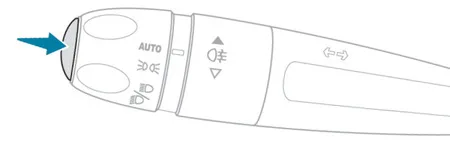
Reset the Peugeot 208 Service Indicator
The service indicator can be reset after every service. If you service the car yourself, follow these steps:
- Switch off the ignition.
- Press and hold the button on the end of the lighting control stalk.
- Press the START/STOP button once without pressing the brake pedal, while still holding the lighting stalk button.
- A temporary display window and countdown appear on the instrument panel.
- Release the button when the display shows "=0". The service indicator has been reset and the spanner symbol disappears.
If you have any trouble resetting the indicator, contact a PEUGEOT dealer or qualified workshop.
Viewing Service Information
View Service Information on a Peugeot 208
You can view service information and reminders through the Driving/Vehicle touchscreen menu, which makes it easy to check service dates and maintenance details:
- Open the Driving/Vehicle menu on the touchscreen.
- Press the "Check" button, which gives quick access to maintenance and service information.
- View the service information: the screen shows details such as the last service date and the distance or time remaining until the next service.
Regular servicing is essential to protect your car's performance, safety and longevity. If in doubt, contact a PEUGEOT dealer or qualified workshop.
Oil Level Indicator
Depending on version, the Peugeot 208 can check the engine oil level using an electric gauge. When you switch on the ignition, the oil level is shown on the instrument panel for a few seconds after the service information. It helps you confirm the engine has enough oil to run properly.
Check the Engine Oil Level Indicator on a Peugeot 208
- Park on level ground: the reading is only valid when the car is on level ground and the engine has been switched off for at least 30 minutes.
- Switch on the ignition: after the service information is displayed, the oil level indicator is shown for a few seconds.
- Read the oil level: the instrument panel shows whether the level is correct or whether oil needs to be added.
Digital instrument panel or Driving/Vehicle touchscreen: on versions with a digital instrument panel, you can press the "Check" button in the Driving/Vehicle touchscreen menu to view and configure some vehicle settings, including the engine oil level.
Checking the oil level regularly helps the engine last and keeps the car performing well. If the level is low or an oil change is due, contact a PEUGEOT dealer or qualified workshop.
Low Oil Level Warning
This warning means the engine doesn't have enough oil. Depending on the instrument panel, the Service warning lamp comes on with an audible signal and an "OIL" or "Oil level incorrect" message. A low oil level can damage the engine and needs immediate attention.
What to do:
- Check the level with the dipstick: park on level ground and let the engine cool for a while. Pull out the dipstick, wipe it, reinsert it and pull it out again to read the level.
- Top up if needed: if the dipstick confirms the level is low, top up to avoid engine damage, using the oil grade and specification in the owner's handbook.
- Keep checking regularly: if the level is low or keeps dropping, it may point to a more serious problem.
- Get it checked: if the level keeps falling, or the warning stays on after topping up, take the car to a PEUGEOT dealer or qualified workshop for a full inspection.
Low oil can cause the engine to overheat and suffer serious damage, so always take this warning seriously.
Oil Level Gauge Fault Warning
The "Oil level fault" warning means the engine oil level can't be measured correctly. Depending on the instrument panel, "OIL_ _" or "Invalid oil level measurement" is displayed, the Service warning lamp comes on and you hear an audible signal. It indicates a fault with the electric oil gauge, so the oil level can no longer be monitored electronically.
What to do:
- Contact a PEUGEOT dealer or qualified workshop: the system has a fault that needs to be checked by a technician.
Check the oil level manually: while the electric gauge isn't working, use the dipstick in the engine compartment. Park on level ground, let the engine cool, then pull out the dipstick, wipe it, reinsert it and check the level.
Keep up regular checks: with the electronic system out of action, manual checks become even more important.
If you have any concerns about your oil level or engine health, see a qualified workshop as soon as possible.
Coolant Temperature Gauge
The coolant temperature gauge shows the temperature of the engine coolant. It is divided into two zones:
Zone A: the coolant temperature is normal.
Zone B: the coolant temperature is too high. The related warning lamp and the red STOP warning lamp come on, a message is displayed and you hear an audible signal.
What to do:
- Stop the car safely: zone B means the engine is overheating, and you must stop in the safest conditions possible.
- Leave the engine running for a few minutes before switching off to help the cooling system bring the temperature down. Switching off abruptly can sometimes cause further damage.
- Switch off the ignition and open the bonnet carefully: the engine and bonnet may be hot, so take care to avoid burns.
- Check the coolant level once the engine has cooled. A low level or a leak in the cooling system may have caused the overheating.
Overheating can cause serious engine damage, so if you get this warning, take the car to a PEUGEOT dealer or qualified workshop as soon as possible.
AdBlue® Range Indicators (BlueHDi)
On Peugeot 208 BlueHDi models, the AdBlue® range indicators give information about the level of AdBlue® fluid, which the diesel engine's exhaust after-treatment needs to work properly. BlueHDi engines use SCR (Selective Catalytic Reduction) and a Diesel Particulate Filter (DPF) to treat exhaust gases, and these systems can't work without AdBlue®.
When AdBlue® Falls Below the Reserve Level
When the AdBlue® reserve falls below a certain level (2,400 km down to 0 km of range), a warning lamp comes on every time you switch on the ignition.
It shows the estimated distance you can drive before the engine is prevented from starting.
When the AdBlue® tank is completely empty, a system stops the engine from starting until the tank is refilled.
Displaying the AdBlue® Range Manually
- On cars with a matrix or digital instrument panel, the range is not shown automatically when it is more than 2,400 km (about 1,500 miles).
- You can display the AdBlue® range manually by pressing the "Check" button in the Driving/Vehicle touchscreen menu.
A low or empty AdBlue® tank affects the emission control systems the diesel engine needs to run cleanly and efficiently, so top up as soon as possible when you get a low-level warning. If you have any concerns, contact a PEUGEOT dealer or qualified workshop.
What to Do When AdBlue® Is Running Low
What you need to do depends on how far the AdBlue® level has fallen and how much range is left. Once the level drops below the reserve, specific warning lamps come on and messages remind you to refill so the engine isn't prevented from starting.
AdBlue® Warnings by Remaining Range
Range between 2,400 km and 500 km (1,500 miles and 800 miles):

- Warning lamps come on.
- Remaining range: between 2,400 km and 500 km.
- What to do: top up with AdBlue® as soon as possible.
Range between 800 km and 100 km (500 miles and 62 miles):
- Warning lamps come on.
- Remaining range: between 800 km and 100 km.
- What to do: refilling is important, as there is a risk the engine won't start.
Range between 100 km and 0 km (62 miles and 0 miles):
- Warning lamps come on.
- Remaining range: between 100 km and 0 km.
- What to do: you must add at least 10 litres of AdBlue® to the tank before the engine can be restarted.
Refilling and detection:
After you refill with AdBlue®, the system may not detect it straight away. It can take a few minutes of driving for the refill to be recognised.
SCR Emission Control System Fault
The SCR (Selective Catalytic Reduction) emission control system on Peugeot 208 BlueHDi models cleans diesel exhaust gases to reduce air pollution. When a fault is detected in the SCR system, various warnings and messages appear on the instrument panel.
Signs of an SCR Emission Control System Fault
Fault detected:
The warning lamps come on with an audible signal and the message "Emissions fault" or "NO START IN".
This warning appears when the fault is first detected, then every time you switch on the ignition for as long as the fault persists.
If the fault is temporary:
On the next journey, the SCR system runs a self-diagnostic check, and the warning goes out if the problem has cleared.
Fault confirmed during the permitted driving phase (between 1,100 km and 0 km / 685 miles and 0 miles):
- If the fault indication is still shown after 50 km (31 miles) of driving, the SCR fault is confirmed.
- The AdBlue warning lamp flashes and the message "Emissions fault: Starting prevented in X km" or "NO START IN X km" appears.
- While driving, the message is shown every 30 seconds, and the warning reappears whenever you switch on the ignition.
- The starting prevention system allows you to drive up to 1,100 km (685 miles).
Starting prevented:
Every time you switch on the ignition, the message "Emissions fault: Starting prevented" or "NO START IN" is displayed.
What to Do If the SCR Emission Control System Has a Fault
When an SCR fault is detected, contact a PEUGEOT dealer or qualified workshop. The system keeps the car compliant with emissions regulations, so the fault must be repaired professionally. Once the "Starting prevented" warning appears, you won't be able to start the car, and it needs urgent attention.
Power Indicator (Electric)
The power indicator on the electric Peugeot 208 shows how much energy the electric drivetrain is using or recovering. It helps you understand the car's energy consumption and charging and drive more efficiently. Its zones are:
CHARGE:
- During deceleration and braking, the car converts kinetic energy into electrical energy to charge the traction battery.
- This zone shows energy being recovered through regenerative braking.
ECO:
- Shows the car is using little energy, with optimised driving range.
- Active during energy-efficient driving and gentle acceleration.
POWER:
- Shows the drivetrain is using more energy during acceleration.
- Active during dynamic driving or hard acceleration.
NEUTRAL:
- With the ignition on, the electric drivetrain is neither using nor producing energy.
- The needle or cursor returns to the "neutral" position between ECO and CHARGE.
- With the ignition off, opening the driver's door wakes the gauge, which goes to the "neutral" position.
The ECO zone helps you save energy, CHARGE shows the battery being recharged efficiently, and POWER shows consumption rising under hard acceleration. Adjusting your driving based on this information helps you get the most range from the car.
Charge Level Indicator (Electric)
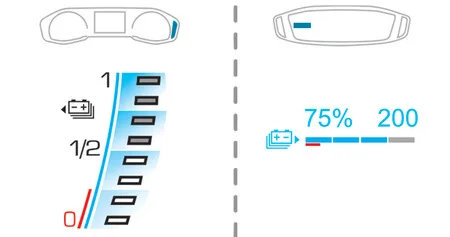
This indicator shows the traction battery's current charge level and remaining range, giving you the information you need to manage energy and plan charging.
What the Charge Level Indicator Does
Charge level and remaining range shown continuously:
When you start the car, the traction battery's charge level and remaining driving range are shown on the instrument panel at all times.
Waking the gauge with the ignition off:
With the ignition off, opening the driver's door activates the gauge.
Related Warning Lamps and Charge Levels
As the energy level drops, two warning levels appear on the instrument panel:
a. Reserve level:

-
When the traction battery charge is low, the lamp comes on steadily and the gauge shows the red zone, with an audible signal.
-
The remaining range is shown on the instrument panel.
-
You are advised to charge the car as soon as possible.
b. Critical level:

-
When the traction battery reaches a critical level, the reserve warning lamp stays on with an audible signal.
-
The car must now be charged.
-
The remaining range is no longer calculated and drive power is gradually reduced.
-
Heating and air conditioning are switched off to reduce energy consumption.
The low and critical level warnings make sure you're never caught out by running out of energy, so you can plan your driving and charging accordingly.
Thermal Comfort Consumption Gauge (Electric)
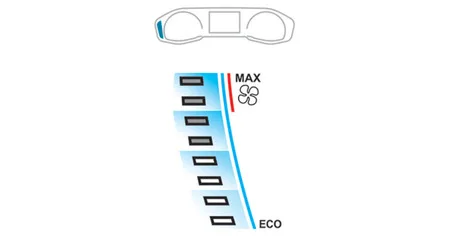
This gauge shows how much electrical energy the cabin's thermal comfort equipment, mainly the heating and air conditioning, is drawing from the traction battery, so you can keep an eye on their consumption.
Features of the Thermal Comfort Consumption Gauge
Display and modes:
- The gauge is usually shown on the digital instrument panel in "Personal" mode.
- When ECO mode is selected, some performance features are limited and the needle or cursor moves into the "ECO" zone.
Using the heating and air conditioning:
- The heating and air conditioning can be used when the READY lamp is on and the car isn't charging, or when the ignition is on and the car is charging ("Lounge" mode).
- You can temporarily select maximum heating or cooling to warm up or cool down the cabin quickly.
- With heating at maximum, the gauge moves into the MAX zone. With air conditioning at maximum, it stays in the ECO zone.
Energy consumption and range:
- Heavy use of thermal comfort equipment, especially at low speed, can significantly reduce the car's range.
- Once the cabin reaches the comfort level you want, adjust the settings to save energy.
- Remember to adjust the settings after starting the car if necessary.
Smell on first use:
If you haven't used the heating for a long time, you may notice a slight smell for the first few minutes.
Key Points to Remember
- A flashing or red service, oil or temperature readout always takes priority over everything else on the panel
- Check the oil level with the dipstick if the electronic gauge reports a fault, rather than relying on the gauge
- Don't let a BlueHDi diesel run out of AdBlue: once the tank is empty, the engine won't restart
- Book your service when the spanner first appears rather than waiting for it to flash
For the warning lamps, see our 208 red warning lights, orange warning lights and green and blue indicator lamps guides, and learn your way around the screens in How to Check Peugeot 208 Warning Lights. For the car as a whole, read our Peugeot 208 review.
Don't forget to follow us on Instagram for more Peugeot guides!
Related guides
Your 208's dashboard and touchscreen can tell you far more than most owners ever look at: trip data, fuel or energy use, the remaining range and, on the e-208, how energy is flowing between the battery and the motor...
The second-generation Peugeot 208 (launched in 2019) has been sold with more powertrains than almost any other small car: non-turbo and turbo petrols, a diesel, a 48-volt hybrid and a fully electric version. This guide...
Please note: this review is based on 2024 model-year data and my own ownership experience from 2022 to 2023. Specifications, equipment and engine line-ups may have changed for 2026. Few superminis turn heads like the...