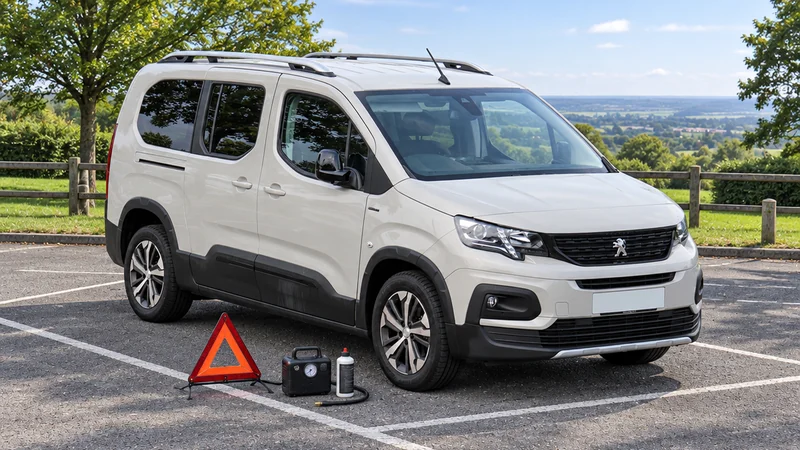
Peugeot Rifter I Spare Wheel and Tyre Repair Kit
Hello and welcome. In this post, we'll look at what to do when you get a flat tyre on your Peugeot Rifter. We cover where the tools are kept, how to use the temporary puncture repair kit and how to fi
How to top up AdBlue on your Peugeot Rifter BlueHDi: SCR system, alerts, where to buy, storage, safety precautions and the refilling procedure.
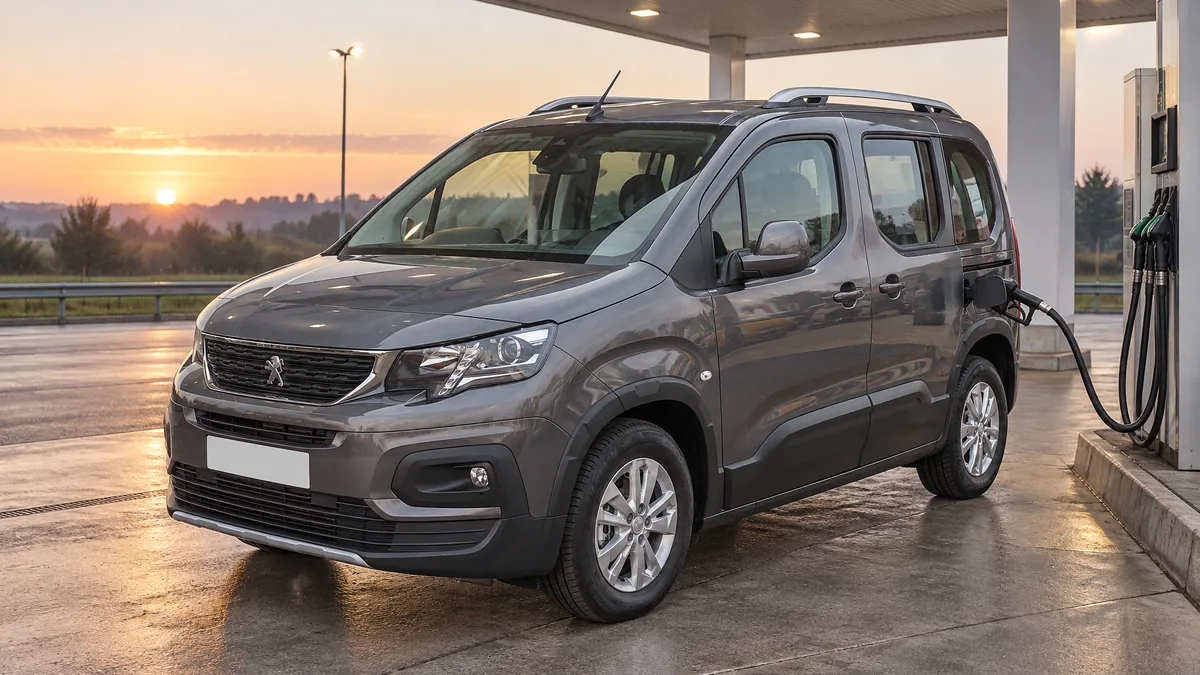
Hello and welcome. In this post, we'll look at the AdBlue tank capacity and how to top it up on the Peugeot Rifter I (2018-2025). BlueHDi Diesel versions of the Peugeot Rifter use AdBlue® to clean up their exhaust gases. We'll cover what the SCR system does, when you will be warned to top up, where to buy AdBlue®, how to store and handle it safely, and how to refill the tank yourself. AdBlue® only applies to BlueHDi Diesel engines, and some details, such as the key or Keyless Entry and Start, depend on your car's version and equipment.
The tank holds about 17 litres, which gives a range of approximately 3,000 miles (5,000 km). Range can vary considerably depending on your driving style and the vehicle.
Scroll the table sideways.
| Section | In short |
|---|---|
| AdBlue (BlueHDi) | Why BlueHDi Diesels use SCR and a DPF |
| SCR system | How SCR works, tank size, range and alerts |
| Supply of AdBlue | Buying, storing, handling and topping up AdBlue |
To meet the Euro 6 standard without hurting performance or fuel consumption, PEUGEOT fits its Diesel engines with a system that treats the exhaust gases. It combines SCR (Selective Catalytic Reduction) with a Diesel Particle Filter (DPF).
The SCR system uses AdBlue®, a liquid that contains urea. A catalytic converter uses it to turn up to 85% of the nitrogen oxides (NOx) into nitrogen and water, which are harmless to health and the environment.
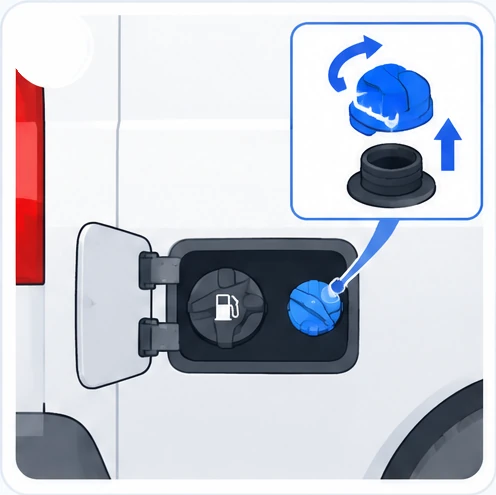
Once the AdBlue® tank is empty, a device required by law stops the engine from being restarted. If the SCR system is faulty, your Rifter no longer meets the Euro 6 standard and starts polluting the environment. If an SCR fault is confirmed, visit a PEUGEOT dealer or a qualified workshop as soon as possible: after 685 miles (1,100 km), a device automatically prevents the engine from starting. In both cases, a range indicator shows how far you can drive before the vehicle is immobilised.
AdBlue® freezes below around -11°C, but the SCR system has a heater for the AdBlue® tank, so you can keep driving in very cold conditions. For the related warning lamps and alerts, see our guides to the Peugeot Rifter orange warning lights and the Peugeot Rifter red warning lights.
Top up the AdBlue® as soon as the first alert tells you the reserve level has been reached. For the SCR system to work correctly, use only AdBlue® that meets the ISO 22241 standard, never transfer it to another container as it would lose its purity, and never dilute it with water.
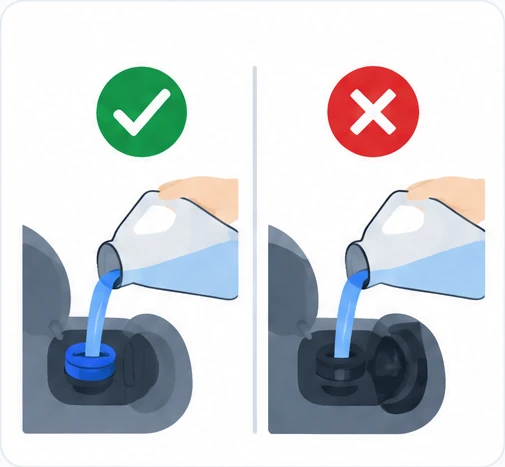
You can buy AdBlue® from a PEUGEOT dealer or a qualified workshop, or at service stations with AdBlue® pumps designed for passenger vehicles. Never top up from an AdBlue® dispenser reserved for heavy goods vehicles.
Storage: AdBlue® freezes at about -11°C and deteriorates above +25°C. Keep containers in a cool place, out of direct sunlight, and the fluid will last at least a year. Frozen fluid can be used once it has completely thawed at room temperature. Never store AdBlue® containers in your vehicle, and keep them out of the reach of children, in their original container.
Precautions: AdBlue® is a urea-based solution. It is non-flammable, colourless and odourless when kept in a cool place.
Before you start: park on a flat, level surface. In winter, make sure the car is above -11°C, otherwise the AdBlue® may be frozen and will not pour into the tank. If so, park somewhere warmer for a few hours first.
Never pour AdBlue® into the Diesel fuel tank. To avoid overfilling, add between 10 and 13 litres from containers, or stop at the nozzle's first automatic cut-out at a service station. The system only registers top-ups of 5 litres or more. If the tank is completely empty, confirmed by the message "Top up AdBlue: Starting impossible", you must add at least 5 litres.
After a breakdown caused by running out of AdBlue®, wait around 5 minutes before switching on the ignition. During this time, do not open the driver's door, unlock the vehicle, insert the key into the ignition switch or bring the Keyless Entry and Start key into the passenger compartment. Then switch on the ignition and wait 10 seconds before starting the engine.
If you splash or spill AdBlue® on the bodywork, rinse it straight away with cold water or wipe it with a damp cloth. If it has crystallised, clean it off with a sponge and hot water. Do not put empty AdBlue® bottles or containers in household waste: use a container reserved for this purpose or take them back to where you bought them.
The tank holds about 17 litres, which gives a range of approximately 3,000 miles (5,000 km). This can vary considerably depending on your driving style and the vehicle.
Add between 10 and 13 litres from containers, or stop at the nozzle's first automatic cut-out at a pump. The system only registers top-ups of 5 litres or more, and if the tank is completely empty you must add at least 5 litres.
No. Never top up from an AdBlue® dispenser reserved for heavy goods vehicles. Use a pump designed for passenger vehicles, or containers from a PEUGEOT dealer or a qualified workshop.
After a breakdown caused by an empty tank, wait around 5 minutes before switching on the ignition, without opening the driver's door, unlocking the car or bringing the key inside. Then switch on the ignition and wait 10 seconds before starting the engine.
Topping up AdBlue® on your Peugeot Rifter is a quick job once you know the steps. Act on the first reserve alert, use the right fluid and add the correct amount, and your BlueHDi engine will keep running cleanly without any risk of being immobilised.
To understand the AdBlue® and SCR alerts on your dashboard, see our guides to the Peugeot Rifter orange warning lights and the Peugeot Rifter red warning lights.
Don't forget to follow us on Instagram for more Peugeot guides!
This is an independent guide, not an official Peugeot publication. If in doubt, contact a PEUGEOT dealer or a qualified workshop before carrying out any work.
Related guides: Peugeot Rifter model guides.
Cover adapted from a photograph by Vauxford — Wikimedia Commons, CC BY-SA 4.0 (AI edited).
Hello and welcome. In this post, we'll look at what to do when you get a flat tyre on your Peugeot Rifter. We cover where the tools are kept, how to use the temporary puncture repair kit and how to fi
Hello and welcome. In this post, we'll look at how to change the bulbs on the Peugeot Rifter I (2018-2025). It covers the safety precautions, the different types of bulb fitted, and the steps for the
Hello and welcome. In this post, we'll look at where the 12 V battery is, and how to jump start or charge it on the Peugeot Rifter I (2018-2025). It covers where to find the battery, how to start the