Peugeot 508 II 12V Battery and Jump Starting
Hello and welcome. This article covers the 12 V battery on the Peugeot 508 II (2018-2023): reaching it, jump starting, charging with a charger, and disconnecting and reconnecting it. We also look at t
Braked and unbraked towing limits for every Peugeot 508 I engine from 2014, plus nose weight, altitude and heat rules, VIN locations and tyre pressures.
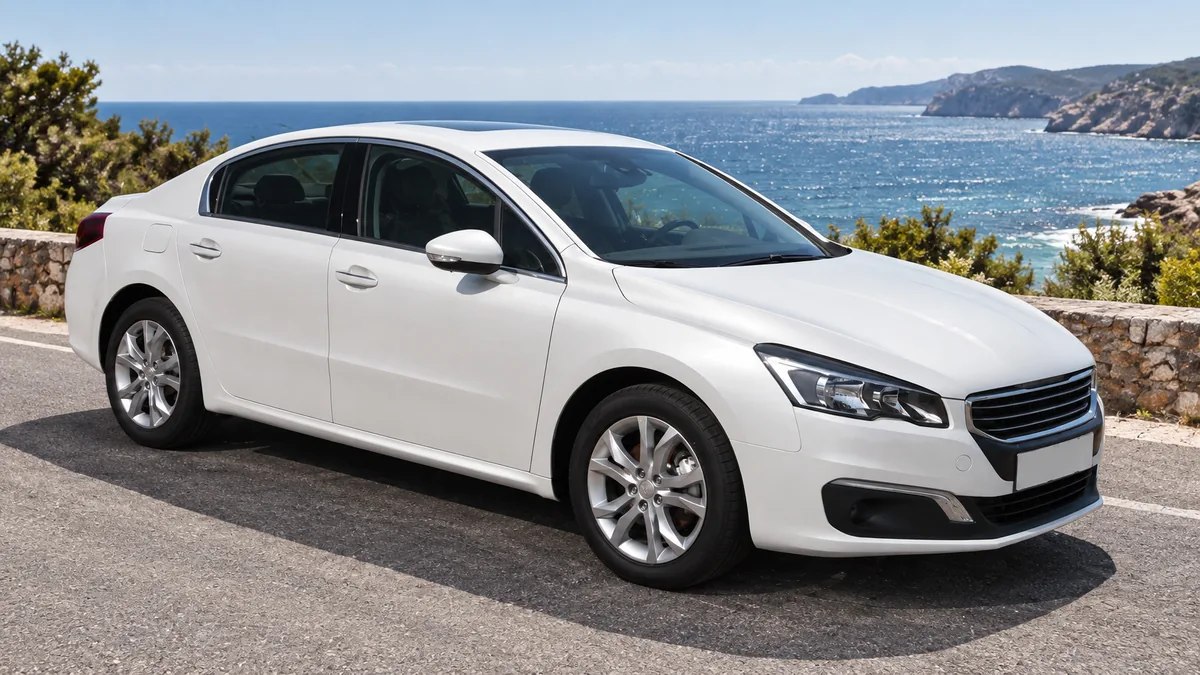
A Peugeot 508 I built from 2014 onwards can pull a braked trailer of between 1,075 kg and 1,875 kg, depending on engine, gearbox and body style. Unbraked trailers top out at 750 kg, and every version has the same 75 kg recommended nose weight.
A Peugeot 508 can tow up to 1,875 kg braked and up to 750 kg unbraked, but only some engine, gearbox and body combinations reach the top figure. The lowest braked limit is 1,075 kg, on the 1.6 l BlueHDi 120 S&S SW with the EAT6 automatic.
All braked figures sit within the gross train weight limit and apply on a 10% or 12% gradient. GTW is the maximum authorised weight of the car and trailer together.
Scroll the table sideways.
| Figure | Range across the 508 line-up |
|---|---|
| Braked trailer | 1,075 kg to 1,875 kg |
| Unbraked trailer | 735 kg to 750 kg |
| Recommended nose weight | 75 kg on every version |
Two patterns are worth knowing before you look up your exact car:
The nose weight is the vertical load pressing down on the towbar ball, whether the ball is removable with or without tools. The exact weights for your car are in the registration document and on the manufacturer's label.
All petrol 508s use a 1.6 l THP engine of 1,598 cm3 that runs on unleaded. The 156 has 110 kW and the 165 S&S has 121 kW.
Scroll the table sideways.
| Engine | Gearbox | Engine code | Body | Braked trailer | Unbraked trailer |
|---|---|---|---|---|---|
| 1.6 l THP 156 | EAT6 6-speed automatic | EP6CDTM AT6 | Saloon | 1,875 kg | 740 kg |
| 1.6 l THP 156 | EAT6 6-speed automatic | EP6CDTM AT6 | SW | 1,775 kg | 750 kg |
| 1.6 l THP 165 S&S | BVM6 6-speed | EP6FDTM MCM STTd | Saloon | 1,875 kg | 735 kg |
| 1.6 l THP 165 S&S | BVM6 6-speed | EP6FDTM MCM STTd | SW | 1,775 kg | 745 kg |
| 1.6 l THP 165 S&S | EAT6 6-speed automatic | EP6FDTM AT6III STTd | Saloon | 1,875 kg | 740 kg |
| 1.6 l THP 165 S&S | EAT6 6-speed automatic | EP6FDTM AT6III STTd | SW | 1,775 kg | 750 kg |
On the petrol cars the gearbox makes no difference to the braked limit. Only the body style changes it. The recommended nose weight is 75 kg throughout.
The BlueHDi range covers a 1.6 l engine of 1,560 cm3 and a 2.0 l engine of 1,997 cm3. The 1.6 l BlueHDi 120 is the one to watch: it has the lowest towing limits in the whole 508 line-up, especially with the automatic gearbox.
Scroll the table sideways.
| Engine | Gearbox | Engine code | Power | Body | Braked trailer | Unbraked trailer |
|---|---|---|---|---|---|---|
| 1.6 l BlueHDi 120 S&S | BVM6 6-speed | DV6FCD MCM STTd | 88 kW | Saloon | 1,475 kg | 740 kg |
| 1.6 l BlueHDi 120 S&S | BVM6 6-speed | DV6FCD MCM STTd | 88 kW | SW | 1,375 kg | 745 kg |
| 1.6 l BlueHDi 120 S&S | EAT6 6-speed automatic | DV6FCD AT6III STTa | 88 kW | Saloon | 1,175 kg | 740 kg |
| 1.6 l BlueHDi 120 S&S | EAT6 6-speed automatic | DV6FCD AT6III STTa | 88 kW | SW | 1,075 kg | 750 kg |
| 2.0 l BlueHDi 136 | BVM6 6-speed | DW10FDD ML6 | 100 kW | Saloon | 1,875 kg | 750 kg |
| 2.0 l BlueHDi 136 | BVM6 6-speed | DW10FDD ML6 | 100 kW | SW | 1,775 kg | 750 kg |
| 2.0 l BlueHDi 150 S&S | BVM6 6-speed | DW10FDD ML6 STTa | 110 kW | Saloon | 1,875 kg | 750 kg |
| 2.0 l BlueHDi 150 S&S | BVM6 6-speed | DW10FDD ML6 STTa | 110 kW | SW | 1,775 kg | 750 kg |
| 2.0 l BlueHDi 180 S&S | EAT6 6-speed automatic | DW10FC AM6III STTa | 132 kW | Saloon | 1,575 kg | 750 kg |
| 2.0 l BlueHDi 180 S&S | EAT6 6-speed automatic | DW10FC AM6III STTa | 132 kW | SW | 1,475 kg | 750 kg |
| 2.0 l BlueHDi 180 S&S | EAT6 6-speed automatic | DW10FC AM6III STTa | 132 kW | Non-hybrid RXH | 1,475 kg | 750 kg |
The most powerful 2.0 l BlueHDi 180 tows less than the 136 and 150: 1,575 kg for the Saloon and 1,475 kg for the SW, against 1,875 kg and 1,775 kg. Nose weight stays at 75 kg on every BlueHDi version.
The 2.0 l HDi engines are listed for the Saloon only. All of them are 1,997 cm3 diesels, with a 750 kg unbraked limit and a 75 kg recommended nose weight.
Scroll the table sideways.
| Engine | Gearbox | Engine code | Power | Braked trailer |
|---|---|---|---|---|
| 2.0 l HDi 136 | BVM6 6-speed | DW10C ML6 | 100 kW | 1,875 kg |
| 2.0 l HDi 136 | EAT6 6-speed automatic | DW10C AM6 | 100 kW | 1,575 kg |
| 2.0 l HDi 140 | BVM6 6-speed | DW10B ML6 | 103 kW | 1,875 kg |
| 2.0 l HDi 163 | EAT6 6-speed automatic | DW10C AM6 | 120 kW | 1,575 kg |
The power figures throughout are type-approved values measured on a test bed under conditions set by European Directive 1999/99/EC. Your car's engine characteristics are also shown in its registration document.
The figures in the tables assume conditions that do not always hold on a real trip.
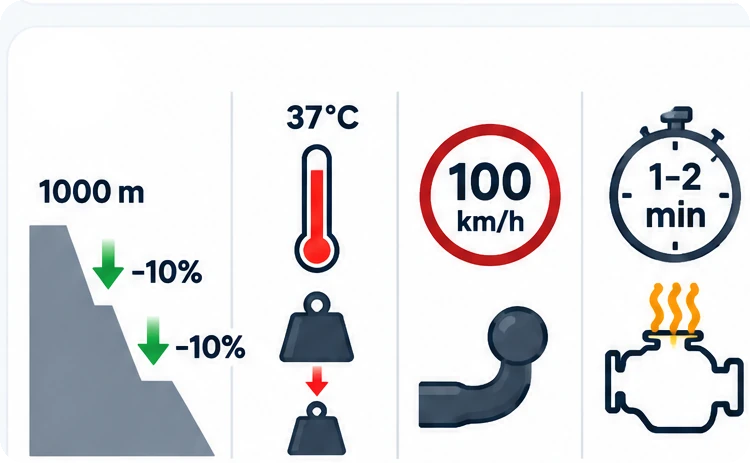
GTW values and towable loads are valid up to 1,000 metres. Above that, reduce the towable load by 10% for each additional 1,000 metres.
In high outside temperatures the car may cut its own performance to protect the engine. Once it is hotter than 37°C outside, limit the towed weight. After you stop in hot weather, let the engine idle for 1 to 2 minutes so it can cool down.
If you are unsure what your car can safely pull, ask a PEUGEOT dealer or a qualified workshop.
The VIN is in two visible places on a Peugeot 508:
The manufacturer's label is a tamper-proof label on the centre pillar, on the right or left side. It is where you confirm your car's legal weights. It shows:
Ground clearance is around 184 mm in ideal conditions. That figure is measured with the driver only and a full fuel tank. It changes with load, the ground surface and the surroundings. If you decide to drive over an obstacle, you take full responsibility for that decision.
The Saloon, SW and Non-hybrid RXH each have their own body dimensions.
The tyre and paint label is on the centre pillar on the driver's side. It gives:
Your car may have come from the factory with tyres that have higher load and speed indices than the label shows. This does not change the inflation pressures.
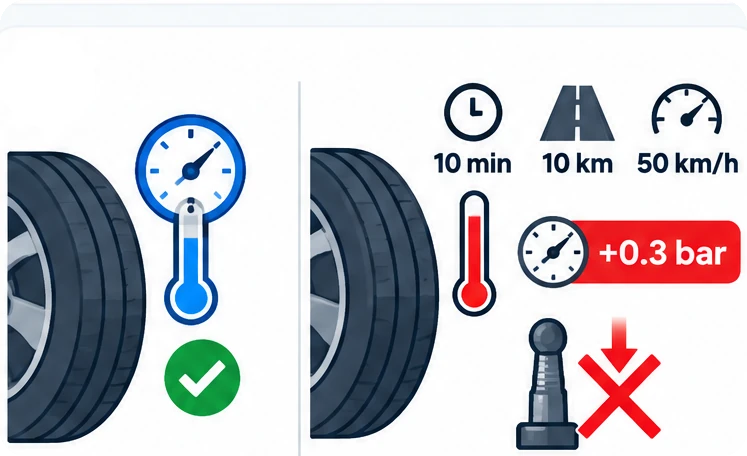
Underinflated tyres also increase fuel consumption, which is a good reason to check them before a long run with a trailer.
The recommended nose weight is 75 kg on every 508 engine and body style. It is the vertical load pressing down on the towbar ball.
Yes. With the same engine and gearbox, the SW's braked trailer limit is 100 kg lower than the Saloon's. Unbraked limits are almost the same, and some SW versions are slightly higher.
Several engines have a lower braked limit when paired with the EAT6 automatic. On the 1.6 l BlueHDi 120, for example, the automatic Saloon is rated at 1,175 kg against 1,475 kg for the BVM6. Always check the figures for your exact combination.
Not always. Above 1,000 metres, cut the towable load by 10% for each additional 1,000 metres. Above 37°C outside, limit the towed weight because the car may reduce performance to protect the engine.
Before you hitch up, compare the GTW on the centre pillar label with the combined weight of car, passengers, luggage and trailer.
Don't forget to follow us on Instagram for more Peugeot guides!
This is an independent guide, not an official Peugeot publication. If in doubt, contact a PEUGEOT dealer or a qualified workshop before carrying out any work.
Related guides: Peugeot 508 model guides; Peugeot 508 I gauges and service indicator; Peugeot 508 I fuse box; Peugeot 508 I 12 V battery and jump-starting.
Cover adapted from a photograph by Navigator84 — Wikimedia Commons, CC BY-SA 4.0 (AI edited).
Hello and welcome. This article covers the 12 V battery on the Peugeot 508 II (2018-2023): reaching it, jump starting, charging with a charger, and disconnecting and reconnecting it. We also look at t
Hello and welcome. This article looks at the under-inflation detection system on the Peugeot 508 II (2018-2023). We cover what the alert means, reinitialising the system after adjusting pressures, and
Hello and welcome. In this post we look at the 12 V battery on the Peugeot 508 I (2014-present). We cover jump starting from another battery, charging with a charger, disconnecting and reconnecting, a