Peugeot 508Updated 11 min read

Peugeot 508 I 12V Battery and Jump Starting

Peugeot 508 I (2014-present) 12 V battery: jump starting, charging with a charger, disconnecting and reconnecting, plus removing and refitting it.
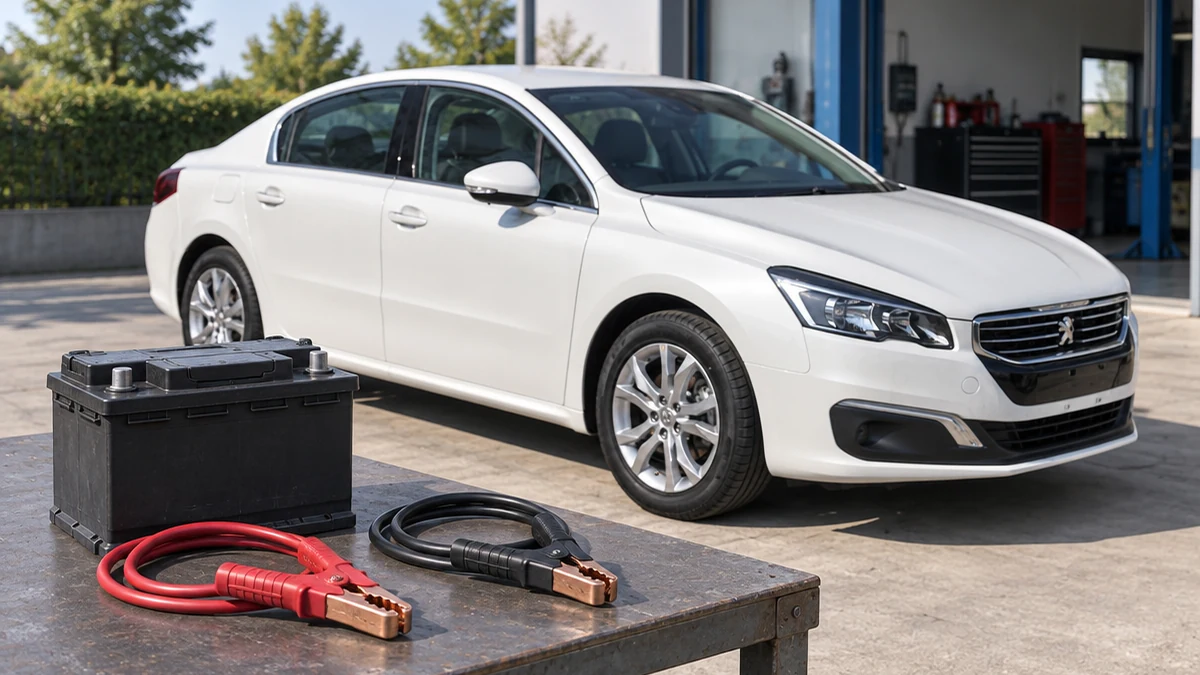
Peugeot 508 I 12V battery and disconnected jump leads
Image adapted from a photo by Navigator84, CC BY-SA 4.0.

Hello and welcome. In this post we look at the 12 V battery on the Peugeot 508 I (2014-present). We cover jump starting from another battery, charging with a charger, disconnecting and reconnecting, and removing and refitting the battery.
Quick Reference

Red battery charge warning symbol

Scroll the table sideways.

SectionIn short
General pointsBattery safety, disposal and Stop & Start notes
Starting using another batteryJump start steps with leads or a booster
Charging the battery using a battery chargerWhen and how to charge with a 12 V charger
Disconnecting the batteryDisconnect and reconnect the (+) terminal clamp
Before removingPreparation before taking the battery out
RemovalStep-by-step battery removal sequence
After refittingRefitting order and checks afterwards

General points

This section covers starting the engine with another battery and charging a flat battery. Before you start, read these safety points about lead-acid starter batteries.

  • Harmful substances: batteries contain harmful substances such as sulphuric acid and lead.
  • Disposal: dispose of batteries in line with regulations and never throw them away with household waste. Take used remote control batteries and vehicle batteries to a special collection point.
  • Protection: protect your eyes and face before handling the battery, and wash your hands afterwards.
  • Fire and explosion risk: always work on the battery in a well ventilated area, away from naked flames and anything that could cause sparks.
  • Stop & Start versions: these cars have a 12 V lead-acid battery of a specific technology and specification. Only a PEUGEOT dealer or a qualified workshop should replace it.
  • Automatic gearbox: do not try to start the engine by pushing the car.

After the first engine start, Stop & Start may not work during that trip. It only becomes available again once the car has been left standing continuously for a period that depends on the outside temperature and the battery's state of charge (up to about 8 hours).

Starting using another battery

The battery is under the bonnet. If it is flat, you can start the engine using a backup battery (external or from another car) with jump leads or a battery booster.

To reach the battery:

  1. Bonnet: open the bonnet using the interior release lever, then the exterior safety catch.
  2. Cover: remove the plastic cover on the (+) terminal.
  3. Fusebox: if necessary, unclip the fusebox to remove the battery.

Before you connect anything, check these safety points:

  • Never try to start the engine by connecting a battery charger.
  • Never use a battery booster of 24 V or higher.
  • Make sure the backup battery has a nominal voltage of 12 V and a capacity at least equal to that of the flat battery.
  • The two cars must not touch each other.
  • Switch off all electrical consumers on both cars (audio system, wipers, lighting, etc.).
  • Keep the jump leads away from moving parts of the engine (fan, belts, etc.).
  • Do not disconnect the (+) terminal while the engine is running.

Then follow these steps:

  1. Cover: lift the plastic cover on the (+) terminal, if your car has one.
  2. Red cable: connect the red cable to the positive terminal (+) of flat battery A (at the metal elbow), then to the positive terminal (+) of backup battery B or the booster.
  3. Green or black cable, first end: connect one end to the negative terminal (-) of backup battery B or the booster (or to an earth point on the other car).
  4. Green or black cable, other end: connect it to earth point C on your car.
  5. Helper car: start the engine of the car with the good battery and leave it running for a few minutes.
  6. Your car: operate the starter and let the engine turn. If it does not start straight away, switch off the ignition and wait a few moments before trying again.
  7. Disconnect: wait until the engine returns to idle, then disconnect the jump leads in the reverse order.
  8. Refit the cover: put the plastic cover back on the (+) terminal, if your car has one.
  9. Recharge: let the engine run for at least 30 minutes, either driving or with the car stationary, so the battery reaches an adequate state of charge.

Some functions, including Stop & Start, are not available if the battery is not charged enough.

Charging the battery using a battery charger

Keeping the battery properly charged gives it the best service life. You may need to charge it if you only use your car for short journeys, or if the car will be off the road for several weeks. Contact a PEUGEOT dealer or a qualified workshop.

If you plan to charge the battery yourself:

  • Use only a charger compatible with lead-acid batteries with a nominal voltage of 12 V.
  • Follow the charger manufacturer's instructions.
  • Never reverse the polarities.
  • You do not need to disconnect the battery.
  1. Ignition: switch off the ignition.
  2. Consumers: switch off all electrical consumers (audio system, lighting, wipers, etc.).
  3. Charger off: switch off charger B before connecting the cables to the battery, to avoid dangerous sparks.
  4. Cables: make sure the charger cables are in good condition.
  5. Cover: raise the plastic cover on the (+) terminal, if your car has one.
  6. Red cable: connect the positive (+) red cable of charger B to the (+) terminal of battery A.
  7. Black cable: connect the negative (-) black cable to earth point C on the car.
  8. Finish: when charging is complete, switch off charger B before disconnecting the cables from battery A.
  9. If the 12 V charger label is present on your car, use only a 12 V charger, otherwise you can cause irreversible damage to the electrical components linked to the Stop & Start system. Never try to charge a frozen battery, as there is a risk of explosion. If the battery has frozen, have it checked by a PEUGEOT dealer or a qualified workshop, who will make sure the internal components are not damaged and the case has not cracked, as this would mean a risk of toxic and corrosive acid leaking.

    Disconnecting the battery

    If your car will be out of use for a long period, disconnect the battery so it keeps enough charge to start the engine.

    Before disconnecting the battery:

    1. Close up: close the windows and the doors.
    2. Consumers: switch off all electrical consumers (audio system, wipers, lighting, etc.).
    3. Ignition: switch off the ignition and wait for four minutes.

    At the battery, detach the (+) terminal only. It has a quick-release clamp.

    To disconnect the (+) terminal:

    1. Lever: raise lever A fully to release clamp B.
    2. Clamp: lift clamp B off.

    To reconnect the (+) terminal:

    1. Lever: raise lever A fully.
    2. Position: refit open clamp B on the (+) terminal.
    3. Press: push clamp B fully down.
    4. Lock: lower lever A to lock clamp B.

    Do not force the lever. If the clamp is not positioned correctly, it will not lock, so start the procedure again.

    After reconnecting, switch on the ignition and wait 1 minute before starting the engine, so the electronic systems can initialise. If minor problems persist, contact a PEUGEOT dealer or a qualified workshop. After reconnecting the battery, you will need to reinitialise some systems yourself:

    • the remote control or electronic key (depending on version)
    • the electric blind(s)
    • the electric windows
    • the date and time
    • the radio preset stations

    Before removing

    This procedure applies only to the Saloon, SW and non-hybrid RHX. It lets you remove the battery safely when you need to change the corresponding bulb. You can also ask a PEUGEOT dealer or a qualified workshop to do it for you.

    1. Location: park the car in a ventilated area with free access, preferably on level ground.
    2. Parking brake: apply the parking brake.
    3. Gear lever: move it into neutral (position N with an automatic gearbox).
    4. Alarm: if your car has an alarm, leave the bonnet open so the alarm is not triggered.
    5. Windows and locks: leave at least one window open if you are in a secure location, otherwise lock all the doors and the boot.
    6. Motorised tailgate: if your car has one, you will not be able to open it once the battery is disconnected.
    7. Ignition: switch off the ignition and remove the key.
    8. Keyless Entry and Starting: take the remote control at least 3 metres away from the car.
    9. Wait: wait about 4 minutes (or 12 minutes with an automatic gearbox) before disconnecting the battery.

    Removal

    Once the car is prepared, remove the battery in this order. The numbers refer to the parts shown in the handbook.

    1. Positive terminal: disconnect the positive (+) terminal of the battery.
    2. First cover: remove battery cover 1.
    3. Negative terminal: release 2, then disconnect the negative (-) terminal from the battery.
    4. Harnesses 3: unclip wiring harnesses 3.
    5. Harness 4: unclip wiring harness 4 and move it aside.
    6. Positive cable nut: remove nut 5 from the positive (+) cable.
    7. Harness 6: move wiring harness 6 aside.
    8. Clips 7 and 8: unclip them using a screwdriver.
    9. Power shut-off unit: raise power shut-off unit 9.
    10. Move the unit: move it forward out of the way.
    11. Clips: unclip the clips.
    12. Second cover: remove battery cover 10.
    13. Battery: using a screwdriver, lever fixing 11 aside and remove the battery.

    After refitting

    To refit the battery, carry out the removal steps in reverse order, connecting the positive (+) terminal last. Then make these checks:

    1. Terminals: check that the battery terminals are secure.
    2. Ignition: switch on the ignition without starting the engine.
    3. Warnings: check there are no error messages or warning lamps on. If there is any problem, contact a PEUGEOT dealer or a qualified workshop to have the system reset.
    4. Doors and windows: check that all doors and windows work correctly.
    5. Wait: wait around 1 minute (or 2 minutes with an automatic gearbox).
    6. Engine: start the engine.
    7. Anti-pinch: check that the anti-pinch systems work correctly: electric windows, sunroof, panoramic sunroof.
    8. Electric parking brake: if your car has one, release and apply it to check it works correctly.
    9. Ignition off: switch off the ignition.
    10. Remote control: get out of the car and check that the remote control works.
    11. Settings: set the time, the preset radio stations and the audio settings.

    After reconnecting the battery, STOP mode (Stop & Start), air conditioning and navigation may be temporarily unavailable. If there are any faults after refitting, contact a PEUGEOT dealer or a qualified workshop.

    Frequently Asked Questions

    How do I jump start a Peugeot 508 with a flat battery?

    Connect the red cable to the (+) terminal of your flat battery and then to the backup battery, and the green or black cable from the backup battery's (-) terminal to earth point C on your car. Start the helper car, leave it running for a few minutes, then operate your starter.

    Can I push start a Peugeot 508 with an automatic gearbox?

    No. You must not try to start the engine by pushing the car if it has an automatic gearbox.

    Why is Stop & Start not working after jump starting my 508?

    Stop & Start is not available if the battery is not charged enough, and it may not work during the trip after the first start. It becomes available again after the car has been left standing for a period of up to about 8 hours, depending on the outside temperature and battery charge.

    What do I need to reset after disconnecting the battery on a Peugeot 508?

    You may need to reinitialise the remote control or electronic key (depending on version), the electric blind(s), the electric windows, the date and time, and the radio preset stations. Switch on the ignition and wait 1 minute before starting the engine.

    A flat battery is frustrating, but with the right steps you can get your Peugeot 508 going again safely. Keep this guide handy, and if anything does not work as expected after charging or refitting the battery, contact a PEUGEOT dealer or a qualified workshop.

    More Peugeot 508 Guides

    If a warning lamp comes on after a battery problem, check our guides to Peugeot 508 red warning lights, Peugeot 508 orange warning lights and Peugeot 508 green and blue indicator lamps.

    Don't forget to follow us on Instagram for more Peugeot guides!

    This is an independent guide, not an official Peugeot publication. Check your vehicle’s own manual before carrying out any work.

Related guides: Peugeot 508 model guides.

Cover adapted from a photograph by Navigator84 — Wikimedia Commons, CC BY-SA 4.0 (AI edited).

Related guides

Guide ·

Peugeot 508 II 12V Battery and Jump Starting

Hello and welcome. This article covers the 12 V battery on the Peugeot 508 II (2018-2023): reaching it, jump starting, charging with a charger, and disconnecting and reconnecting it. We also look at t

Guide ·

Peugeot 508 II Tyre Pressure

Hello and welcome. This article looks at the under-inflation detection system on the Peugeot 508 II (2018-2023). We cover what the alert means, reinitialising the system after adjusting pressures, and

Guide ·

Peugeot 508 I Tyre Pressure

Hello and welcome. In this post we look at tyre under-inflation detection on the Peugeot 508 I (2014-present). We cover how the system works, what to do when the warning comes on, what a fault looks l