Peugeot 508 II Tyre Pressure
Hello and welcome. This article looks at the under-inflation detection system on the Peugeot 508 II (2018-2023). We cover what the alert means, reinitialising the system after adjusting pressures, and
Peugeot 508 II (2018-2023) 12 V battery: access, jump starting, charging and disconnecting, plus the accessory batteries on Rechargeable hybrids.
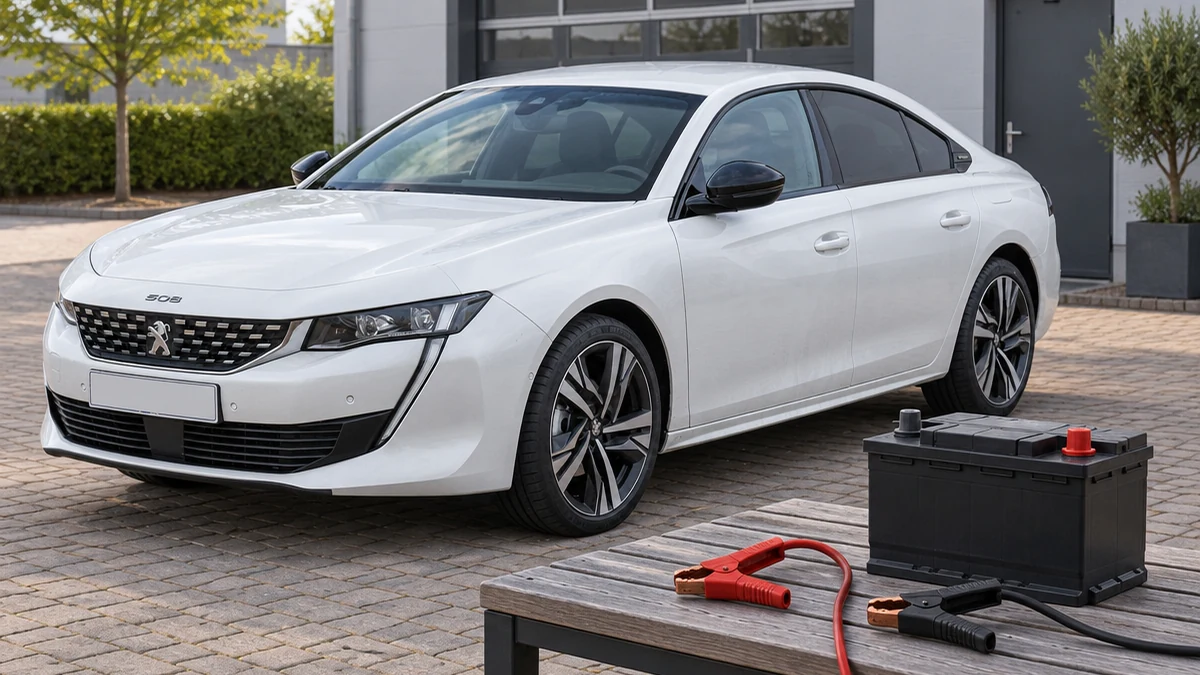
Hello and welcome. This article covers the 12 V battery on the Peugeot 508 II (2018-2023): reaching it, jump starting, charging with a charger, and disconnecting and reconnecting it. We also look at the two accessory batteries on Rechargeable hybrid versions.
Scroll the table sideways.
| Section | In short |
|---|---|
| Lead-acid starter batteries | Safety rules, disposal and frozen battery warnings |
| With petrol/Diesel engines | Access, jump start, charge and disconnect the battery |
| With Rechargeable hybrid engines | Two accessory batteries: access, charging, disconnection order |
Your 508's starter battery is a lead-acid battery. It contains harmful substances, sulphuric acid and lead, so it needs careful handling and proper disposal.
The symbols on the battery remind you of these points:
On petrol and Diesel versions, the battery is under the bonnet. Here is how to reach it, start the engine from another battery, charge it, and disconnect and reconnect it.
Accessing the battery
The (+) positive terminal has a quick-release terminal. The (-) negative terminal is not accessible, so a remote earth point is provided near the battery.
Starting using another battery
If the battery is flat, you can start the engine with a backup battery (external or from another vehicle) and jump leads, or with a battery booster. Before you start, keep these warnings in mind:
If you drive off straight away before the battery has enough charge, some functions, such as Stop & Start, can be affected.
Charging the battery using a battery charger
Keeping the battery well charged is essential for a long service life. You may need to charge it if you mostly make short journeys, or if the car will be off the road for several weeks. Consult a PEUGEOT dealer or a qualified workshop. If you charge it yourself, use only a charger compatible with 12 V lead-acid batteries, follow the charger manufacturer's instructions and never reverse the polarities. You do not need to disconnect the battery.
If your car carries the label calling for a 12 V charger, use only a 12 V charger to avoid irreversible damage to the electrical components.
Disconnecting and reconnecting the battery
If the car will not be used for an extended period, disconnecting the battery is recommended so it keeps enough charge to start the engine. Before you do so:
Once you have reached the battery, you only need to disconnect the (+) terminal, which has a quick-release clamp.
To disconnect the (+) terminal:
To reconnect the (+) terminal:
Do not force the lever. If the clamp is not positioned correctly, it will not lock, so start the procedure again.
Stop & Start may not work during the trip after the first engine start. It will only be available again after the car has been immobilised for a continuous period, which depends on the outside temperature and the battery's state of charge (up to about 8 hours).
Following reconnection
After reconnecting the battery, switch on the ignition and wait 1 minute before starting the engine, so the electronic systems can initialise. If minor problems persist, contact a PEUGEOT dealer or a qualified workshop. After reconnecting the battery, reinitialise this equipment:
When you switch on the ignition after reconnecting, the message "Collision risk detection system fault" appears on the instrument panel. This is perfectly normal, and the message disappears while you drive.
Rechargeable hybrid versions of the 508 have two accessory batteries, one at the front and one at the rear. To replace them, contact a PEUGEOT dealer or a qualified workshop. Never use these batteries to start or jump start another vehicle.
Accessing the front battery
The front battery is under the bonnet.
The (+) positive terminal has a quick-release terminal. The (-) negative terminal is not accessible, so a remote earth point is provided near the battery.
Accessing the rear battery
The rear battery is in the boot. Lift the boot floor to reach it. The (+) positive terminal is protected by a red plastic cover and is not accessible. The (-) negative terminal has a black quick-release connector.
Charging the front battery using a battery charger
Keeping the front battery well charged is essential for a long service life. You may need to charge it if you mostly make short journeys, or if the car will be off the road for several weeks. Consult a PEUGEOT dealer or a qualified workshop. If you charge it yourself, use only a charger compatible with 12 V lead-acid batteries, follow the charger manufacturer's instructions and never reverse the polarities. You do not need to disconnect the battery.
Disconnecting and reconnecting the accessory batteries
Use this procedure if the car will be immobilised for a long time. Before disconnecting the batteries:
Never reverse the order of the disconnection and reconnection steps, as this risks irreversible damage.
To disconnect:
To reconnect:
On petrol and Diesel versions, the battery is under the bonnet. The negative terminal is not accessible, so you use the remote earth point near the battery instead.
Let the engine run for at least 30 minutes with the car stationary so the battery reaches an adequate state of charge. Driving off straight away can affect functions such as Stop & Start.
No. You must not start or jump start another vehicle using the accessory batteries of a Rechargeable hybrid 508.
This message is perfectly normal when you switch on the ignition after reconnecting the battery. It disappears while you drive.
Handled correctly, a flat battery on your Peugeot 508 is easy to deal with. Follow the steps in the right order, keep the safety warnings in mind, and if anything is unclear or the problem keeps coming back, contact a PEUGEOT dealer or a qualified workshop.
If a warning lamp comes on after a battery problem, see our guides to Peugeot 508 red warning lights, Peugeot 508 orange warning lights and Peugeot 508 green and blue indicator lamps.
Don't forget to follow us on Instagram for more Peugeot guides!
This is an independent guide, not an official Peugeot publication. Check your vehicle’s own manual before carrying out any work.
Related guides: Peugeot 508 model guides.
Cover adapted from a photograph by Vauxford — Wikimedia Commons, CC BY-SA 4.0 (AI edited).
Hello and welcome. This article looks at the under-inflation detection system on the Peugeot 508 II (2018-2023). We cover what the alert means, reinitialising the system after adjusting pressures, and
In the 508, the instrument panel and the 10-inch touchscreen work together. The trip computer data sits in front of you, while apps such as Energy live on the central screen. This guide explains how to check your trip...
The Peugeot 508's instrument panel constantly reports on the car's health: when the next service is due, whether the oil level is right, how hot the engine is and, on BlueHDi diesels, how far you can go before the...