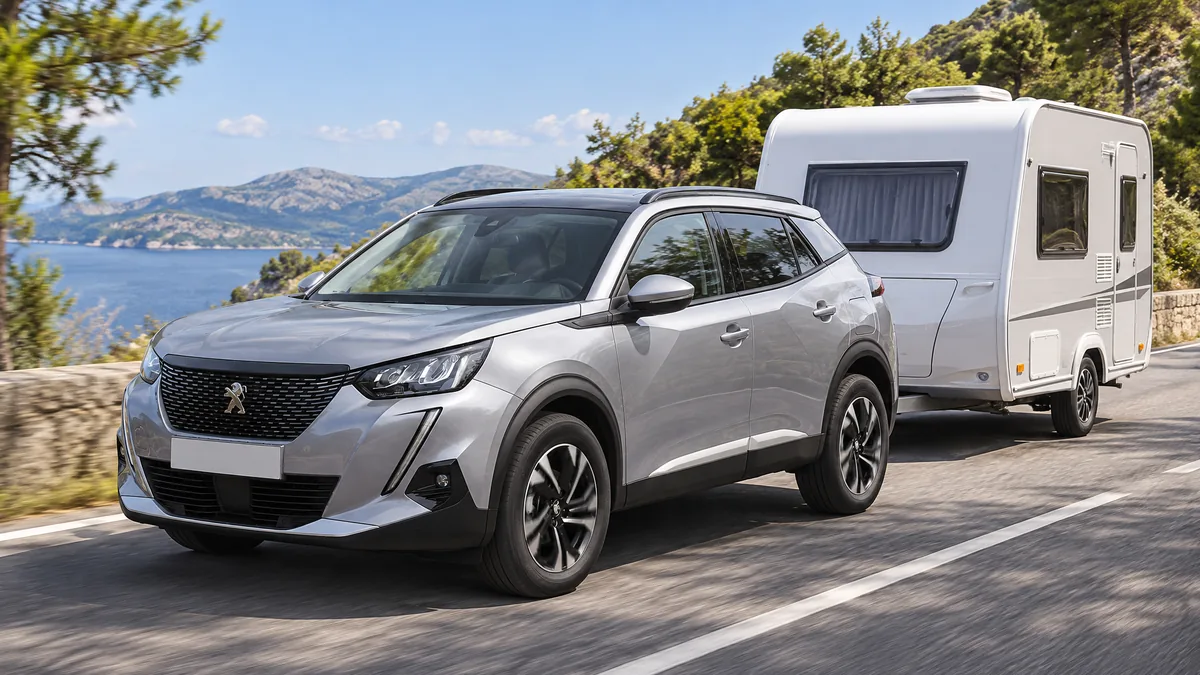
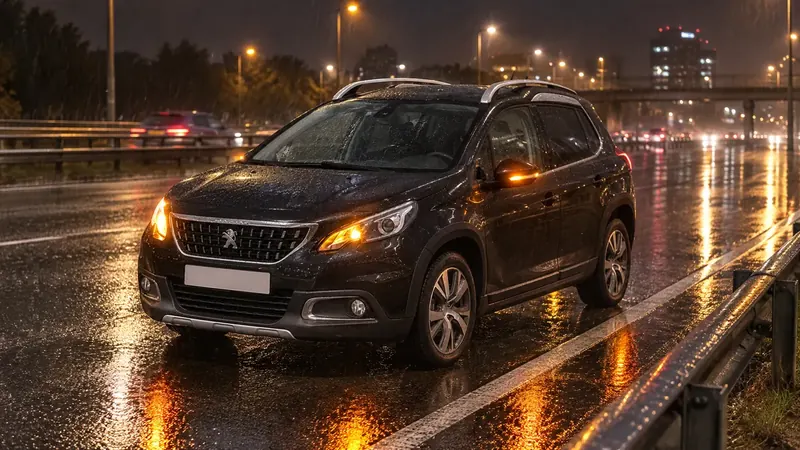
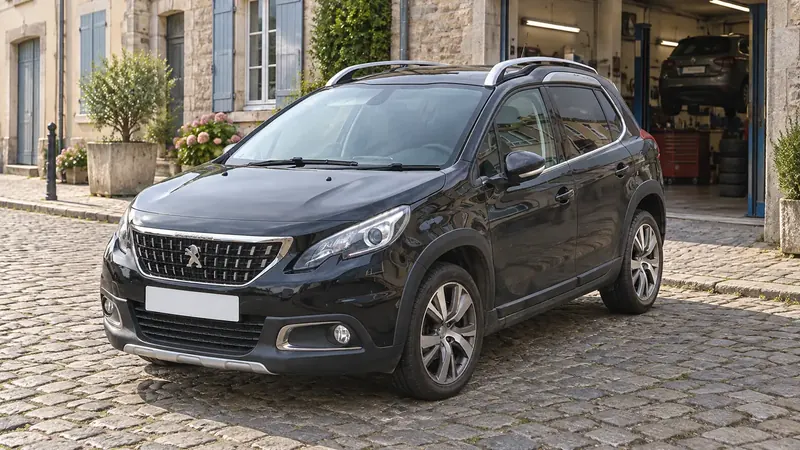
Hello and welcome. In this post, we'll look at the detachable towball, towing the car, and towed loads on the Peugeot 2008 II (2019-2023). It also explains why an electric 2008 cannot be fitted with a towing device. Some items depend on the version or equipment fitted, so not everything here will apply to your 2008.
How much can a Peugeot 2008 tow?
It depends on the engine and gearbox. Braked trailer figures are 500 kg or 1,200 kg, and the maximum nose weight is 61 kg for the petrol and diesel versions listed. An electric 2008 cannot be fitted with a towing device. Always check the figure on your registration document.
Quick Reference
Scroll the table sideways.
Section
In short
Towing device
Load distribution, altitude, bicycle carriers and approved towing devices
Towing device with quickly detachable towball
Parts, safety checks, fitting and removing the detachable towball
Towing the vehicle
Rules and steps for being towed or towing another car
Engine technical data and towed loads
Where to find weights, altitude rules and towing speed limit
Engines and towed loads - Petrol
Power, fuel and towed loads for each petrol engine
Engines and towed loads - Diesel
Power, fuel and towed loads for each diesel engine
Towing device
How you load a trailer or a towball accessory affects how safely your 2008 handles.
Load distribution:
Put the heaviest items in the trailer as close as possible to the axle.
Aim for a nose weight close to the maximum permitted, but never above it.
Air density decreases with altitude, which reduces engine performance. Reduce the maximum towable load by 10% per 1,000 metres of altitude.
Towing devices:
Use genuine towing devices and wiring harnesses approved by PEUGEOT. recommends having them fitted by a PEUGEOT dealer or a qualified workshop.
If a PEUGEOT dealer does not fit them, they must still be fitted in line with the vehicle manufacturer's instructions.
Certain driving or manoeuvring aid functions switch off automatically while an approved towing system is in use.
For driving with a trailer and the Trailer stability assist, see the corresponding section below.
Safety: Never exceed the maximum authorised towable weight shown on your registration certificate, on the manufacturer's label and in the towed-load tables below. If you use accessories on the towing device, such as bicycle carriers or tow boxes, stay within the maximum authorised nose weight and carry no more than 4 conventional bicycles or 2 electric bicycles. Place the heaviest bicycles as close as possible to the car, and follow the law in the country where you are driving.
Electric motor: An electric 2008 cannot be fitted with a towing device under any circumstances, so it cannot tow a trailer or caravan.
Towing device with quickly detachable towball
You can fit and remove this genuine towing device without any tools.
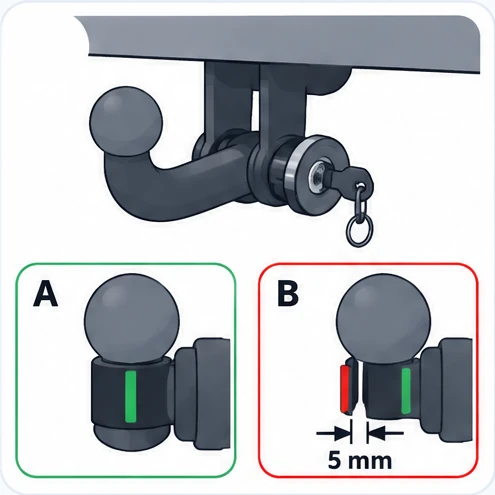
Parts of the towing device:
1: Carrier
2: Protective plug
3: Connection socket
4: Safety eye
5: Detachable towball
6: Locking/unlocking wheel
7: Security key lock
8: Label to note the key references
Positions:
A, locked: the green marks are opposite each other and the wheel touches the towball, with no gap.
B, unlocked: the red mark is opposite the green mark and the wheel no longer touches the towball, leaving a gap of around 5 mm.
Stick the supplied label somewhere clearly visible, close to the carrier or in the boot. Trailers with LED lamps are not compatible with the wiring harness of this device.
Before each use, check that:
The green mark on the wheel lines up with the green mark on the towball.
The wheel touches the towball (position A).
The security key lock is closed and the key removed, so the wheel can no longer be turned.
The towball cannot move in its carrier. Test this by trying to shake it by hand.
If the towball is not locked, the trailer can come off, with a risk of an accident.
During use: Never release the locking system with a trailer or load carrier on the towball. Never exceed the Gross Train Weight (GTW) or the maximum authorised load on the towing device, as the device could come away from the car. Before driving, check the headlamp height adjustment and make sure the trailer lamps work properly.
After use: When you travel without a trailer or load carrier, remove the towball and fit the protective plug into the carrier, so the number plate and its lighting stay clearly visible.
Maintenance: The towball and carrier only work correctly if you keep them clean. Before using a high-pressure jet wash, remove the towball and fit the protective plug to the carrier. For any work on the towing device, contact a PEUGEOT dealer or a qualified workshop.
Fitting the towball:
Remove the plug: Below the rear bumper, take the protective plug (2) out of the carrier (1).
Insert the towball: Put the end of the towball (5) into the carrier (1) and push it upwards. It locks into position automatically.
Mind your hands: The wheel (6) turns a quarter turn anti-clockwise, so keep your hands clear.
Check the lock: Make sure the mechanism has locked correctly (position A).
Lock it: Close the lock (7) with the key.
Remove the key: The key cannot be removed while the lock is open.
Fit the cap: Clip the cap onto the lock.
Uncover the towball: Remove the protective cover from the towball.
Hitch up: Attach the trailer to the towball.
Safety cable: Attach the trailer cable to the safety eye (4) on the carrier.
Connect the plug: Insert the trailer plug and turn it a quarter turn to connect it to the connection socket (3) on the carrier.
Removing the towball:
Disconnect the plug: Hold the trailer plug, turn it a quarter turn and pull it out of the connection socket (3).
Safety cable: Detach the trailer safety cable from the safety eye (4).
Unhitch: Unhitch the trailer from the towball.
Cover the towball: Put the protective cover back over the towball.
Remove the cap: Take the cap off the lock and press it onto the head of the key.
Insert the key: Put the key into the lock (7).
Unlock: Open the lock with the key.
Release the wheel: Hold the towball (5) firmly in one hand. With the other hand, pull and turn the wheel (6) fully clockwise until it stops, without letting go of it.
Remove the towball: Pull the towball out of the base of the carrier (1).
Let go of the wheel: The wheel locks automatically in the unlocked position (position B).
Fit the plug: Put the protective plug (2) back into the carrier (1).
Store it: Keep the towball in its bag to protect it from knocks and dirt.
Towing the vehicle
This section covers having your 2008 towed and using it to tow another vehicle.
General recommendations:
Follow the law in the country where you are driving.
Make sure the towing vehicle is heavier than the towed vehicle.
The driver must stay at the wheel of the towed vehicle and hold a valid driving licence.
With all four wheels on the ground, always use an approved towbar. Ropes and straps are prohibited.
The towing vehicle must move off gently.
When the car is towed with its engine off, there is no braking or steering assistance.
Call a professional recovery service if:
You have broken down on a motorway or main road.
You cannot put the gearbox into neutral, unlock the steering or release the parking brake.
You cannot tow a vehicle with an automatic gearbox with the engine running.
The vehicle would be towed with only two wheels on the ground.
It is a four-wheel drive vehicle.
No approved towbar is available.
Before towing the car, you must put it in free-wheeling mode. See the Free-wheeling section below. also includes a chart of towing constraints for each type of vehicle (internal combustion with manual or automatic gearbox, and electric), covering front wheels on the ground, rear wheels on the ground, flatbed and four wheels on the ground with a towbar. If the battery or electric parking brake fails, you must call a professional with a flatbed recovery vehicle (except on manual gearbox cars).
Electric motor: An electric 2008 can never be used to tow another vehicle, although it can be used, for example, to get out of a rut.
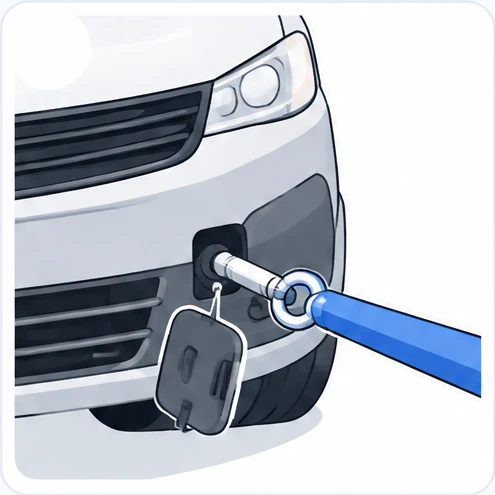
For the towing eye, see the Tool kit section below.
Getting to the front screw thread:
Unclip the cover: Press on the left-hand part of the cover.
Release the cover: Move it to the right and then downwards.
Having your car towed:
Fit the towing eye: Screw it in fully.
Fit the towbar: Install the towbar.
Neutral: Put the gearbox into neutral. If you do not, some components, such as the brakes and transmission, can be damaged, and braking assistance may be missing the next time the engine is started.
Steering and brake: Unlock the steering and release the parking brake.
Hazard lamps: Switch on the hazard warning lamps on both vehicles, as required by the law in the country where you are driving.
Drive off: Move off gently, drive slowly and only for a short distance.
With an automatic gearbox, never tow the car with the driving wheels on the ground and the engine off.
Getting to the rear screw thread:
Unclip the cover: Press on the right-hand part of the cover.
Remove the cover: Pull it downwards.
Towing another vehicle:
Fit the towing eye: Screw it in fully.
Fit the towbar: Install the towbar.
Hazard lamps: Switch on the hazard warning lamps on both vehicles.
Drive off: Move off gently, drive slowly and only for a short distance.
Engine technical data and towed loads
Your engine details are shown on the registration document and in sales brochures. tables only include values available at the time of publication, so contact a PEUGEOT dealer or a qualified workshop for any missing values. The maximum power is the value type-approved on a test bed under conditions defined by European legislation (Directive 1999/99/EC).
Weights and towed loads are shown on the registration document, in sales brochures and on the manufacturer's plate or label.
The GTW (Gross Train Weight) and towed load values are valid up to a maximum altitude of 1,000 metres.
Reduce the towed load by 10% for each additional 1,000 metres of altitude.
The maximum authorised nose weight is the weight permitted on the towball.
Safety: In high outside temperatures, performance can be limited to protect the engine, so reduce the towed weight when it is hotter than 37°C. Towing can affect road holding even when the car is lightly loaded, and braking distances are longer with a trailer. Never exceed 62 mph (100 km/h) when towing, and follow local law.
Engines and towed loads - Petrol
These are the petrol engine values. All 1.2 PureTech engines have a cubic capacity of 1,199 cc, and the 1.5 VTi 115 has 1,498 cc.
Scroll the table sideways.
Engine and gearbox
Codes (engine / model)
Max. power, EC standard (kW)
Fuel
1.2 PureTech 100, BVM6 (Manual 6-speed)
EB2ADTMD MB6 / HNB
74
Unleaded (RON 91 minimum)
1.2 PureTech 100 S&S, BVM6 (Manual 6-speed)
EB2ADTD MB6 STT / HNK
75
Unleaded (RON 95 minimum)
1.2 PureTech 130, EAT6 (Auto. 6-speed)
EB2ADTSM AT6III / HNL
96
Unleaded (RON 91 minimum)
1.2 PureTech 130 S&S, BVM6 (Manual 6-speed)
EB2ADTS MB6 STT / HNS
96
Unleaded (RON 95 minimum)
1.2 PureTech 130 S&S, EAT8 (Auto. 8-speed)
EB2ADTS ATN8 STT / HNS
96
Unleaded (RON 95 minimum)
1.2 PureTech 155, EAT8 (Auto. 8-speed)
EB2ADTXM ATN8 / HNJ
115
Unleaded (RON 95 minimum)
1.2 PureTech 155 S&S, EAT8 (Auto. 8-speed)
EB2ADTX ATN8 STT / HNN
115
Unleaded (RON 95 minimum)
1.5 VTi 115, EAT6 (Auto. 6-speed)
EC5F AT6III / NFJ
84
Unleaded (RON 91 minimum)
Braked trailer weights apply within the GTW limit, on a 10% or 12% gradient.
Scroll the table sideways.
Engine and gearbox
Braked trailer (kg)
Unbraked trailer (kg)
Max. nose weight (kg)
1.2 PureTech 100, BVM6
500
500
61
1.2 PureTech 100 S&S, BVM6
1,200
630
61
1.2 PureTech 130, EAT6
500
500
61
1.2 PureTech 130 S&S, BVM6
1,200
633
61
1.2 PureTech 130 S&S, EAT8
1,200
640
61
1.2 PureTech 155, EAT8
500
500
61
1.2 PureTech 155 S&S, EAT8
1,200
640
61
1.5 VTi 115, EAT6
500
500
61
Engines and towed loads - Diesel
These are the diesel engine values. Both 1.5 BlueHDi engines have a cubic capacity of 1,499 cc.
Scroll the table sideways.
Engine and gearbox
Codes (engine / model)
Max. power, EC standard (kW)
Fuel
1.5 BlueHDi 110 S&S, BVM6 (Manual 6-speed)
DV5RCE MB6 STT / YHS
81
Diesel (EN 590)
1.5 BlueHDi 130 S&S, EAT8 (Auto. 8-speed)
DV5RC ATN8 STT / YHZ
96
Diesel (EN 590)
Braked trailer weights apply within the GTW limit, on a 10% or 12% gradient.
Scroll the table sideways.
Engine and gearbox
Braked trailer (kg)
Unbraked trailer (kg)
Max. nose weight (kg)
1.5 BlueHDi 110 S&S, BVM6
1,200
640
61
1.5 BlueHDi 130 S&S, EAT8
1,200
670
61
Frequently Asked Questions
Can I fit a tow bar to an electric Peugeot 2008?
No. an electric 2008 cannot be fitted with a towing device under any circumstances, so it cannot tow a trailer or caravan.
How much can a Peugeot 2008 tow?
It depends on the engine and gearbox: braked trailer weights are either 500 kg or 1,200 kg, and unbraked weights range from 500 kg to 670 kg. Check the tables above and your registration certificate for your exact version.
What is the maximum nose weight on a Peugeot 2008?
The maximum authorised nose weight is 61 kg for every petrol and diesel engine listed below.
Can I tow my Peugeot 2008 with a rope?
No. When the car is towed with all four wheels on the ground, you must use an approved towbar, because ropes and straps are prohibited.
Towing safely with your Peugeot 2008 comes down to staying within the weight limits, checking the towball every time and following the right steps. Keep this guide handy. If in doubt, ask a PEUGEOT dealer or a qualified workshop.
Don't forget to follow us on Instagram for more Peugeot guides!
This is an independent guide, not an official Peugeot publication. If in doubt, contact a PEUGEOT dealer or a qualified workshop before carrying out any work.
Changing a bulb on your Peugeot 2008 is a job you can often do yourself, as long as you know which bulb goes where and how to reach it. This guide lists the front and rear lamps with their bulb types, explains …
Your Peugeot 2008 has several gauges and indicators that show the state of the car between services. This guide explains the service indicator, the coolant temperature gauge, the oil level checks and the AdBlue…
Your Peugeot 2008 has fuseboxes in the passenger compartment and under the bonnet. This guide shows you how to reach the fuse extraction tweezers, how to change a fuse safely, and which fuse protects which func…