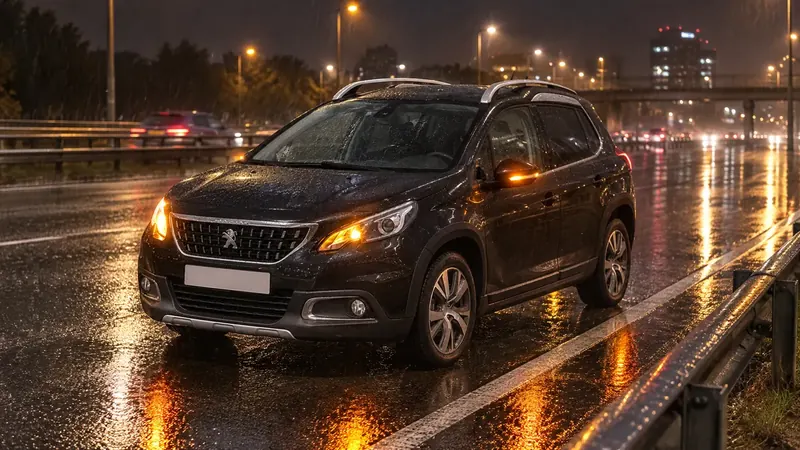
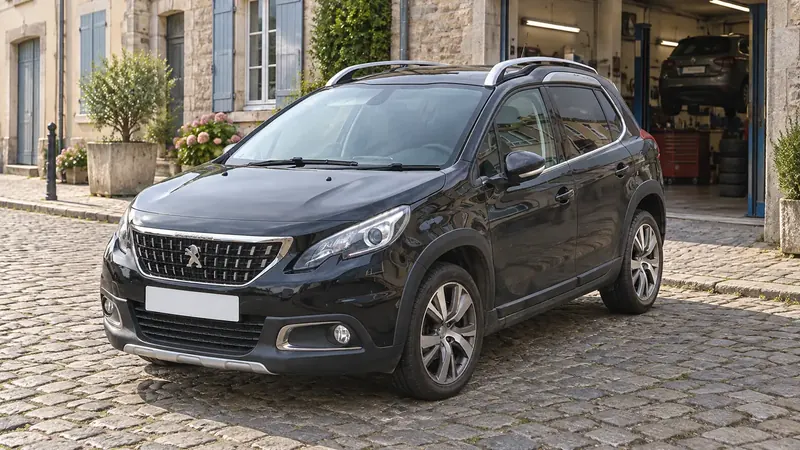
How speed limiter, cruise control, adaptive cruise, lane assists, blind spot monitoring and Active Safety Brake work on the Peugeot 2008 II (2019-2023).
Hello and welcome. In this post, we'll look at the driver assistance systems on the Peugeot 2008 II (2019-2023). Your Peugeot 2008 can be fitted with a range of driving aids, from the speed limiter and cruise control to Lane positioning assist, Blind spot monitoring and the Active Safety Brake. This guide explains how each system works, how you switch it on and off, and what the displays on the instrument panel mean. Some systems and functions depend on the version or equipment fitted, so your 2008 may not have all of them.
What is the minimum speed for cruise control on the Peugeot 2008?
Standard cruise control needs a minimum speed of 25 mph (40 km/h). With a manual gearbox, third gear or higher must also be engaged.
Quick Reference
Scroll the table sideways.
Section
In short
Driving and manoeuvring aids - General recommendations
Your responsibilities and what can affect the sensors
Speed limiter
Stops the car exceeding a speed you set
Cruise control
Holds a set speed without the accelerator
Adaptive cruise control
Holds your speed and distance to the car ahead
Lane positioning assist
Steers to hold your chosen position in the lane
Lane keeping assist
Corrects steering if you drift out of lane
Blind spot monitoring
Warns of vehicles in your blind spots
Active Safety Brake with Collision Risk Alert and Intelligent emergency braking assistance
Collision warnings and automatic emergency braking
Driving and manoeuvring aids - General recommendations
Driving and manoeuvring aids can never replace your own vigilance. You must follow the Highway Code, stay in control of the car at all times and be able to take back control whenever needed. You must also adapt your speed to the weather, the traffic and the state of the road.
You are responsible for watching the traffic, judging the distance and relative speed of other vehicles and anticipating their moves before you indicate and change lanes.
These systems cannot overcome the laws of physics.
Driving aids: hold the steering wheel with both hands, always use the door and interior mirrors, keep your feet close to the pedals and take a break every 2 hours.
Manoeuvring aids: always check around the car before and throughout the manoeuvre, in particular using the mirrors.
Radar(s): dirt such as mud or ice, poor weather such as heavy rain or snow, stickers or other objects over the detection zone, or damaged bumpers can affect the radar and its functions. Do not cover the detection zones on the front and rear bumpers. If a bumper is to be repainted, contact a PEUGEOT dealer or a qualified workshop, because some types of paint could interfere with the radar.
Driving aids camera: the camera and its functions can be impaired or stop working if the windscreen area in front of it is dirty, misty, frosty, covered with snow, damaged or masked by a sticker. In humid and cold weather, demist the windscreen regularly. Poor visibility (for example weak street lighting, heavy rain, thick fog or snow) and dazzle (for example oncoming headlamps, low sun, reflections on a wet road, leaving a tunnel, or alternating shade and light) can also reduce detection. If the windscreen is replaced, contact a PEUGEOT dealer or a qualified workshop to recalibrate the camera, otherwise the related driving aids can be disrupted.
Other cameras: images on the touch screen or instrument panel can be distorted by the terrain. In shade, bright sunlight or poor lighting, the image can look darker with less contrast. Obstacles can appear further away than they really are.
Sensors: noise from loud vehicles and machinery (for example lorries or pneumatic drills), snow or dead leaves building up on the road, and damaged bumpers or mirrors can all disrupt the sensors and their functions.
Speed limiter
The speed limiter stops your car going faster than the speed you have programmed (the speed setting). You switch it on manually, the minimum speed setting is 19 mph (30 km/h), and the setting stays in the memory when you switch off the ignition.
Scroll the table sideways.
No.
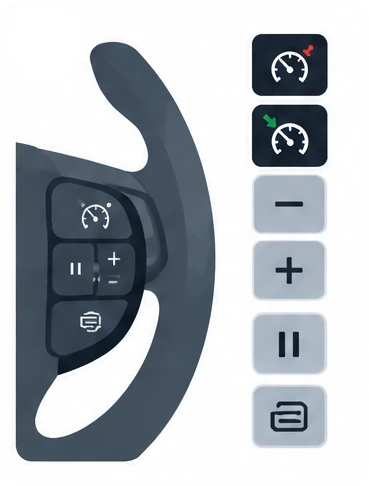
Steering-mounted control
1
ON (LIMIT position)/OFF
2
Reduce the speed setting
3
Increase the speed setting
4
Pause/resume the speed limiter with the speed setting previously stored
5
Use the speed suggested by the Road signs recognition function (MEM display)
The instrument panel shows the on/pause status (6), the speed limiter mode selection (7), the speed setting value (8) and, depending on version, the speed suggested by Road signs recognition (9).
Switching on and pausing:
Select the mode: turn thumbwheel 1 to the LIMIT position. The function is paused.
Switch on: if the most recent speed setting suits you, press button 4-II.
Pause: press 4-II again to pause the function temporarily.
If the speed setting stays below your car's speed for a long time, an audible warning sounds.
Adjusting the speed setting: you do not need to switch the limiter on first. Briefly press 2-SET- or 3-SET+ repeatedly for steps of +/- 1 mph (1 km/h), or press and hold for steps of +/- 5 mph (5 km/h). To use the speed suggested by Road signs recognition:
Request: press 5-MEM once. A message confirms the memorisation request.
Save: press 5-MEM again to save the suggested speed.
The new speed setting then appears on the instrument panel.
Temporarily exceeding the speed setting: press the accelerator pedal fully. The limiter is temporarily deactivated and the speed setting flashes. Release the pedal to drop back below the setting. Once your speed returns to the setting, the limiter works again and the display stops flashing. If the speed is exceeded without you accelerating, for example on a steep slope, an audible signal sounds straight away. On a steep descent or under sharp acceleration, the limiter cannot stop the car exceeding the setting, so brake if you need to.
Switching off: turn thumbwheel 1 to OFF. The speed limiter information disappears from the display.
Malfunction: flashing dashes, then fixed dashes, replace the speed setting. Have the system checked by a PEUGEOT dealer or a qualified workshop.
Cruise control
Cruise control keeps your car at the speed you have programmed without you using the accelerator pedal. You switch it on manually, and it needs a minimum speed of 25 mph (40 km/h).
Manual gearbox: third gear or higher must be engaged.
Automatic gearbox: mode D, or second gear or higher in mode M, must be engaged.
Drive selector: mode D or B must be engaged.
On engines with Stop & Start, cruise control stays active after a gear change, whatever the gearbox type. Switching off the ignition cancels any speed setting.
Scroll the table sideways.
No.
Steering-mounted control
1
ON (CRUISE position)/OFF
2
Activate cruise control at the current speed/decrease speed setting
3
Activate cruise control at the current speed/increase speed setting
4
Pause/resume cruise control with the speed setting previously saved
5
Use the speed suggested by the Road signs recognition function (MEM display)
The instrument panel shows pause/resume (6), the cruise control mode selection (7), the speed setting value (8) and, depending on version, the speed suggested by Road signs recognition (9).
Switching on and pausing:
Select the mode: turn thumbwheel 1 to the CRUISE position. The function is paused.
Activate: once you reach the speed you want, press 2-SET- or 3-SET+. Your current speed is saved as the speed setting.
Release: take your foot off the accelerator pedal.
Pause: press 4-II to pause the function temporarily.
Resume: press 4-II again to switch cruise control back on.
Cruise control also pauses when you press the brake pedal, or automatically if the electronic stability control (ESC) system is triggered.
Changing the cruise speed: cruise control must be active. Briefly press 2-SET- or 3-SET+ repeatedly for steps of +/- 1 mph (1 km/h), or press and hold for steps of +/- 5 mph (5 km/h). Holding the button changes the car's speed quickly, so set a speed fairly close to your current speed to avoid sudden acceleration or deceleration. To use the speed suggested by Road signs recognition, press 5-MEM once and a message confirms the memorisation request.
Adaptive cruise control
Adaptive cruise control keeps your car at the speed you set while holding a safety distance, also set by you, from the vehicle in front. It manages acceleration and deceleration automatically. With a manual gearbox, it slows the car down as far as 19 mph (30 km/h). With the Stop & Go function, it brakes the car to a complete stop and moves it off again.
The system uses a camera at the top of the windscreen and, depending on version, a radar in the front bumper. It is mainly designed for main roads and motorways, and only works with moving vehicles travelling in the same direction as you. The brake lamps come on when the system slows the car, so driving with faulty brake lamps can be dangerous. If you indicate to overtake a slower vehicle, the system can briefly reduce the distance to the vehicle ahead to help you overtake, without exceeding the speed setting.
Scroll the table sideways.
No.
Steering-mounted control
1
ON (CRUISE position)/OFF
2
Activate cruise control at the current speed/decrease speed setting
3
Activate cruise control at the current speed/increase speed setting
4
Pause/resume cruise control with the speed setting previously saved; confirm restart after an automatic stop (versions with Stop & Go)
5
Use the speed suggested by the Road signs recognition function (MEM display)
6
Display and adjust the distance setting to the vehicle in front
Your speed must be between 19 and 112 mph (30 and 180 km/h) with a manual gearbox, or between 0 and 112 mph (0 and 180 km/h) with an EAT8 automatic gearbox or a drive selector.
Get it ready: with the engine running, turn thumbwheel 1 down to CRUISE. The display is grey.
Set the speed: press 2-SET- or 3-SET+. Your current speed becomes the speed setting (minimum 19 mph (30 km/h)) and cruise control activates straight away (green display).
Adjust: press 3-SET+ to increase or 2-SET- to decrease the setting. Hold the button for steps of 5 mph (km/h), which changes the car's speed quickly.
Pause: press 4-II or the brake pedal (grey display).
Resume: press 4-II (green display).
Switch off: turn thumbwheel 1 up to OFF.
Cruise control also pauses:
automatically, if the ESC system is triggered.
when you engage neutral.
when the car's speed drops below 19 mph (30 km/h) with a manual gearbox.
when the engine speed drops below 1,100 rpm with a manual gearbox.
when you press the clutch pedal for more than 10 seconds.
when you use the electric parking brake.
It stays active after a gear change, whatever the gearbox type. If you try to reactivate it when the safety conditions are not met, “Activation refused, unsuitable conditions” appears briefly.
After an automatic stop: with an EAT8 gearbox or a drive selector, if traffic does not let the car move off within 3 seconds of stopping, press 4-II or the accelerator pedal to move off. If you do nothing, the electric parking brake is applied automatically after about 5 minutes.
Road signs recognition speed: press 5-MEM to accept the suggested speed, then press again to confirm. Choose a setting fairly close to your current speed to avoid sudden acceleration or deceleration.
Distance to the vehicle in front: press 6 to show the thresholds “Distant”, “Normal” and “Close”, then press again to select one. After a few seconds it is accepted, and it is memorised when you switch off the ignition.
Temporarily exceeding the setting: press the accelerator pedal fully. Distance monitoring and cruise control are deactivated while you keep accelerating, and “Cruise control on hold” is displayed.
The instrument panel shows a detected vehicle (full symbol, 7), cruise control active (colour not grey, 8), the speed setting (9), the Road signs recognition speed (10), the car held stationary on automatic or drive selector versions (11), the distance setting (12) and the position of the detected vehicle (13).
Messages and alerts (the order can vary):
“Cruise paused” or “Cruise control on hold”: after brief acceleration by you.
“Active cruise control”, no vehicle detected.
“Cruise paused”, vehicle detected.
“Active cruise control”, vehicle detected.
Orange “Take back control”: brake or accelerate, depending on the situation.
Red “Take back control”.
Lane positioning assist
Lane positioning assist identifies the edges of the lane and steers the car to keep it inside the lane, in the side position you have chosen. It uses a camera on the upper part of the windscreen and is best suited to motorways and main roads.
Operating conditions:
Adaptive cruise control active.
Lane marked with lines on both sides.
ESC system operational.
ASR system activated.
No trailer detected.
No space-saver spare wheel in use.
Car not under strong lateral acceleration.
Direction indicators off when you activate the system.
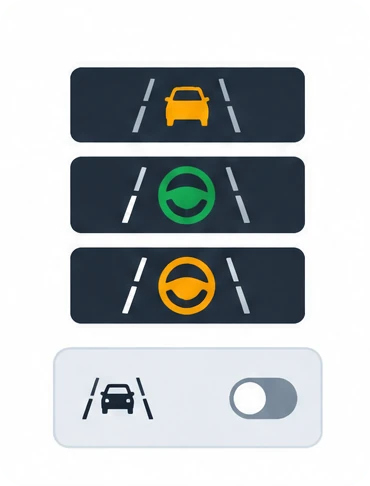
Activation and deactivation: with Adaptive cruise control with Stop&Go activated, press the Lane positioning assist button. The indicator lamp in the button lights up green and the symbol appears on the instrument panel. Press the button again to deactivate it: the lamp goes off and the symbol disappears. The system status is saved when you switch off the ignition.
Grey symbol: one or more operating conditions are not met, the system is paused.
Green symbol: all conditions are met, the system is active.
Orange symbol: system malfunction.
In use: hold the steering wheel properly. With the green symbol, the system makes small steering corrections to keep the car where you placed it in the lane, which is not necessarily the centre. You can feel movements in the steering wheel. To change position, turn the wheel, which suspends the function, place the car where you want it and hold it there until the function reactivates. The system then regulates on the new position.
Act promptly if traffic or the road surface calls for it, by moving the steering wheel to suspend the system. Any brake pedal action that pauses Adaptive cruise control also pauses this system. If the system detects that you are not holding the wheel firmly enough, it gives a series of gradual alerts, then deactivates itself if you do not respond. In that case, press the button again to reactivate it.
Automatic pause: when the ESC triggers, or when one of the lane markings is not detected for a long time. In that case Lane keeping assist can take over, and the system reactivates once the conditions are met again.
Suspension by your action:
Using the direction indicators.
Driving outside the lane limits.
Gripping the steering wheel too tightly or turning it sharply.
Pressing the brake pedal (pause until cruise control is reactivated) or the accelerator pedal (suspended while the pedal is pressed).
Pausing Adaptive cruise control.
Deactivating the ASR.
Driving situations (the order of the alerts can differ):
Scroll the table sideways.
Button lamp
Thumbwheel
Symbols / display
Meaning
Off
CRUISE
Grey / grey
Cruise paused. Lane positioning assist not activated.
Off
CRUISE
Green / grey
Active cruise control. Lane positioning assist not activated.
Green
CRUISE
Green / green
Drive Assist Plus activated. Working normally, with correction at the steering wheel.
Green
CRUISE
Grey / grey
Drive Assist Plus paused.
Green
CRUISE
Green or grey / grey
Drive Assist Plus activated. Not all Lane positioning assist conditions are met.
Green
OFF or LIMIT
Grey / grey
Cruise control deactivated. Not all Lane positioning assist conditions are met.
Lane keeping assist
Lane keeping assist corrects the car's path when it detects a risk of drifting out of your lane unintentionally or, depending on version, crossing a verge or hard shoulder. It uses a camera on the upper part of the windscreen to read the lane markings and, depending on version, the edge of the road. It is particularly useful on motorways and main roads.
Operating conditions:
Speed between 43 and 112 mph (70 and 180 km/h).
Road marked with a central dividing line.
Steering wheel held with both hands.
Direction indicators off when you activate the system.
ESC system activated and operational.
The system only helps when the car risks wandering out of its lane. It does not manage the safe distance, your speed or braking. Keep both hands on the wheel so you stay in control when the system can no longer act, for example if the central line disappears.
How it works: when the system detects a risk of crossing a lane marking or a lane boundary such as a grass verge, it steers the car back into its lane. You feel the steering wheel turn and the warning lamp flashes during the correction. You can stop the correction by holding the wheel firmly, for example in an emergency manoeuvre. Using the direction indicators interrupts it immediately, and no correction is made while they are on and for a few seconds after you switch them off.
Scroll the table sideways.
Status
Display or message
Meaning
OFF
Grey
Function deactivated.
ON
Grey
System active, conditions not met: speed below 43 mph (70 km/h), no lane marking recognised, ASR/DSC deactivated or ESC triggered, or sporty driving.
ON
Grey
Automatic deactivation or standby, for example a trailer detected or the space-saver spare wheel in use.
ON
Green
Lane marking detected, speed above 43 mph (70 km/h).
ON
Orange/green
The system is correcting the path on the side where the risk is detected (orange line).
ON
Orange/green, “Hold the wheel”
The correction will not be enough and you must steer as well. If the wheel is not held properly, an audible warning and message continue until the correction ends or you grip the wheel.
The audible warnings get longer if several corrections happen in quick succession, and become continuous until you respond. “Hold the wheel” can also appear when your hands are on the wheel.
Blind spot monitoring
Blind spot monitoring warns you when another vehicle (car, lorry or motorcycle) is in your blind spots, using sensors on the sides of the bumpers. Depending on the country of sale, the symbol printed on the mirror does not necessarily mean your car has the function.
A warning lamp appears in the door mirror on the side concerned:
Fixed: immediately, when you are being overtaken.
Flashing: after about one second, when you overtake a vehicle slowly and use the direction indicator.
Activation and deactivation: change the settings in the Driving/Vehicle touch screen menu. When you start the car, the lamp lights up in each mirror to show the system is active. The status is memorised when you switch off the ignition. The system is automatically deactivated when you tow with a towing device approved by PEUGEOT.
Operating conditions:
All vehicles moving in the same direction, in adjacent lanes.
Your speed between 7 and 87 mph (12 and 140 km/h) without Park Assist, or between 19 and 87 mph (30 and 140 km/h) with Park Assist.
When you overtake, a speed difference of less than 6 mph (10 km/h).
When you are overtaken, a speed difference of less than 16 mph (25 km/h).
Traffic flowing normally.
When you overtake over a period of time, the overtaken vehicle stays in the blind spot.
A straight or slightly curved road.
No trailer, caravan or similar behind your car.
No alert is given for:
stationary objects such as parked vehicles, safety rails, lampposts or signs.
vehicles travelling in the opposite direction.
winding roads or sharp turns.
Active Safety Brake with Collision Risk Alert and Intelligent emergency braking assistance
This system warns you when there is a risk of colliding with the vehicle in front, a pedestrian or a cyclist, and reduces your speed to avoid a collision or limit its severity. It also takes motorcyclists into account and can react to animals, but animals (especially those smaller than 0.5 m) and objects on the road are not necessarily detected.
Below 19 mph (30 km/h), automatic emergency braking can bring the car to a complete stop.
Otherwise, on versions with a camera only, the speed can be reduced by a maximum of 16 mph (25 km/h).
On versions with a camera and radar, the reduction can reach 31 mph (50 km/h) if both sensors detect the threat.
It includes three functions: Collision Risk Alert, Intelligent emergency braking assistance (iEBA) and Active Safety Brake (automatic emergency braking). It uses a multifunction camera at the top of the windscreen and, depending on version, a radar in the front bumper. The system is there to assist you, not to replace your vigilance, and you remain responsible for watching the traffic. When it detects a possible collision, it prepares the braking circuit, which can cause a slight noise and a slight feeling of deceleration.
Activation and deactivation: the system switches on automatically every time you start the engine. Change the settings in the Driving/Vehicle touch screen menu. When it is deactivated, a warning lamp lights up with a message.
Operating conditions:
Car moving forward without a trailer.
Brake system operational.
ASR system activated.
Seat belts fastened for all passengers.
Steady speed on roads with little or no curvature.
If the warning lamp lights up without a message, automatic braking is not available because a condition is not met. This is normal and does not need a workshop. If detection is reduced or temporarily unavailable because of the conditions around you, nothing is shown, because no action is needed from you.
With the ignition on, deactivate the system in the configuration menu whenever automatic braking could be a risk, for example:
towing a trailer, particularly one without its own brakes.
carrying long objects on roof bars.
driving with snow chains.
using an automatic car wash.
doing maintenance such as changing a wheel or working in the engine compartment.
placing the car on a rolling bench in a workshop.
towing the car.
after damage to the windscreen close to the camera.
The system deactivates itself if certain space-saver spare wheels (smaller diameter) are detected, if there is a fault with the brake pedal switch or with at least two brake lamps, and after a severe crash, for example with airbag deployment. Have it checked by a PEUGEOT dealer or a qualified workshop. Driving with faulty brake lamps can be dangerous, and do not overload the car: keep within the GVW limit and the load height limits for roof bars.
Collision Risk Alert: warns you of a risk of collision with the vehicle in front, a pedestrian or a cyclist. Set its sensitivity in the Driving/Vehicle touch screen menu by choosing “Far”, “Normal” or “Close”. The last threshold is memorised when you switch off the ignition.
The system takes into account the car's dynamics, the speed difference between your car and the detected object, and how you are driving (pedals, steering wheel) to give the alert at the most relevant moment:
Level 1 (orange): visual alert only, the vehicle in front is very close. “Vehicle close” is displayed.
Level 2 (red): visual and audible alert, a collision is imminent. “Brake!” is displayed.
If you approach a vehicle too quickly, level 2 can appear straight away. Level 1 depends on the threshold you chose, only reacts to moving vehicles and is disabled automatically at lower speed. Warnings can be missing, late or seem unjustified, so always stay in control and be ready to react.
Frequently Asked Questions
What is the minimum speed for cruise control on the Peugeot 2008?
Standard cruise control needs a minimum speed of 25 mph (40 km/h). With a manual gearbox, third gear or higher must also be engaged.
Why is the Lane positioning assist symbol grey on my 2008?
A grey symbol means one or more operating conditions are not met, so the system is paused. For example, Adaptive cruise control must be active and the lane must be marked with lines on both sides.
Do I need to recalibrate the camera after a windscreen replacement?
Yes. Contact a PEUGEOT dealer or a qualified workshop to recalibrate the camera, otherwise the related driving aids can be disrupted.
When should I switch off the Active Safety Brake on my Peugeot 2008?
Deactivate it whenever automatic braking could be a risk, such as towing a trailer, driving with snow chains, using an automatic car wash or doing maintenance. You do this in the vehicle's configuration menu with the ignition on.
Driving aids on your Peugeot 2008 can make long journeys easier, but they only work within their limits and you always stay in charge. Keep the windscreen and bumpers clean, know what each display means, and ask a PEUGEOT dealer or a qualified workshop for full details on any system.
Don't forget to follow us on Instagram for more Peugeot guides!
This is an independent guide, not an official Peugeot publication. If in doubt, contact a PEUGEOT dealer or a qualified workshop before carrying out any work.
Changing a bulb on your Peugeot 2008 is a job you can often do yourself, as long as you know which bulb goes where and how to reach it. This guide lists the front and rear lamps with their bulb types, explains …
Your Peugeot 2008 has several gauges and indicators that show the state of the car between services. This guide explains the service indicator, the coolant temperature gauge, the oil level checks and the AdBlue…
Your Peugeot 2008 has fuseboxes in the passenger compartment and under the bonnet. This guide shows you how to reach the fuse extraction tweezers, how to change a fuse safely, and which fuse protects which func…