Hello and welcome. In this post, we'll look at tyre pressures and how to reset the under-inflation detection on the Peugeot 2008 I (2016-present). Your Peugeot 2008 can monitor the pressure in all four tyres while you drive and warn you if one or more of them loses pressure. This guide explains how the under-inflation detection system works, what to do when the alert comes on, how to reinitialise the system and where to find your tyre pressures and identification markings. Some features, such as the touch screen, the on-screen messages and the puncture repair equipment, depend on your car's version or equipment.
How do you reset the tyre pressure warning on a Peugeot 2008 I?
Set the pressures to the door-label values first, then reset the under-inflation detection from the driving-aids or configuration menu so the system learns the new values.
Quick Reference
Scroll the table sideways.
Section
In short
Under-inflation detection
How the system monitors pressures and when to check them
Under-inflation alert
Warning lamp on: slow down, stop safely, check tyres
Reinitialisation
Reset the system after adjusting pressures or changing wheels
Malfunction
Flashing lamp with Service lamp means a system fault
Identification markings
Where to find the VIN and tyre pressure label
Under-inflation detection
The under-inflation detection system monitors the pressure in all four tyres automatically once the car is moving. It compares information from the wheel speed sensors with reference values. These reference values must be reinitialised every time you adjust a tyre pressure or change a wheel. As soon as the system detects a drop in pressure in one or more tyres, it triggers an alert.
The system does not replace your own vigilance as a driver. You still need to check the tyre pressures every month and before a long journey, including the spare wheel.
Why it matters: under-inflated tyres impair handling, extend braking distances and cause premature tyre wear, particularly with heavy loads, at high speeds or on long journeys.
Fuel consumption: driving with under-inflated tyres increases fuel consumption.
Where to find the pressures: the correct pressures for your car are on the tyre pressure label. See the Identification markings section below.
When to check: check the pressures when the tyres are cold, meaning the car has been stopped for 1 hour or has covered less than 6 mph (10 km) at moderate speeds.
If the tyres are hot: add 0.3 bar to the pressures shown on the label.
Under-inflation alert
The under-inflation alert is shown by the warning lamp staying on, an audible signal and, depending on equipment, a message on the screen.
Slow down: reduce your speed straight away and avoid sharp steering movements and sudden braking.
Stop: stop the car as soon as it is safe to do so.
Deal with the tyre: if you have a puncture, use the temporary puncture repair kit or the spare wheel, depending on equipment.
If there is no puncture, you have two options:
With a compressor: if you have one, such as the compressor in the temporary puncture repair kit, check the pressures of all four tyres when cold.
Without a compressor: if you cannot check the pressures straight away, drive carefully at reduced speed.
A loss of pressure does not always make the tyre bulge visibly, so do not rely on a visual check alone. The alert stays active until you reinitialise the system, and it can only be relied on if you reinitialised it with all four tyres at the correct pressure.
Reinitialisation
You must reinitialise the system after adjusting the pressure in one or more tyres, and after changing one or more wheels.
Before you start, make sure the pressures in all four tyres are correct for how you are using the car and match the tyre pressure label. The system does not warn you if a pressure is wrong at the moment you reinitialise it, and the alert can only be relied on if all four tyres were correctly adjusted at that time.
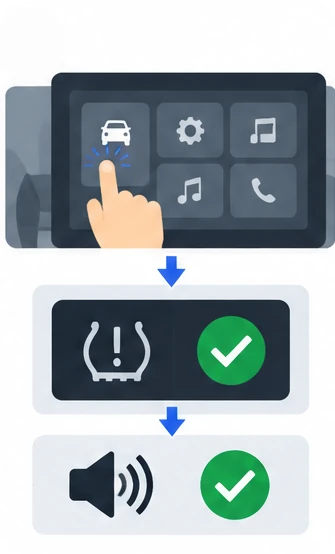
With the touch screen, reinitialise the system with the ignition on and the car stationary:
Select the function: on the touch screen, press "Under-inflation initialisation".
Confirm: press "Yes". An audible signal and a message confirm the reinitialisation.
The system then treats the newly saved pressures as its reference values. You do not need to reinitialise it after fitting or removing snow chains.
Malfunction
If the under-inflation warning lamp flashes and then stays on, and the Service warning lamp also comes on, there is a fault with the system. In this case, under-inflation monitoring of the tyres is no longer assured.
Have the system checked by a PEUGEOT dealer or a qualified workshop. After any work on the system, the pressures of all four tyres must be checked and the system reinitialised.
Identification markings
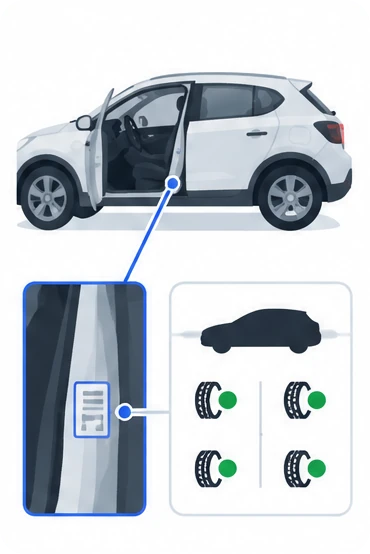
Your 2008 has several visible markings that identify the car. The tyre/paint label is the one that gives you the tyre pressures.
Scroll the table sideways.
Marking
Location
A. Vehicle Identification Number (VIN)
Under the bonnet, engraved on the bodywork near the suspension damper mounting
B. Vehicle Identification Number (VIN)
On the dashboard, on a label visible through the windscreen
C. Manufacturer's label
Tamper-proof label on the middle door pillar, right or left side
D. Tyre/paint label
On the centre pillar on the driver's side
The manufacturer's label shows:
the name of the manufacturer
the European Whole Vehicle Type Approval number
the Vehicle Identification Number (VIN)
the maximum authorised vehicle weight (Gross Vehicle Weight or GVW)
the maximum authorised vehicle + trailer weight (Gross Train Weight or GTW)
the maximum weight on the front axle
the maximum weight on the rear axle
The tyre/paint label shows:
the tyre inflation pressures with and without load
the tyre specification: dimensions, type, and load and speed indices
the spare tyre pressure
the paint colour code
Your car may have been fitted from new with tyres that have higher load and speed indices than those on the label. This does not affect the inflation pressures.
Frequently Asked Questions
Where is the tyre pressure label on a Peugeot 2008?
The tyre/paint label is on the centre pillar on the driver's side. It shows the pressures with and without load, the tyre specification and the spare tyre pressure.
How do I reset the tyre pressure warning on my Peugeot 2008?
With the ignition on and the car stationary, press "Under-inflation initialisation" on the touch screen, then press "Yes". Make sure all four tyres are at the correct pressure first.
Why is my Peugeot 2008 tyre pressure light still on after pumping up the tyres?
The alert stays active until you reinitialise the system. Reinitialise it once all four tyres are at the correct pressure.
Do I need to reset the 2008 tyre pressure system after fitting snow chains?
No. the system does not need to be reinitialised after fitting or removing snow chains.
The under-inflation detection system is a useful extra check, but it only works properly if you keep your tyres at the right pressures and reinitialise it each time you adjust them or change a wheel. Check your tyres every month and before long journeys, and you will get the best from your 2008.
Don't forget to follow us on Instagram for more Peugeot guides!
This is an independent guide, not an official Peugeot publication. If in doubt, contact a PEUGEOT dealer or a qualified workshop before carrying out any work.
Changing a bulb on your Peugeot 2008 is a job you can often do yourself, as long as you know which bulb goes where and how to reach it. This guide lists the front and rear lamps with their bulb types, explains …
Your Peugeot 2008 has several gauges and indicators that show the state of the car between services. This guide explains the service indicator, the coolant temperature gauge, the oil level checks and the AdBlue…
Your Peugeot 2008 has fuseboxes in the passenger compartment and under the bonnet. This guide shows you how to reach the fuse extraction tweezers, how to change a fuse safely, and which fuse protects which func…