Resetting the service spanner on a Peugeot Traveller III from 2016 to 2024 takes one button and the ignition. It must be done after every service. The other gauges are covered below too, from oil level and coolant temperature to AdBlue range and the electric versions' battery displays.
How do I reset the service light on my Peugeot Traveller?
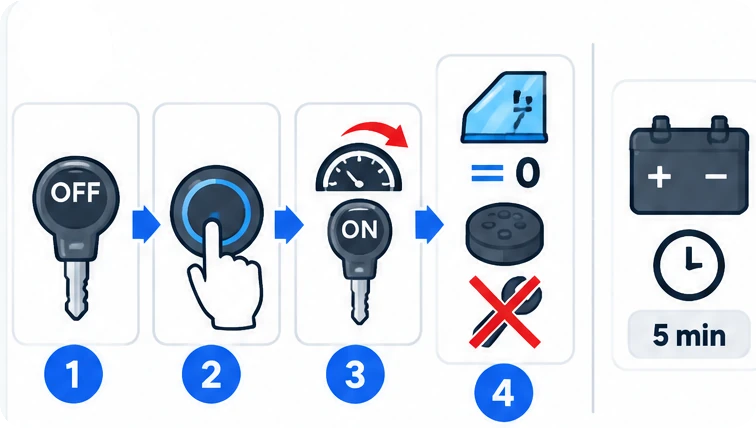
Switch the ignition off, then press and hold the button while you switch the ignition back on. Keep holding it through the countdown and let go when =0 appears. The spanner then disappears.
The sequence
Switch the ignition off.
Press and hold the button.
Switch the ignition on. The distance recorder display starts counting down.
Release the button when =0 is displayed. The spanner disappears.
If you need to disconnect the battery after the reset, lock the vehicle first and wait at least 5 minutes. This gives the system time to register the reset.
Checking the service information without resetting it
You can bring up the service information whenever you like. Press the button and the details show for a few seconds, then disappear. This is a quick way to check how far you are from the next service before you book it.
What the spanner and service display mean
The service indicator appears on the instrument panel. How it looks depends on the version. On some, the distance recorder line shows the distance left before the next service. Once the service is overdue, it shows the distance covered since then, with a minus sign in front. On others, an alert message gives both the distance and the time left before the service, or how long it is overdue.
Scroll the table sideways.
Spanner behaviour at ignition on
Meaning
What to do
On for a short time
Between 1,000 km and 3,000 km left before the next service
Nothing yet. Plan ahead
Stays on
Next service due in less than 1,000 km
Have the vehicle serviced very soon
Flashes, then stays on
Servicing interval exceeded
Have the vehicle serviced as soon as possible
On BlueHDi Diesel engines, the flashing spanner comes with the Service warning lamp.
The distance displayed is worked out from both the distance driven and the time since the last service. A van that covers few kilometres can therefore still be flagged for a service. The alert can also appear when a due date is close, even if the distance looks comfortable.
Engine oil level indicator
Some versions have an electric oil gauge. On these, the oil level status shows on the instrument panel for a few seconds when you switch on the ignition, along with the servicing information. The reading is only accurate if the vehicle is on level ground and the engine has been off for more than 30 minutes. A reading taken just after a drive is not reliable.
Oil level correct: a message on the instrument panel confirms it.
Low oil level: a message warns you. Check the level with the dipstick. If it confirms the level is low, top up to avoid damaging the engine.
Oil gauge malfunction: a message is displayed. Consult a PEUGEOT dealer or a qualified workshop.
While the electric gauge is faulty, the oil level is no longer monitored at all. Until it is fixed, check the level yourself with the manual dipstick in the engine compartment.
Coolant temperature on Diesel versions
With the engine running, the needle should sit in the normal zone, which means the temperature is correct. If it moves into the high-temperature zone, the coolant warning lamp and the STOP warning lamp light up in red. A message and an audible signal come with them.
When that happens, stop as soon as it is safe to do so. Leave the engine running for a few minutes before switching it off. Once the ignition is off, open the bonnet carefully and check the coolant level.
Topping up the coolant safely
After a few minutes of driving, the temperature and pressure in the cooling system rise, so never rush this.
Wait at least one hour for the engine to cool.
Unscrew the cap by two turns to let the pressure drop.
Once the pressure has dropped, remove the cap.
Top up to the MAX mark.
There is a real risk of scalding when topping up. Do not fill above the maximum level marked on the reservoir.
AdBlue range and SCR warnings on BlueHDi engines
BlueHDi Diesel engines treat exhaust gases with the SCR, or Selective Catalytic Reduction, emissions control system working together with the Diesel particle filter. Neither can work without AdBlue fluid. Once the AdBlue tank is empty, a starting prevention system required by regulations switches on automatically. The engine will not start again until AdBlue has been topped up to the minimum level.
When the range appears
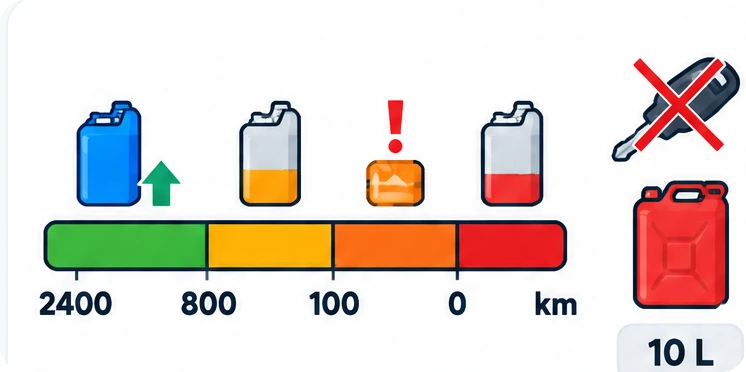
Above 2,400 km of range, the AdBlue range is not shown automatically. Press the button to display it for a short time. With the touch screen, you can find it in the Driving/Vehicle menu.
Below 2,400 km, the AdBlue is in its reserve level. A warning lamp lights up when you switch on the ignition, and the instrument panel shows an estimate of how far you can drive before starting is prevented. Regular messages also remind you to top up.
Euro 6.3/6.4 BlueHDi stages
Scroll the table sideways.
Remaining range
What to do
2,400 km to 800 km
Top up
800 km to 100 km
Top up as soon as possible
100 km to 0 km
A top-up is vital. The engine may be prevented from starting
0 km
Add at least 10 litres of AdBlue to be able to restart the engine
The system may not register a top-up straight away. It can take a few minutes of driving before the new level is detected.
When the SCR system develops a fault
If a fault is detected, warning lamps light up with an audible signal and an "Emissions control fault" or "NO START IN" message. The alert first appears while you are driving. After that it comes up each time you switch on the ignition, for as long as the fault is still there. A temporary fault clears during the next journey, once the system has run its self-diagnostic checks.
If the warning is still on after 50 km of driving, the fault is confirmed. The AdBlue warning lamp flashes. A message reading "Emissions control fault: starting prevented in" or "NO START IN" shows the distance you have left. While you drive, this message repeats every 30 seconds, and it appears again each time you switch on the ignition. You can drive up to 1,100 km before starting is prevented, so get the system checked by a PEUGEOT dealer or a qualified workshop well before that.
Once the limit is reached, "Emissions control fault: Starting prevented" or "NO START IN" appears every time you switch on the ignition. To restart the engine, contact a PEUGEOT dealer or a qualified workshop.
Electric Traveller: power, charge and comfort gauges
Power indicator
CHARGE: the traction battery is recharging while you slow down or brake.
ECO: energy use is moderate and range is optimised.
POWER: the drive train is using energy to accelerate.
Neutral: the drive train is neither using nor generating energy. When you switch on the ignition, the needle sweeps across the dial and then settles here, between ECO and CHARGE.
With the ignition off, opening the driver's door wakes the indicator, and the needle moves to the neutral position.
Charge level indicator
Once the vehicle is started, the traction battery's actual charge level and remaining range are shown continuously. Opening the driver's door with the ignition off also activates this display. There are two alert levels:
Reserve: the charge is low. The LED stays on and the needle sits in the red zone, with an audible signal. Check the remaining range on the instrument panel and put the vehicle on charge as soon as possible.
Critical: the charge is critical. This LED stays on together with the reserve LED, with an audible signal. You must put the vehicle on charge.
At the critical level, the remaining range is no longer calculated and drive train power gradually decreases. The heating and air conditioning are also switched off, even if their consumption needle is not at ECO.
Thermal comfort consumption indicator
This gauge shows how much traction battery energy the heating and air conditioning are using. You can run them when the vehicle is unplugged and the READY lamp is lit. When the vehicle is plugged in, you can run them with the ignition on, which is Lounge mode.
Selecting ECO mode limits some of this equipment, and the needle moves into the ECO zone. On full heating, the needle sits in the MAX zone. On full air conditioning, it stays in the ECO zone. A short burst at maximum is fine for heating or cooling the cabin quickly. Once you are comfortable, turn the settings back down, and check them each time you set off. Heavy use, particularly at low speed, can cut the range noticeably. After a long spell without the heating, a slight smell for the first few minutes is normal.
Total and trip distance recorders
The total and trip distances show for thirty seconds when you switch off the ignition, open the driver's door, or lock or unlock the vehicle.
Total distance recorder: the distance covered since the vehicle was first registered.
Trip distance recorder on Diesel versions: the distance covered since you last reset it.
To reset the trip recorder, switch the ignition on and press the button until zeros appear.
Frequently Asked Questions
Why does the service spanner come back after I reset it?
If the battery was disconnected straight after the reset, the system may not have registered it. Before disconnecting, lock the vehicle and wait at least 5 minutes.
Why is my Peugeot Traveller asking for a service when I have barely driven it?
The service distance is calculated from both the distance covered and the time since the last service. A van that does few kilometres will still reach its due date. The alert can also appear when that date is close.
How much AdBlue do I need if the engine will not start?
On Euro 6.3/6.4 BlueHDi engines, add at least 10 litres of AdBlue once the range has reached 0 km. The system may need a few minutes of driving to detect the top-up. If an emissions control fault caused the starting prevention, contact a PEUGEOT dealer or a qualified workshop instead.
Can I trust the oil level reading on the instrument panel?
Only if the vehicle is on level ground and the engine has been off for more than 30 minutes. If a low level is shown, confirm it with the dipstick before topping up. If the gauge itself reports a fault, the oil is no longer monitored, so check it by hand.
A flashing spanner or a falling AdBlue range is easy to deal with early and costly to ignore. A glance at the start-up display when you switch on the ignition is all it takes.
Don't forget to follow us on Instagram for more Peugeot guides!
This is an independent guide, not an official Peugeot publication. If in doubt, contact a PEUGEOT dealer or a qualified workshop before carrying out any work.
Hello and welcome. In this post we look at the 12 V battery on the Peugeot Traveller III (2016-2024). We cover where to find it, jump starting from another battery, charging with a charger, and discon