Peugeot Rifter I Spare Wheel and Tyre Repair Kit
Hello and welcome. In this post, we'll look at what to do when you get a flat tyre on your Peugeot Rifter. We cover where the tools are kept, how to use the temporary puncture repair kit and how to fi
Charging the electric Peugeot Rifter 2018-2025: mode 2, 3 and 4 currents, flap indicator lamps, deferred charging, unplugging and battery care tips.
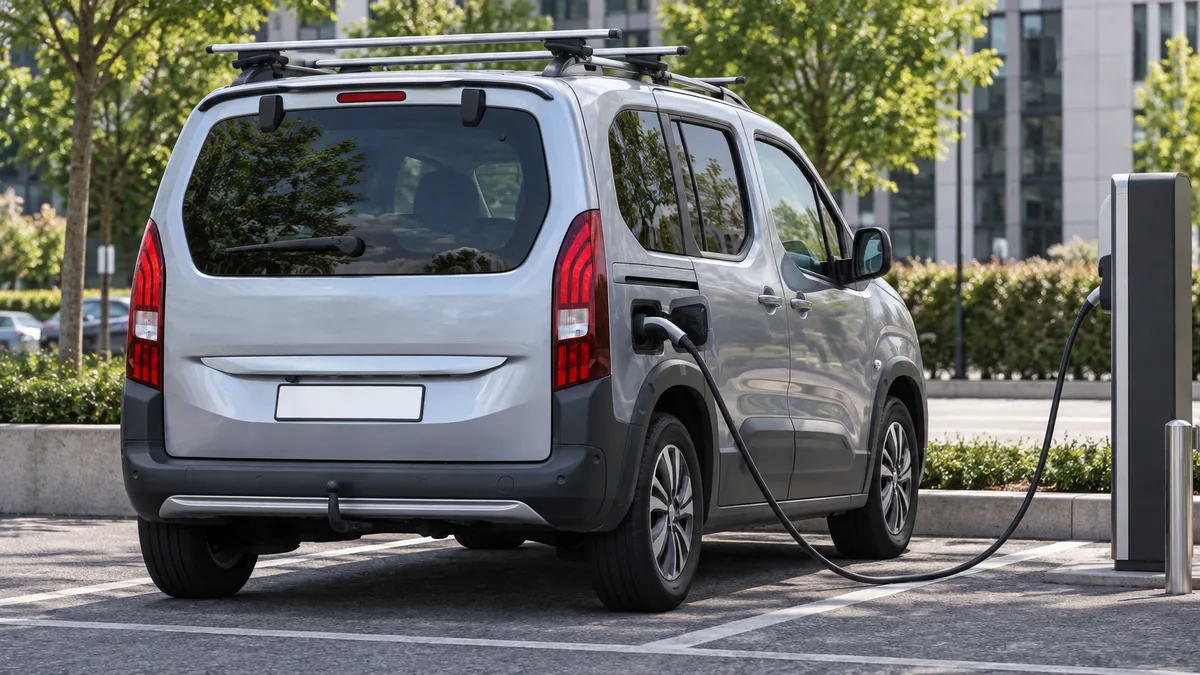
The electric Peugeot Rifter of 2018-2025 charges from a domestic socket, an accelerated charging unit such as a Wallbox, or a fast public charger. The lamps in the charging flap and on the cable's control unit tell you whether the car is charging. Getting the habits right, including the charge level you aim for, how you unplug and where you park, also protects the traction battery.
Put the drive selector in P, open the charging flap with its push-button, check the connector is clean, then plug in the domestic cable, an accelerated charging unit or a fast public charger. When the indicator lamp in the flap flashes green, charging has started. When the red nozzle locking lamp comes on, the nozzle is locked.
If the selector is not in P, the car will not charge. You also don't need to wait for the traction battery to fall to its reserve level before plugging in.
Scroll the table sideways.
| Charging type | Equipment | Current type | Maximum charging current |
|---|---|---|---|
| Standard charging, mode 2 | Standard domestic socket | AC | 8 A |
| Standard charging, mode 2 | Green'Up socket | AC | 16 A |
| Accelerated charging, mode 3 | Accelerated charging unit or Wallbox | Single-phase or three-phase AC | 32 A |
| Superfast charging, mode 4 | Fast public charger with its own built-in cable | DC | Not specified |
A Green'Up socket has to be fitted by a professional installer. Whether an accelerated charging unit comes with the car depends on the version.
Identification labels on the car, the charging cable and the charger show which equipment fits:
Scroll the table sideways.
| Location | Configuration | Power type and voltage range |
|---|---|---|
| Charging connector, vehicle side | TYPE 2 | AC below 480 Vrms |
| Charging socket, charger side | TYPE 2 | AC below 480 Vrms |
| Charging connector, vehicle side | COMBO 2 FF | DC 50 V – 500 V |
The mode 2 domestic cable and the mode 3 cable both carry identification label C. The superfast mode 4 cable carries label K. Depending on version, the car comes with a charging cable that suits the electrical systems in the country where it was sold. Before you charge abroad, check that the local system is compatible. PEUGEOT dealers sell a full range of charging cables.
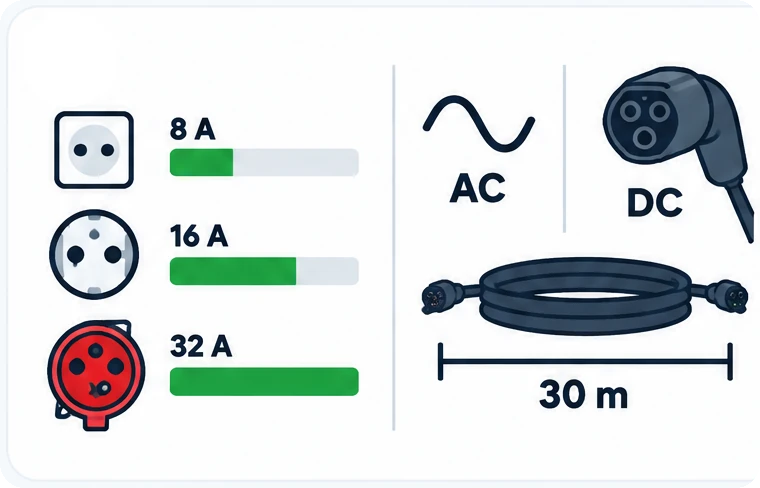
For every type of charging, start with the selector in P. Then open the flap and check the charging connector for foreign bodies.
Only use fast public chargers whose cable is no longer than 30 metres. Before you start, check that the station and its cable are compatible with the car.
If the green lamp does not flash, charging has not started. Restart the procedure and make sure every connection is properly made.
The nozzle locking lamp is fixed red when the nozzle is seated and locked. It flashes red when the nozzle is in the wrong position or cannot lock.
Scroll the table sideways.
| Charging indicator lamp | Meaning |
|---|---|
| Fixed white | Welcome lighting when you open the flap and disconnect the cable |
| Fixed blue | Deferred charging is set |
| Flashing green | Charging |
| Fixed green | Charging complete |
| Fixed red | Malfunction |
After charging finishes, the green lamp goes off after about 2 minutes as the car goes into standby. It comes back on when you open a door or unlock with Keyless Entry and Start, to show the battery is full.
Scroll the table sideways.
| Lamps | Meaning |
|---|---|
| None lit | Not connected to the power supply, or no power available from the socket |
| POWER green only | Connected to the socket, or to the socket and the car, but not charging |
| POWER green, CHARGE flashing green | Charging, or temperature pre-conditioning is running |
| POWER green, CHARGE fixed green | Waiting to charge, or charging is complete |
| FAULT red only | Control unit malfunction, no charging allowed |
| All three together | Self-test, or the control unit is in diagnostic mode |
All the lamps come on briefly when you plug into a domestic socket. If none come on, check the circuit-breaker for that socket. If it has tripped, ask a professional to check that the electrical system is compatible and to carry out any repairs. If it has not tripped, stop using the cable and contact a PEUGEOT dealer or a qualified workshop.
A red FAULT lamp means charging is not allowed or must stop straight away. Check the connections and the electrical system first. If the lamp stays on, contact a PEUGEOT dealer or a qualified workshop.
If an error lamp comes back after a reset, have the control unit checked by a PEUGEOT dealer before you charge again.
Deferred charging works only in modes 2 and 3, not at a fast public charger.
Unlocking the car stops a domestic or accelerated charge. If you don't then open a door, open the boot or touch the nozzle, the car locks again after 30 seconds and charging carries on. Never stop charging by pulling the plug out of the wall.
The nozzle lock is linked to the locking of the loading area. If selective door unlocking is active, press the unlock button twice to release the nozzle.
When the nozzle is removed, the instrument panel says charging is complete, even if you unplugged before the battery was full.
Never take apart or modify an accelerated charging unit, because of the risk of electrocution or fire. Use it as its maker's instructions describe.
Don't work under the bonnet. Some areas stay very hot for up to an hour after charging ends, and the fan can start at any moment, with a risk of cuts or strangulation. When you have finished, check that the charging flap is closed. Don't leave the cable plugged into the domestic socket, because of the risk of short-circuit or electrocution if it touches water or ends up in it.
PEUGEOT's electric vehicles meet the ICNIRP 1998 limits for electromagnetic fields. Ask your doctor or the maker of your implant what precautions to take. If in doubt, don't stay in or near the car, the cable or the charging unit during domestic or accelerated charging, even briefly. For superfast charging, keep away from fast charging points altogether and ask someone else to charge the car.
The traction battery powers the motor as well as the heating and cooling in the cabin. Range varies with your driving, the route, how much you use the heating and cooling, and the age of the battery's components. Battery life depends on the climate, the distance driven and how often the car is fast-charged. Follow PEUGEOT's recommendations and the battery is designed to last the life of the vehicle.
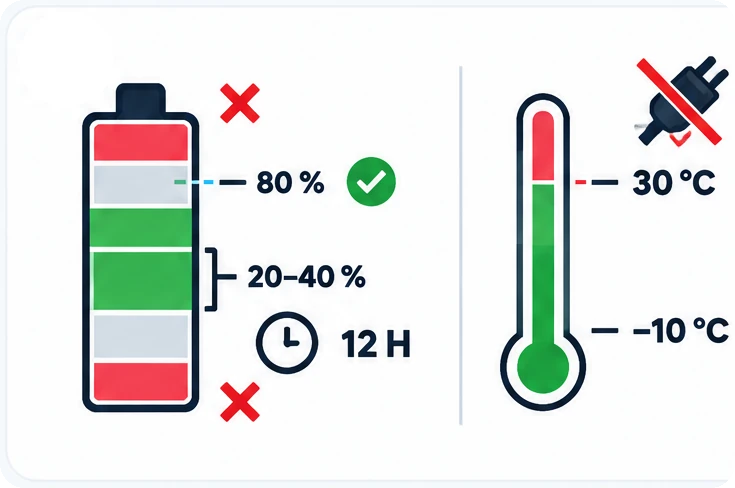
When it is below freezing outside, avoid parking outdoors for several hours with less than 20% charge. At a fast public charger, charging takes longer below 0°C. Below -20°C it is still possible but slower again, because the battery has to be warmed first. Driving with too little charge can leave you stranded and lead to an accident, so always keep enough in reserve.
After more than 4 weeks without use, self-discharge can stop a car with a low charge from restarting, especially in sub-zero temperatures. Before a long lay-up:
The drive system runs at about 400 V. You can spot it by its orange cables, and its parts carry a high voltage warning symbol. It can cause burns or a fatal electric shock, and damage to it is not always visible. Never touch these parts, damaged or not, and keep jewellery and other metal objects away from them. Never cut, modify or disconnect the orange cables, never open the traction battery cover, and never use cutting tools or heat sources near them. Only qualified people in approved workshops may work on the system. The power train can also be hot after driving and after you switch off.
If the coolant tank level is low, have it topped up only by a qualified and trained workshop, so they can confirm the leak is not coming from the traction battery.
An accident or a hit to the underbody can seriously damage the electrical circuit or the traction battery. Stop as soon as it is safe, switch off the ignition and contact a PEUGEOT dealer or a qualified workshop. Toxic, flammable gases or fluids may leak straight away or later. Move away from the car, don't breathe the fumes, and tell the emergency services that it has a traction battery. Never touch liquid leaking from the battery. If it gets on your skin, wash it off with plenty of water and see a doctor as soon as possible.
If the charging flap takes even a light knock, stop using it. Never dismantle or modify the charging connector. Contact a PEUGEOT dealer or a qualified workshop instead. If the traction battery ever has to be replaced, ask a PEUGEOT dealer how to dispose of it. PEUGEOT works with qualified operators to give old batteries a second life or recycle them.
Yes, with the mode 2 domestic cable, at up to 8 A from a standard socket. A Green'Up socket fitted by a professional installer raises this to 16 A. The socket must be correctly earthed and protected by a 30 mA residual current device.
No. The domestic cable must never be used with an extension cable, a multi-plug socket, a conversion adaptor or a damaged socket. Plug it directly into a suitable wall socket, and don't let the socket carry the weight of the control unit.
First check that the drive selector is in P, because the car will not charge in any other position. Then restart the procedure and make sure every connection is firmly made. If the cable's control unit lamps don't light at all, check the circuit-breaker. If the FAULT lamp stays red, contact a PEUGEOT dealer or a qualified workshop.
No. Try to stay below 80% most of the time rather than charging fully every day. Avoid leaving the car sitting for long periods with a very low or very high charge, because 20 to 40% is the best level for storage.
If charging won't start, check that the selector is in P and that every connection is properly made. Check the colour of the flap lamp before you walk away and you'll know whether the car is actually charging.
Don't forget to follow us on Instagram for more Peugeot guides!
This is an independent guide, not an official Peugeot publication. If in doubt, contact a PEUGEOT dealer or a qualified workshop before carrying out any work.
Related guides: Peugeot Rifter model guides; Peugeot Rifter fuse box; Peugeot Rifter 12 V battery and jump-starting; Peugeot Rifter fuel and refuelling.
Cover adapted from a photograph by Charles from Port Chester, New York — Wikimedia Commons, CC BY 2.0 (AI edited).
Hello and welcome. In this post, we'll look at what to do when you get a flat tyre on your Peugeot Rifter. We cover where the tools are kept, how to use the temporary puncture repair kit and how to fi
Hello and welcome. In this post, we'll look at how to change the bulbs on the Peugeot Rifter I (2018-2025). It covers the safety precautions, the different types of bulb fitted, and the steps for the
Hello and welcome. In this post, we'll look at where the 12 V battery is, and how to jump start or charge it on the Peugeot Rifter I (2018-2025). It covers where to find the battery, how to start the