Peugeot Partner III 12V Battery and Jump Starting
Peugeot Partner III van (2018-2021) 12 V battery: where to find it, jump starting, charging with a charger, and disconnecting and reconnecting it.
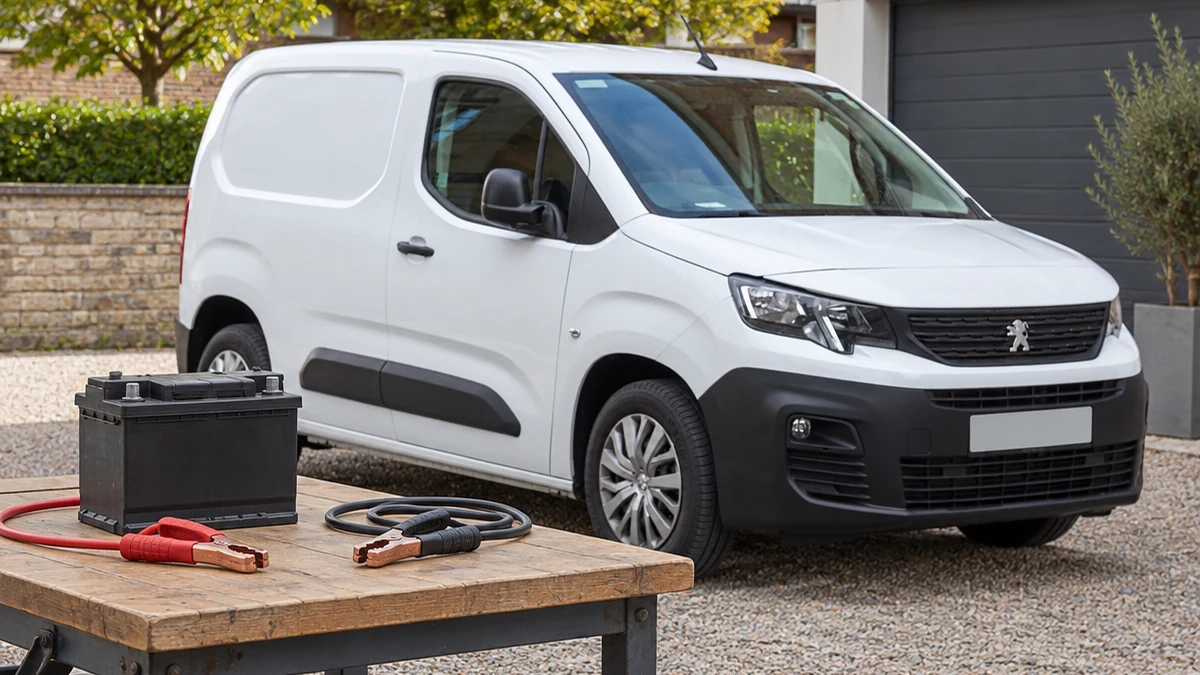
Hello and welcome. In this post we look at the 12 V battery on the Peugeot Partner III van (2018-2021). We cover where it is, jump starting from another battery, charging with a charger, and disconnecting and reconnecting it.
Quick Reference
Scroll the table sideways.
| Section | In short |
|---|---|
| Lead-acid starter batteries | Safety and disposal rules for the lead-acid battery |
| Access to the battery | Battery is under the bonnet, use the earth point |
| Starting using another battery | Jump start with leads or a booster, step by step |
| Charging the battery using a battery charger | When and how to charge with a 12 V charger |
| Disconnecting the battery | Disconnect, reconnect and reset systems afterwards |
Lead-acid starter batteries
This section explains how to start the engine using another battery and how to charge a discharged battery. Before you start, read the safety and disposal rules below.
- Harmful substances: batteries contain harmful substances such as sulphuric acid and lead.
- Disposal: they must be disposed of in line with regulations and must never be thrown away with household waste. Take used remote control batteries and vehicle batteries to a special collection point.
- Protection: protect your eyes and face before handling the battery.
- Ventilation: always work on the battery in a well ventilated area, away from naked flames and sources of sparks, to avoid the risk of explosion or fire.
- Afterwards: wash your hands when you have finished.
Versions with Stop & Start have a 12 V lead-acid battery with special technology and specifications. Only a PEUGEOT dealer or a qualified workshop should replace it.
Access to the battery
The battery is under the bonnet.
- Open the bonnet: pull the interior release lever, then release the exterior safety catch.
- Secure the bonnet: fit the bonnet stay so the bonnet stays open.
You cannot reach the battery's (-) terminal. Instead, there is a remote earth point near the battery. For more on the bonnet and the engine, see the corresponding sections of the handbook.
Starting using another battery
If your van's battery is flat, you can start the engine with a backup battery (a separate one or one in another vehicle) and jump leads, or with a battery booster.
Before you connect anything, follow these safety rules:
- Never start the engine by connecting a battery charger.
- Never use a battery booster of 24 V or higher.
- Check that the backup battery has a nominal voltage of 12 V and a capacity at least equal to that of the flat battery.
- Make sure the two vehicles are not touching each other.
- Switch off all electrical equipment on both vehicles, such as the audio system, wipers and lighting.
- Keep the jump leads away from moving engine parts, such as the fan and the belt.
- Do not disconnect the (+) terminal while the engine is running.
- Red cable: connect the red cable to the (+) terminal of flat battery A (at the metal elbow), then to the (+) terminal of backup battery B or the booster.
- Green or black cable, first end: connect one end to the (-) terminal of backup battery B or the booster, or to an earth point on the assisting vehicle.
- Green or black cable, second end: connect the other end to earth point C on your van.
- Assisting vehicle: start its engine and leave it running for a few minutes.
- Your van: operate the starter and let the engine run. If it does not start straight away, switch off the ignition and wait a few moments before trying again.
- Idle: wait for the engine to return to idle.
- Disconnect: remove the jump leads in reverse order.
- Recharge: let the engine run for at least 30 minutes, either driving or stationary, so the battery reaches an adequate state of charge.
Some functions, including Stop & Start, are not available until the battery is sufficiently charged.
Charging the battery using a battery charger
Keeping the battery well charged is essential for a long battery life. You may need to charge it if you mainly use your van for short journeys, or if the van will be off the road for several weeks. Contact a PEUGEOT dealer or a qualified workshop for this.
If you charge the battery yourself:
- Use only a charger compatible with lead-acid batteries with a nominal voltage of 12 V.
- Follow the charger manufacturer's instructions.
- Never reverse the polarities.
- You do not need to disconnect the battery.
- Ignition: switch off the ignition.
- Electrical equipment: switch off everything electrical, such as the audio system, lighting and wipers.
- Charger off: switch off charger B before connecting its cables to the battery, to avoid dangerous sparks.
- Check the cables: make sure the charger cables are in good condition.
- Terminal cover: lift the plastic cover on the (+) terminal, if your van has one.
- Red cable: connect the positive (+) red cable to the (+) terminal of battery A.
- Black cable: connect the negative (-) black cable to earth point C on the van.
- Finish: when charging is complete, switch off charger B before disconnecting the cables from battery A.
If the battery carries the Stop & Start label shown in the handbook, use only a 12 V charger, otherwise you can cause irreversible damage to the electrical components linked to the Stop & Start system. Never try to charge a frozen battery, as there is a risk of explosion. If the battery has frozen, have it checked by a PEUGEOT dealer or a qualified workshop, who will make sure the internal parts are not damaged and the case has not cracked, as a cracked case means a risk of toxic and corrosive acid leaking.
Disconnecting the battery
If your van will be unused for an extended period, disconnect the battery so it keeps enough charge to start the engine.
Before you disconnect the battery:
- Close up: close all doors, windows, the tailgate and the sunroof.
- Electrical equipment: switch off everything electrical, such as the audio system, wipers and headlamps.
- Ignition: switch off the ignition and wait for four minutes.
You only need to disconnect the (+) terminal at the battery. It has a quick-release terminal clamp.
Disconnecting the (+) terminal:
- Release: raise lever A fully to release clamp B.
- Remove: lift clamp B off the terminal.
Reconnecting the (+) terminal:
- Lever up: raise lever A fully.
- Fit the clamp: place the open clamp B on the (+) terminal.
- Push down: push clamp B fully down.
- Lock: lower lever A to lock clamp B.
Do not force the lever. If the clamp is not positioned correctly, it will not lock, so start the procedure again.
After reconnecting: turn on the ignition and wait 1 minute before starting the engine, so the electronic systems can initialise. If minor problems persist after this, contact a PEUGEOT dealer or a qualified workshop.
You will need to reset some systems yourself, using the corresponding sections of the handbook:
- the remote control key or the electronic key (depending on version)
- the electric windows
- the electric doors
- the date and time
- the radio preset stations
Stop & Start may not work during the first trip after the engine is started. It will only be available again after the van has been left standing continuously for a period that depends on the outside temperature and the battery's state of charge (up to about 8 hours).
Frequently Asked Questions
Where is the battery on a Peugeot Partner van?
The battery is under the bonnet. The (-) terminal cannot be reached, so you use the remote earth point near the battery instead.
How long should I run my Partner after a jump start?
Let the engine run for at least 30 minutes, either driving or stationary, so the battery reaches an adequate state of charge.
Can I use a 24 V booster to jump start my Peugeot Partner?
No. Never use a battery booster of 24 V or higher, and make sure any backup battery has a nominal voltage of 12 V.
Why is Stop & Start not working after reconnecting the battery?
Stop & Start may not work on the first trip after reconnecting. It comes back after the van has been left standing continuously for a period that depends on the outside temperature and battery charge (up to about 8 hours).
A flat battery is easy to deal with when you follow the right steps in the right order. Keep this guide handy, protect yourself before handling the battery, and if you are unsure at any point, contact a PEUGEOT dealer or a qualified workshop.
More Peugeot Partner Guides
If a battery charge lamp or another warning comes on, see our guides to Peugeot Partner red warning lights, Peugeot Partner orange warning lights and Peugeot Partner green and blue indicator lamps.
Don't forget to follow us on Instagram for more Peugeot guides!
This is an independent guide, not an official Peugeot publication. Check your vehicle’s own manual before carrying out any work.
Related guides: Peugeot Partner model guides.
Cover adapted from a photograph by Vauxford — Wikimedia Commons, CC BY-SA 4.0 (AI edited).
