Orange warning lamps on your dashboard point to a fault or a situation that needs your attention. They are not usually as urgent as red lamps, but you should not ignore them. Some need a quick check from you, and others mean the van should be looked at by a PEUGEOT dealer or a qualified workshop.
This guide covers the Peugeot Partner II van produced from 1 March 2017 onwards and is based on the handbook for that period. Some lamps only appear on certain versions or depending on the equipment fitted, so you may not see every one of them on your van.
Quick Reference
Scroll the table sideways.
Warning
Urgency
In short
Service
Get it checked soon
Minor or major faults detected
EOBD emissions control system
Get it checked soon
Emissions fault, catalytic converter at risk
ABS
Get it checked soon
Anti-lock braking fault, normal braking remains
ESC
Get it checked soon
Flashing: system working; steady: fault
Under-inflation
Action needed from you
Low tyre pressure or monitoring fault
Front / lateral airbag
Get it checked soon
Airbag fault detected
Deactivation of the passenger’s front airbag
Information / status
Passenger front airbag switched off
Particle filter
Get it checked soon
Particle filter malfunction
AdBlue® (BlueHDi Diesel)
Action needed from you
AdBlue low or empty, top up
SCR emissions control system (BlueHDi Diesel)
Get it checked soon
SCR emissions fault, starting may be prevented
Rear foglamps
Information / status
Rear foglamps switched on
Service
This is the Service warning lamp. If it comes on for a short time and then goes out, it points to minor faults or warnings. If it stays on, major faults are present.
What to do:
If the lamp comes on temporarily:
Check the alert log on the display or screen. You will find more about this in the Trip computer section of the handbook.
Contact a PEUGEOT dealer or a qualified workshop.
If the lamp stays on:
Check the alert log on the display or screen to see which faults are present.
Contact a PEUGEOT dealer or a qualified workshop.
EOBD emissions control system
This is the engine self-diagnosis lamp for the EOBD system. When it flashes or stays on, there is a fault with the emissions control system. EOBD (European On Board Diagnosis) is a diagnostics system that monitors emissions limits for carbon monoxide (CO), unburnt hydrocarbons (HC), nitrogen oxides (NOx) and particles, using oxygen sensors fitted after the catalytic converters.
What to do:
Be aware that the catalytic converter could be damaged.
Have the system checked as soon as possible by a PEUGEOT dealer or a qualified workshop.
ABS
This lamp shows the ABS symbol. When it stays on, the anti-lock braking system has a fault. Your van still has normal braking, but without the anti-lock function.
What to do:
Drive carefully and keep your speed down.
Contact a PEUGEOT dealer or a qualified workshop without delay.
ESC
This lamp shows the ESC symbol. When it flashes, the ASR or ESC system is working to give you better grip and help keep the van stable and on course. When it stays on, there is a fault with the ASR or ESC system, which can be caused by something like under-inflated tyres.
What to do:
If the lamp is flashing:
No action is needed. The system is helping to keep the van stable, so drive smoothly.
If the lamp stays on:
Check your tyre pressures.
Have the system checked by a PEUGEOT dealer or a qualified workshop, as parts such as a wheel speed sensor or the hydraulic unit may need looking at.
Under-inflation
This lamp shows the tyre under-inflation symbol. When it stays on by itself, one or more wheels do not have enough pressure. If it flashes and then stays on with the Service warning lamp, and a message appears depending on your equipment, the tyre pressure monitoring system has a fault or no sensor has been detected on one of the wheels.
What to do:
If the under-inflation lamp stays on by itself:
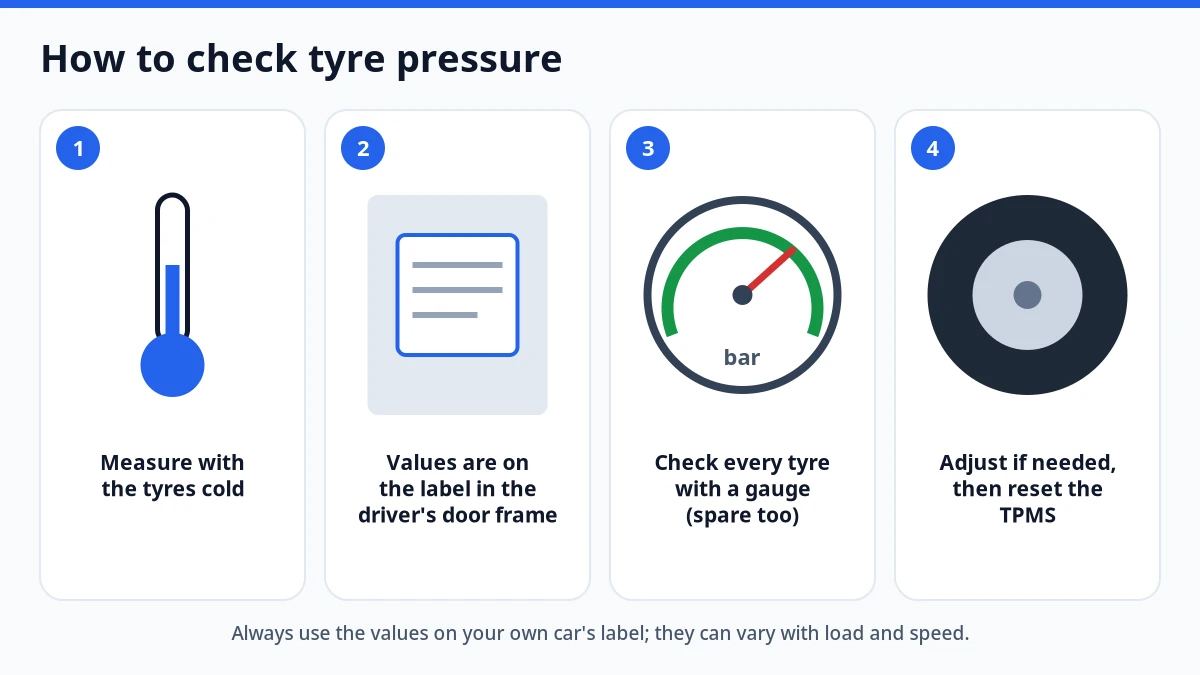
Check your tyre pressures as soon as possible.
Ideally, do this check when the tyres are cold.
If the lamp flashes and then stays on with the Service warning lamp:
Be aware that the system can no longer reliably warn you about low tyre pressure.
Have the system checked by a PEUGEOT dealer or a qualified workshop.
Front / lateral airbag
This lamp shows the airbag symbol. If it flashes or stays on, there is a fault with one of the airbags.
What to do:
Have the airbags checked by a PEUGEOT dealer or a qualified workshop.
See the Airbags section of the handbook for more information.
Deactivation of the passenger’s front airbag
This lamp shows the passenger front airbag deactivation symbol. When it stays on, the passenger's front airbag has been deliberately switched off, which is what you need when a rear-facing child seat is fitted.
What to do:
See the Airbags section of the handbook for more information on switching the passenger airbag off and on.
Particle filter
This lamp shows the particle filter symbol. When it stays on, there is a problem with the particle filter, for example with the level of diesel additive or a risk of the filter becoming blocked.
What to do:
Have the particle filter checked by a PEUGEOT dealer or a qualified workshop.
See the Checking levels section of the handbook for more information.
AdBlue® (BlueHDi Diesel)
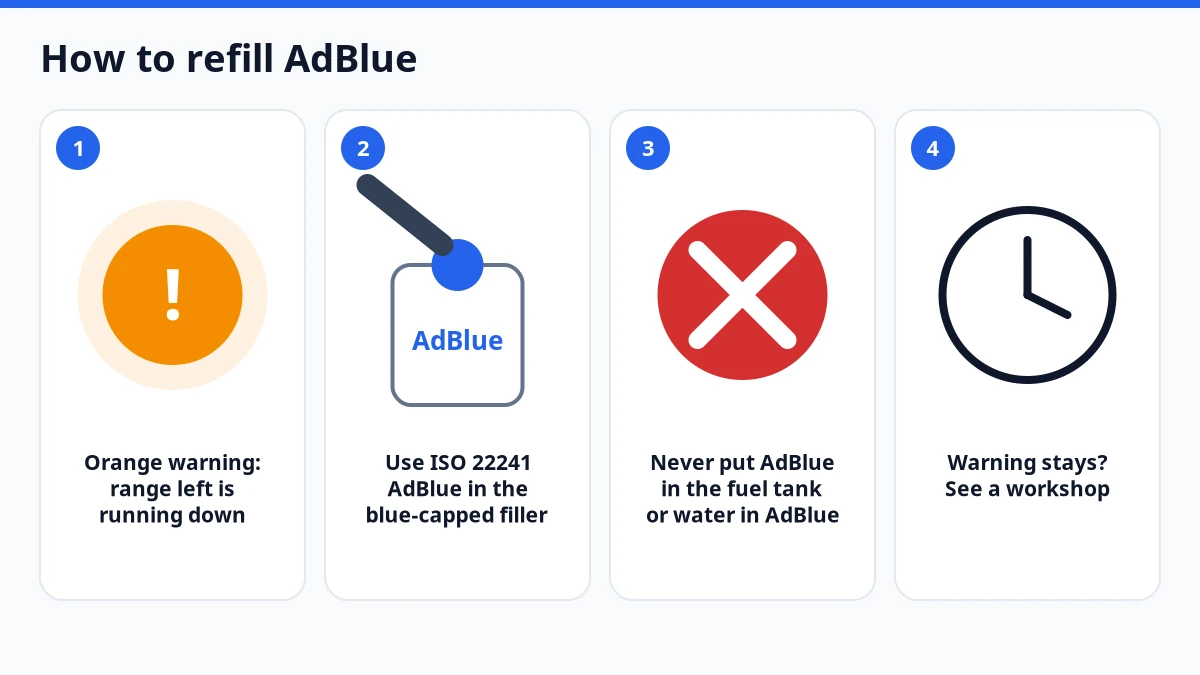
This lamp shows the AdBlue® symbol and is fitted to BlueHDi Diesel models. How it lights up tells you how much driving range you have left before you need more AdBlue®, and each warning comes with a beep and a message.
What to do:
If the AdBlue® lamp stays on by itself when you switch on the ignition, the remaining range is between 375 miles (600 km) and 1500 miles (2,400 km):
Top up the AdBlue® as soon as you can.
If the AdBlue® lamp flashes with the Service warning lamp and the message shows your remaining range, you have between 0 and 370 miles (0 and 600 km) left:
You must top up the AdBlue® to avoid a breakdown.
If the AdBlue® lamp flashes with the Service warning lamp and the message says starting is prevented, the AdBlue® tank is empty and the starting inhibition system required by law stops the engine from starting:
Top up the AdBlue® so that you can restart the engine.
Add at least 5 litres of AdBlue® to the AdBlue® tank.
SCR emissions control system (BlueHDi Diesel)
On BlueHDi Diesel models, a fault with the SCR emissions control system is shown by the AdBlue® lamp together with the Service and engine self-diagnosis warning lamps, along with a beep and a message. Whether the lamps stay on or flash tells you how serious the fault is.
What to do:
If the lamps stay on when you switch on the ignition, a temporary fault has been detected:
No action is needed. The alert goes away once exhaust emissions return to normal.
If the lamps flash when you switch on the ignition and the message shows your remaining range, the fault has been confirmed after 31 miles (50 km) of driving with the alert. You can drive for up to 685 miles (1,100 km) before the engine starting inhibition system is triggered:
Contact a PEUGEOT dealer or a qualified workshop without delay to avoid a breakdown.
If the lamps flash when you switch on the ignition and the message says starting is prevented, you have gone past the permitted driving limit and the engine will not start:
Call a PEUGEOT dealer or a qualified workshop, as they will need to get the engine running again.
Rear foglamps
This lamp shows the rear foglamp symbol. When it stays on, you have switched the rear foglamps on yourself.
What to do:
Remember that the rear foglamps only work when the sidelamps or dipped beam headlamps are on.
Switch the rear foglamps off when visibility is normal, as their red light is dazzling and you could be cautioned for using them.
If You're Not Sure
If an orange lamp comes on and you are not sure what it means, check the message on the display or screen and the alert log, then compare it with the descriptions above. If you still have doubts, or the van does not feel right, stop somewhere safe and contact a PEUGEOT dealer or a qualified workshop for advice.
Orange lamps are your Partner's way of telling you something needs attention before it becomes a bigger problem. Deal with them promptly, keep an eye on your tyre pressures and AdBlue® level, and your van should keep working as hard as you do.
A red warning lamp means something needs your attention straight away. It may be a serious fault that means you must stop, or something simple you need to sort out yourself, such as fastening a seat belt or...
Orange warning lamps are there to get your attention. They usually point to a fault, a system that needs checking or something you need to do soon, such as charging the battery or checking your tyres. They are less...
Green and blue lamps on your instrument panel mostly tell you that a system is switched on or show its current status. A few of them, especially those linked to the traction battery and the electric system, can...