Peugeot 308 Review 2026: A Practical Buyer's Guide
Is the Peugeot 308 worth buying? Our buyer's guide covers the PureTech, hybrid and diesel engines, boot space, rear room, safety, kit and known issues.
Please note: this guide is built on 2024 model-year information for the third-generation 308 (launched in 2021/22). Engines, trims and equipment have been updated since, so treat the figures below as a starting point rather than today's price-list spec.
The family hatchback class is crowded with sensible choices: the Volkswagen Golf, Ford Focus, Vauxhall Astra (which shares much of its engineering with the Peugeot) and Hyundai i30. The 308 is the one that tries hardest to feel like something more expensive. Below is a buyer-focused look at where it succeeds, where it falls short, and which version makes the most sense.
The Short Version
- Best for: drivers who want a premium-feeling cabin and sharp styling without stepping up to a German badge.
- Think twice if: you dislike small steering wheels, or you want the roomiest back seat in the class.
- Pick of the range (2024): the plug-in hybrid, if you can charge at home; otherwise the 130 hp 1.2 PureTech with the EAT8 automatic.
Scroll the table sideways.
| At a glance (2024 data) | Peugeot 308 hatchback |
|---|---|
| Body styles | 5-door hatchback, SW estate |
| Engines | 1.2 PureTech petrol, 1.5 BlueHDi diesel, 1.6 plug-in hybrid |
| 0-62 mph (1.2 PureTech 130) | 9.7 seconds |
| Boot (seats up / folded) | 412 / 1,323 litres |
| Euro NCAP | 4 stars (2022) |
| Warranty | 3 years / 60,000 miles |
How It Looks
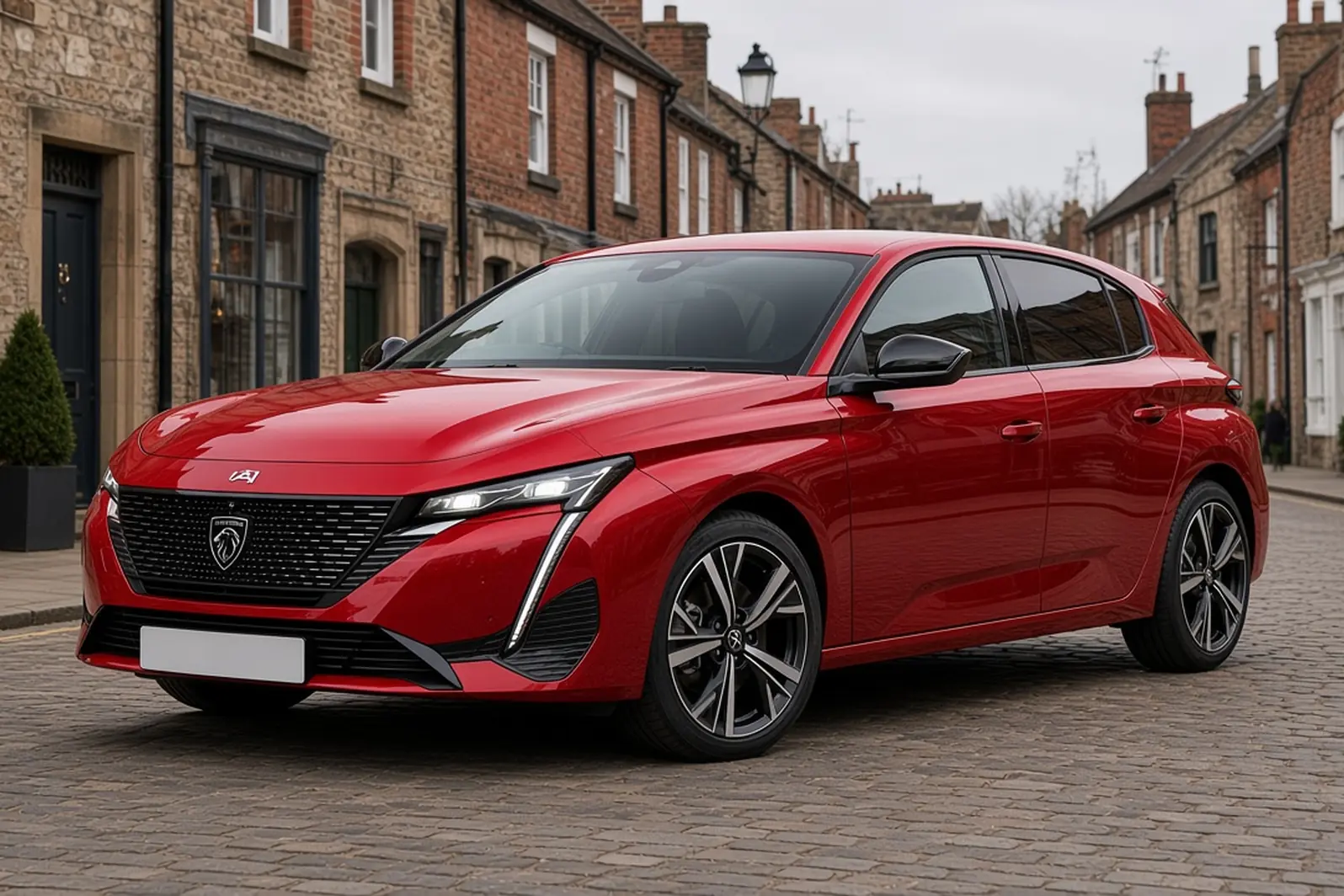
This generation was a clean-sheet redesign rather than a facelift, and it was the first Peugeot to wear the brand's new shield-style lion badge. The front end is dominated by a wide grille and fang-shaped LED daytime running lights that reach down into the bumper, while a long bonnet with sculpted creases and a sloping roofline give it a lower, more athletic profile than most rivals. At the back, the tailgate is shaped rather than flat and the "claw" LED lights stretch across the width of the car.
Bright colours suit it, and Elixir Red in particular shows off the surfacing. Next to a Golf it looks more adventurous; whether that's a plus depends on your taste.
Engines and Which One to Choose
Peugeot offered three distinct types of powertrain, though availability varied by market:
- 1.2 PureTech petrol (130 hp): the three-cylinder turbo used across the Stellantis range for over a decade. In 130 hp form it does 0-62 mph in 9.7 seconds. It's perfectly adequate rather than quick, and pairs well with the eight-speed EAT8 automatic.
- 1.5 BlueHDi diesel: the torquey choice for high-mileage motorway drivers.
- 1.6 plug-in hybrid (180 hp): a 1.6 petrol engine teamed with an electric motor. It can run on electricity alone for up to 37 km (about 23 miles), which covers a lot of school runs and commutes, and its extra power makes it noticeably brisker than the 130 hp petrol.
If you have off-street parking and a home charger, the hybrid is the version that best suits the 308's upmarket character. If not, the petrol automatic is the simpler, cheaper buy. For a deeper look at the drivetrains, see our Peugeot 308 engine and performance review and the dedicated 308 hybrid review.
Official and real-world fuel economy
On the WLTP cycle the 1.2 PureTech 130 automatic was rated at 7.2-7.4 l/100 km in town, 5.0-5.1 l/100 km out of town and 5.8-5.9 l/100 km combined. In everyday driving, an owner taking it easy in town can expect roughly 6.5-7 l/100 km, a little more in heavy city traffic.
Inside the Cabin
The i-Cockpit layout is the 308's party piece: a small, flat-bottomed steering wheel, a high-set digital instrument display that you read over the top of the rim rather than through it, and a frameless 10-inch central touchscreen. Below the screen sits a strip of configurable touch shortcuts that Peugeot calls i-Toggles, which you can set up for the functions you use most.
Material quality is a genuine strength. Even lower trims get pleasant surfaces where your hands fall, and higher trims add leather and Alcantara. Dual-zone climate control was available, as were massaging front seats, and the options list stretched to night vision and adaptive cruise control, features you'd usually expect on a larger, pricier car.
A word on the steering wheel: most drivers adapt within a day or two and come to enjoy the quick, go-kart-like feel. A minority, particularly those who like to sit low with the wheel set high, find the rim hides part of the instrument display. Make sure you try your preferred seating position on a test drive.
Storage
The centre console is split in two. The driver's side carries the main driving controls in an arch that runs down to the wireless charging pad, while the passenger side is given over to storage. Peugeot quotes up to 34 litres of cabin storage in total, including two cupholders and a large bin under the armrest.
Rear Seats and Boot
The back seat isn't the biggest in the class, but two average-sized adults sit comfortably, and knee and head room are better than in many rivals. It's a clear step up from the 208: at 180 cm (5 ft 11 in) I found the rear seats perfectly comfortable.
The boot holds 412 litres with the seats up and 1,323 litres with them folded. That's more than the 381 litres you get in a Golf, and plenty for a family holiday. The plug-in hybrid gives up some of that space to its battery, so check the figure if you're buying the PHEV. The rear seatback splits one-third/two-thirds.
On the Road
The 308 strikes a good balance between comfort and agility. The steering is precise and nicely weighted, the suspension absorbs bumps well while keeping body roll in check, and the chassis feels responsive on a twisty road. At motorway speeds wind and road noise are well suppressed, so it's a relaxing long-distance car.
The 130 hp petrol won't win many traffic-light drag races, but it has enough low-down torque for daily driving. One quirk to be aware of with the PureTech automatic is a slight hesitation when pulling away slowly or creeping in stop-start traffic, as the turbo and gearbox take a moment to respond. You get used to it quickly. The hybrid, with 180 hp and silent electric running, feels quicker and smoother around town.
Reliability and Known Issues
The current 308 is still fairly young, so there's limited long-term data. Earlier generations, however, had a few well-documented weak spots that are worth knowing about if you're shopping for a used example:
- Oil leaks on the older 1.6 turbo petrol, often from the crankcase breather pipe. Keep an eye on the oil level.
- Premature clutch wear on some manual cars, sometimes before 100,000 miles. Regular clutch fluid changes help.
- Electrical gremlins in older cars: faulty switches, sensors and lighting components triggering warning lights.
- Rear suspension links on the 2014-2018 saloon, which could fail early and are fixed with updated parts.
If a warning light does appear, our guides to Peugeot 308 red warnings and orange warnings explain what each symbol means and how urgent it is.
Servicing
Peugeot dealers offer pre-paid service plans, and the three-year plans in particular can bring running costs down noticeably. Check with your local dealer for current pricing in your country.
Safety
Euro NCAP awarded the 308 four stars when it was tested in 2022. The full breakdown is on the Euro NCAP website.
Every 308 came with the core electronic safety systems: ABS with electronic brake-force distribution, emergency brake assist, traction control and ESP stability control, hill start assist, tyre pressure monitoring, a post-collision safety brake that stops the car rolling into a second impact, and trailer stability assist for towing. Front and curtain airbags were fitted, with a switch to disable the front passenger airbag for a rear-facing child seat, plus ISOFIX mounts on the outer rear seats and seatbelt reminders front and rear.
Driver assistance depended on trim. Highlights included:
- Automatic emergency braking using both a camera and radar
- Adaptive cruise control with Stop & Go
- Active lane keeping and lane positioning assist
- Blind-spot monitoring and rear cross-traffic alert
- Extended traffic sign recognition with speed limit suggestions
- Driver attention warning
- Automatic high beam
Equipment Highlights (2024 Range)
Rather than reprint a full price list, here are the features that made the biggest difference, grouped by area. Exact availability varied by trim and market.
Technology: a 10-inch digital instrument panel (3D on higher trims), 3D navigation, wireless Apple CarPlay and Android Auto, wireless phone charging, keyless start, an electric parking brake and eCall automatic emergency calling. Higher trims gained four USB-C sockets in place of one.
Parking: front and rear sensors, a 180-degree reversing camera with three view modes, and the optional VisioPark pack with side sensors and a 360-degree four-camera view. Door mirrors could dip automatically in reverse to help you see the kerb.
Comfort: fully automatic climate control with rear air vents, the AQS air quality system with Clean Cabin filtration, heated front seats, a lumbar-adjustable driver's seat, a heated steering wheel on GT models, ambient lighting, an auto-dimming frameless rear-view mirror, automatic wipers with Peugeot's Magic Wash and an opening glass sunroof.
Exterior: LED headlights as standard, Matrix LED headlights on top trims, 3D LED rear lights on the GT, tinted rear windows and alloy wheels from 16 to 18 inches. A space-saver spare wheel was fitted on many versions.
The Verdict
The Peugeot 308 is one of the most stylish and best-finished cars in its class, and it backs that up with a comfortable, composed drive and a usefully large boot. The small-wheel i-Cockpit won't suit everyone, and the 130 hp petrol is merely adequate, but the overall package feels more premium than its price suggests. If you're cross-shopping a Golf or Focus, book a test drive in the 308 too: it deserves a place on the shortlist.
For a closer look at the dashboard, see what the Peugeot 308 warning lights mean.
Related guides
The third-generation 308 moved almost everything onto screens: a digital instrument panel and a 10-inch touchscreen with configurable "i-Toggle" shortcuts. Once you know where things are, it's quick to use. This guide...
The 308's digital instrument panel shows a lot more than speed and revs. Alongside the warning lamps there are status readouts for servicing, oil level, engine temperature, AdBlue (on diesels) and, on plug-in hybrids...
"Hybrid" covers a lot of ground in the current Peugeot 308 range. On a hatchback or SW badged Hybrid 136, it means a self-charging petrol car with a small electric boost. On a Plug-in Hybrid 180, 195 or 225, it means a...