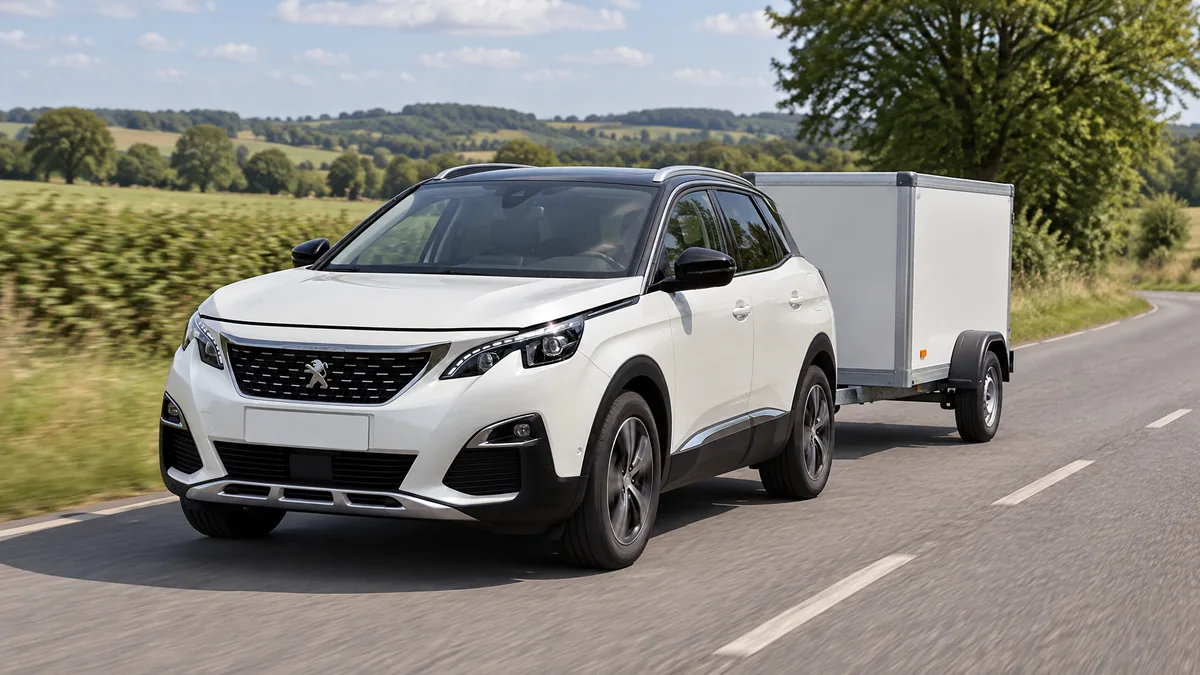
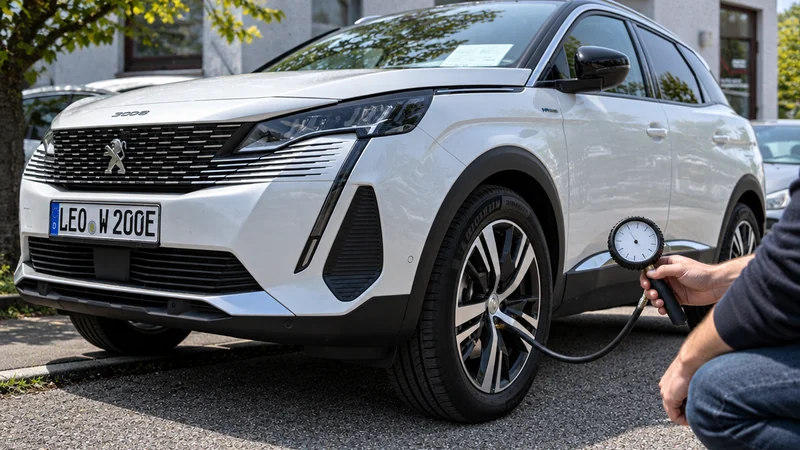
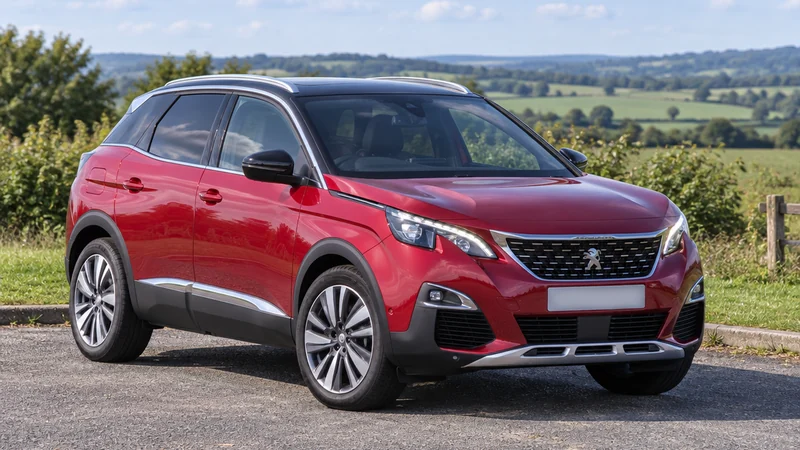
Hello and welcome. In this post, we'll look at the detachable towball, towing the car, and towed loads on the Peugeot 3008 II (2016-present). Getting these right keeps your car, your trailer and other road users safe. It covers the Peugeot 3008 II (2016-present), including vehicles produced from 03/10/2023. Some items, such as the motorised tailgate, the towing device and certain engines, depend on your car's version or equipment, so not everything here will apply to your 3008. Some items, such as the motorised tailgate, the towing device and certain engines, depend on your car's version or equipment, so not everything here will apply to your 3008.
How much can a Peugeot 3008 tow?
It depends on the engine. For example, the braked trailer value is 1,400 kg for the PureTech 130 manual and 1,250 kg for the rechargeable hybrid versions. Always check the figure on your registration document and the manufacturer's label.
Quick Reference
Scroll the table sideways.
Section
In short
Towing device
Load distribution, altitude, fitting and bicycle carrier rules
Towing device with quickly detachable towball
Parts, safety checks, fitting, removing and cleaning the towball
Towing the vehicle
Rules and steps for being towed or towing
Engine technical data and towed loads
Where to find weights, altitude and heat limits
Engines and towed loads - Petrol
Towed loads for PureTech and THP petrol engines
Engines and towed loads, BlueHDi Diesel
Towed loads for the BlueHDi 130 EAT8
Engines and towed loads - Hybrid
Towed loads and specs for the HYBRID 136
Engines and towed loads - Rechargeable hybrid
Towed loads and specs for HYBRID and HYBRID4 versions
Towing device
These are general rules for towing a trailer or carrying accessories on the towball of your 3008.
Load distribution: place the heaviest items in the trailer as close as possible to the axle, so that the nose weight approaches the maximum permitted without exceeding it.
Altitude: air density decreases with altitude, which reduces engine performance. Reduce the maximum towable load by 10% per 1,000 metres of altitude.
Genuine parts: use genuine towing devices and wiring harnesses approved by PEUGEOT. recommends having them fitted by a PEUGEOT dealer or a qualified workshop. If they are fitted elsewhere, they must still be fitted in line with the vehicle manufacturer's instructions.
Hands-Free Tailgate Access: if your car has a motorised tailgate with this function and the towing device was fitted outside the PEUGEOT dealer network, you must have the detection system recalibrated by a PEUGEOT dealer or a qualified workshop. Otherwise the Hands-Free Tailgate Access function could malfunction.
Driving aids: certain driving or manoeuvring aid functions are deactivated automatically while an approved towing system is in use.
Safety: always comply with the maximum authorised towable weight shown on your registration certificate, on the manufacturer's label and in the Technical data section of. If you fit accessories to the towing device, such as a bicycle carrier or a tow box, comply with the maximum authorised nose weight and do not carry more than 4 conventional bicycles or 2 electric bicycles. Load the heaviest bicycles as close as possible to the car, and observe the legislation in force in the country where you are driving.
To avoid opening the motorised tailgate by accident while you operate the towing device, either deactivate the hands-free function in advance in the vehicle's configuration menu, or move the electronic key out of the recognition zone with the tailgate closed. For driving with a trailer and Trailer stability assist, see the corresponding section below.
Towing device with quickly detachable towball
This genuine towing device needs no tools to fit or remove the towball. The main parts are:
1: Carrier
2: Protective plug
3: Connection socket
4: Safety eye
5: Detachable towball
6: Locking/unlocking wheel
7: Security key lock
8: Label to note the key references
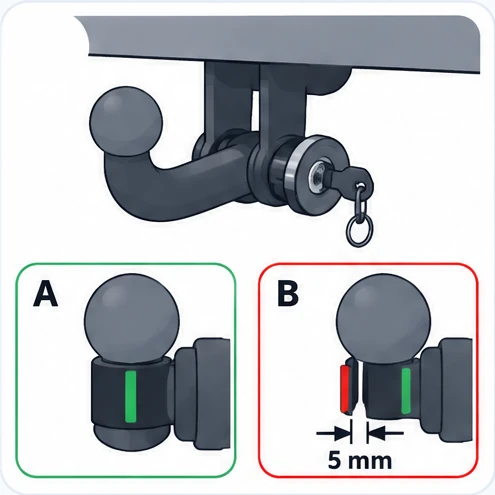
In the locked position (A), the green marks are opposite each other and the wheel is in contact with the towball, with no gap. In the unlocked position (B), the red mark is opposite the green mark and the wheel is no longer in contact with the towball, leaving a gap of around 5 mm. Stick the supplied key reference label somewhere clearly visible, close to the carrier or in the boot.
Warning: trailers with LED lamps are not compatible with the wiring harness of this device.
Before each use, check that the towball is fitted correctly:
The green mark on the wheel is in line with the green mark on the towball.
The wheel is in contact with the towball (position A).
The security key lock is closed and the key removed, so the wheel can no longer be turned.
The towball does not move in its carrier when you try to shake it by hand.
If the towball is not locked, the trailer can become detached, with a risk of an accident.
During use, never release the locking system with a trailer or load carrier on the towball. Never exceed the Gross Train Weight (GTW), and always comply with the maximum authorised load on the towing device, or the device may come away from the car. Before driving, check the headlamp height adjustment and make sure the trailer lamps work correctly.
After use, when you drive without a trailer or load carrier, remove the towball and fit the protective plug into the carrier so that the number plate and its lighting stay clearly visible.
Fitting the towball
Remove the plug: below the rear bumper, take the protective plug 2 out of the carrier 1.
Insert the towball: push the end of the towball 5 upwards into the carrier 1. It locks into position automatically.
Keep your hands clear: the wheel 6 turns a quarter turn anti-clockwise as it locks.
Check the lock: make sure the mechanism has locked correctly (position A).
Close the lock: turn the key to close the lock 7.
Remove the key: the key cannot be removed while the lock is open.
Fit the cap: clip the cap onto the lock.
Uncover the towball: remove the protective cover from the towball.
Hitch up: attach the trailer to the towball.
Safety cable: attach the trailer's cable to the safety eye 4 on the carrier.
Connect the plug: insert the trailer plug into the connection socket 3 on the carrier and turn it a quarter turn.
Removing the towball
Disconnect the plug: grasp the trailer plug, turn it a quarter turn and pull it out of the connection socket 3.
Safety cable: detach the trailer's safety cable from the safety eye 4.
Unhitch: unhitch the trailer from the towball.
Cover the towball: put the protective cover back over the towball.
Remove the cap: take the cap off the lock and press it onto the head of the key.
Insert the key: put the key into the lock 7.
Open the lock: turn the key to open the lock.
Release the wheel: hold the towball 5 firmly in one hand. With the other hand, pull and turn the wheel 6 fully clockwise until it stops, and keep holding it.
Take out the towball: pull the towball out of the base of the carrier 1.
Let go of the wheel: release the wheel. It locks automatically in the unlocked position (position B).
Fit the plug: put the protective plug 2 back into the carrier 1.
Store the towball: keep it in its bag to protect it from knocks and dirt.
Maintenance: the towball only works correctly if it and its carrier are kept clean. Before using a high-pressure jet wash on the car, remove the towball and fit the protective plug to the carrier. For any work on the towing device, contact a PEUGEOT dealer or a qualified workshop.
Towing the vehicle
This section explains how to have your 3008 towed, or tow another vehicle, using a removable towing eye.
General recommendations:
Observe the legislation in force in the country where you are driving.
Check that the towing vehicle is heavier than the towed vehicle.
The driver must stay at the wheel of the towed vehicle and hold a valid driving licence.
When towing a vehicle with all four wheels on the ground, always use an approved towbar. Ropes and straps are prohibited.
The towing vehicle must move off gently.
When the car is towed with its engine off, there is no braking or steering assistance.
Call a professional recovery service if:
you have broken down on a motorway or main road
you cannot put the gearbox into neutral, unlock the steering or release the parking brake
you cannot tow a vehicle with an automatic gearbox with the engine running
the car would be towed with only two wheels on the ground
the vehicle is four-wheel drive
no approved towbar is available
Hybrid vehicles: with both rear wheels on the ground, towing is only authorised for short distances (about 9 miles (15 km)) and at reduced speed (maximum 15 mph (25 km/h)). With all four wheels on the ground, the car can be towed a maximum of 0.06 mile (100 metres) at a maximum speed of 6 mph (10 km/h), with the automatic gearbox in mode N and N shown on the instrument panel.
Rechargeable hybrid vehicles: before any intervention, with the ignition on, press the brake pedal and select mode N, then switch off the hybrid system (READY indicator lamp off). Always use professionals to recover the car on a flatbed lorry or trailer. Use the towing eye only to free the car if it is stuck, or to secure it for recovery on a flatbed lorry or trailer.
A towing constraints table shows which methods (front wheels on the ground, rear wheels on the ground, flatbed, or four wheels on the ground with towbar) apply to internal combustion manual, internal combustion automatic, hybrid automatic, and rechargeable hybrid 2WD and 4WD versions. Check it for your car. If the battery or electric parking brake fails, you must call a professional with a flatbed recovery vehicle (this excludes manual gearbox cars).
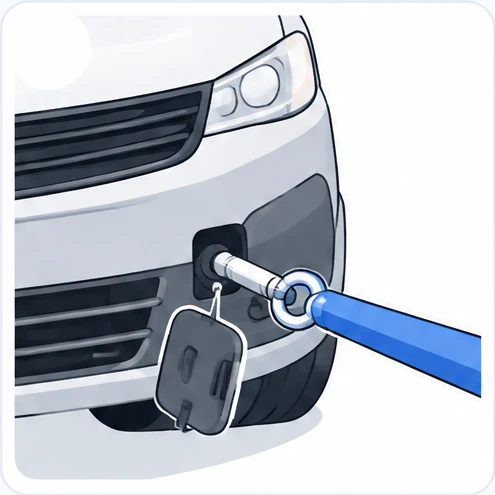
Accessing the tools: the towing eye is stored in a tool box under the boot floor.
Having your car towed
Uncover the thread: unclip the front cover by pressing its top left-hand corner.
Fit the eye: screw the towing eye in fully.
Fit the towbar: install the towbar.
Neutral: put the gearbox into neutral.
Steering and brake: unlock the steering and release the parking brake.
Hazard lamps: switch on the hazard warning lamps on both vehicles, in line with local legislation.
Drive off: move off gently, drive slowly and only for a short distance.
Warning: if you do not put the gearbox into neutral, some components (for example braking and transmission) could be damaged, and there may be no braking assistance the next time the engine is started. With an automatic gearbox, never tow the car with the driving wheels on the ground and the engine off.
Towing another vehicle
Unclip the cover: press the left-hand section of the rear cover.
Open the cover: pull the cover downwards.
Fit the eye: screw the towing eye in fully.
Fit the towbar: install the towbar.
Hazard lamps: switch on the hazard warning lamps on both vehicles.
Drive off: move off gently, drive slowly and only for a short distance.
Engine technical data and towed loads
Your car's engine characteristics are given in the registration document and in sales brochures. The tables only show values available at the time of publication, so contact a PEUGEOT dealer or a qualified workshop for any missing values. The maximum power is the value type-approved on a test bed, as defined by Regulation EU 715/2007.
Weights and towed loads are shown on the registration document, in sales brochures and on the manufacturer's plate or label.
Altitude: the GTW (Gross Train Weight) and towed load values are valid up to a maximum altitude of 1,000 metres. Reduce the towed load by 10% for each additional 1,000 metres.
Nose weight: the maximum authorised nose weight is the weight permitted on the towball.
Warning: in high outside temperatures, performance may be limited to protect the engine. When the outside temperature is higher than 37°C, reduce the towed weight. Towing can affect road holding even when the car is lightly loaded, and braking distances are longer with a trailer. When towing, never exceed 62 mph (100 km/h), and observe local legislation.
Engines and towed loads - Petrol
These petrol engines are listed for the 3008. The PureTech 130 has a cubic capacity of 1,199 cc, and the THP 150, THP 165 and PureTech 180 have 1,598 cc. All run on unleaded fuel.
Scroll the table sideways.
Engine
Gearbox
Codes
Max. power: EC standard (kW)
PureTech 130 S&S BVM6
BVM6 (Manual 6-speed)
EB2ADTS MB6 STT
96
PureTech 130 S&S EAT8
EAT8 (Auto. 8-speed)
EB2ADTS ATN8 STT
96
THP 150 EAT6
EAT6 (Auto. 6-speed)
EP6FDTMD AT6III
110
THP 165 EAT6
EAT6 (Auto. 6-speed)
EP6FDTM AT6III
121.4
PureTech 180 S&S EAT8
EAT8 (Auto. 8-speed)
EP6FADTXD ATN8 STT
133
Braked trailer values are within the GTW limit, on a 10% or 12% gradient.
Scroll the table sideways.
Engine and model codes
Braked trailer (kg)
Unbraked trailer (kg)
Max. nose weight (kg)
PureTech 130 BVM6, 3008 (HNSM/C)
1,400
690
80
PureTech 130 EAT8, 3008 (HNSU/C, HNSC/C)
1,150
690
80
THP 150, 3008 (5GXV/C)
600
600
80
THP 165, 3008 (5GYV/C, 5GYW/C, 5GYZ/C, 5GSD/C)
600 (1,550 for Australia only)
600
80
PureTech 180, 3008 (5GFU/C)
1,500
750
80
Engines and towed loads, BlueHDi Diesel
One BlueHDi Diesel engine is listed: the BlueHDi 130 S&S EAT8, with an EAT8 (Auto. 8-speed) gearbox, codes DV5RC ATN8 STT, a cubic capacity of 1,499 cc and a maximum power (EC standard) of 96 kW.
Scroll the table sideways.
Item
3008 (YHZU/C)
Braked trailer (within the GTW limit) on a 10% or 12% gradient (kg)
1,300
Unbraked trailer (kg)
750
Maximum authorised nose weight (kg)
80
Engines and towed loads - Hybrid
The HYBRID 136 e-DCS6 has the codes EB2LTDH2 EDCT6. Its towed loads are:
Scroll the table sideways.
Item
3008 (HPYE/C)
Braked trailer (within the GTW limit) on a 10% or 12% gradient (kg)
Three rechargeable hybrid versions are listed. All have an electric automatic 8-speed gearbox, run on unleaded fuel and use electric motors that are synchronous with permanent magnets and a Lithium-Ion traction battery. The model codes begin with M4.
Scroll the table sideways.
Item
HYBRID 180 e-EAT8
HYBRID 225 e-EAT8
HYBRID4 300 e-EAT8
Codes
EP6FADTXDHPE EATN8 FWD
EP6FADTXDHPD EATN8 FWD
EP6FADTXHPP EATN8 AWD
Model codes
DGLU/C
DGZU/C
5GBU/C
Braked trailer (within the GTW limit) on a 10% or 12% gradient (kg)
1,250
1,250
1,250
Unbraked trailer (kg)
600
750
750
Maximum authorised nose weight (kg)
70
70
70
Petrol engine
PureTech 150
PureTech 180
PureTech 200
Cubic capacity (cc)
1,598
1,598
1,598
Petrol engine max. power: EC standard (kW)
110
132
147
Electric motor max. power: EC standard (kW)
81
81
Front: 81, Rear: 83
Battery voltage (Volts AC)
240-400
240-400
240-400
Installed capacity (kWh)
12.4
14.2
14.2
Combined power (kW)
133
165
220
Frequently Asked Questions
How much can a Peugeot 3008 tow?
It depends on the engine. For example, the braked trailer value is 1,400 kg for the 3008 PureTech 130 manual and 1,250 kg for the rechargeable hybrid versions. Always check the maximum towable weight on your registration certificate and the manufacturer's label.
Can I use a trailer with LED lights on the Peugeot 3008 detachable towball?
No. Trailers with LED lamps are not compatible with the wiring harness of the quickly detachable towball.
What is the maximum speed when towing with a Peugeot 3008?
Never exceed 62 mph (100 km/h) when towing, and observe the local legislation in force.
Can a Peugeot 3008 Hybrid be towed with all four wheels on the ground?
Yes, but only for a maximum of 0.06 mile (100 metres) at a maximum of 6 mph (10 km/h), with the automatic gearbox in mode N and N shown on the instrument panel. For rechargeable hybrids, always use professionals with a flatbed lorry or trailer.
Towing safely with your Peugeot 3008 comes down to respecting the weight limits, checking the towball before every trip and following the right steps when your car needs a tow. Keep this guide handy, and if anything is unclear, ask a PEUGEOT dealer or a qualified workshop.
Don't forget to follow us on Instagram for more Peugeot guides!
This is an independent guide, not an official Peugeot publication. If in doubt, contact a PEUGEOT dealer or a qualified workshop before carrying out any work.
Hello and welcome. In this article we look at the 12 V battery on the Peugeot 3008 II (2016-present). We will cover jump starting, charging with a battery charger, and disconnecting and reconnecting t
Hello and welcome. In this article we look at tyre pressures and the under-inflation detection system on the Peugeot 3008 II (2016-present). We will cover how the system works, what to do when the ale
Hello and welcome. In this article we look at the technical specifications of the Peugeot 3008 II (2016-present). We will cover engine figures, towed loads, hybrid motor and battery details, and where