Hello and welcome. In this post, we'll look at the seat belts, airbags, child seats, ISOFIX and i-Size mountings and child locks on the Peugeot 3008 II. You'll find how to fasten each belt, what the warning lamps mean, where each type of child seat can go and how to switch off the front passenger airbag.
Quick Reference
Scroll the table sideways.
Section
In short
Seat belts
How belts work, fastening, alerts and safe use
Airbags
Airbag types, when they deploy and safe seating
Child seats
Fitting child seats and switching off the passenger airbag
ISOFIX mountings
ISOFIX rings, TOP TETHER fitting and seat positions
i-Size child seats
Where i-Size child seats can be fitted
Manual child lock
Stops a rear door opening from inside
Electric child lock
Locks rear doors and rear windows from inside
Seat belts
Every seat belt has an inertia reel. It adjusts the strap length to your shape automatically and returns the belt to its storage when it is not in use. The reel locks the strap automatically in a collision, under emergency braking or if the car rolls over. To release it, pull the strap firmly, then let go so it reels in slightly.
Pyrotechnic pretensioning: this improves safety in a frontal or side impact. Depending on how severe the impact is, it instantly tightens the seat belts against the occupants' bodies. It works when the ignition is on.
Force limiting: this reduces the pressure of the seat belt on the occupant's chest, which improves their protection.
In an impact, the pretensioners may fire before the airbags and independently of them, depending on the type and seriousness of the impact. When they fire, you will hear a noise and see a little harmless smoke from the cartridge in the system. The airbag warning lamp comes on in every case. After any impact, have the seat belt system checked, and replaced if needed, by a PEUGEOT dealer or a qualified workshop.
Front seat belts
The front seat belts have both pyrotechnic pretensioning and force limiting.
Fasten: pull the strap, then push the tongue into the buckle.
Check: pull on the strap to make sure the belt is fastened correctly.
Unfasten: press the red button on the buckle.
Store: guide the belt as it reels in.
Adjust the height: squeeze control A and slide it to the notch you want.
Rear seat belts
Each rear seat has a three-point seat belt with an inertia reel, and the outer seats have pyrotechnic pretensioning and force limiting. When the centre belt is not in use, an elastic strap holds its buckle horizontally. In the second row, each seat also has a three-point belt with an inertia reel, with pretensioning and force limiting on the outer seats.
Before you do anything with the rear seats, check that the outer seat belts are properly tensioned and the centre seat belt is completely reeled in. This avoids damaging the belts.
Second row centre seat belt
The centre belt in the second row is built into the roof.
Tongue A: pull the strap and push tongue A into the left buckle. This is on the passenger's right when they are seated.
Tongue B: push tongue B into the right buckle. This is on the passenger's left when they are seated.
Check: pull the strap to make sure each buckle is fastened correctly.
Release: press the red button on buckle B, then the black button on buckle A.
Store: guide the strap as it reels in, then offer tongue B, then tongue A, to the magnet at the anchoring point on the roof.
Third row seat belts
Fasten: pull the strap, then push the tongue into the buckle.
Check: pull on the strap to make sure the belt is fastened correctly.
Unfasten: press the red button on the buckle.
Reel in: guide the belt as it reels in.
Store: flatten the strap against the boot side trim using the magnetic retaining system.
Always make sure the seat belts are secured when they are not in use.
Seat belt alerts
The red warning lamp comes on in the instrument panel and in the front passenger airbag and seat belts warning lamps display when a belt is not fastened or has been unfastened. Red indicator lamps on the display show which seats are affected.
Not fastened at the front: with the ignition on, the lamps light up if the driver and/or front passenger have not fastened their belts. Above 12 mph (20 km/h), they flash with an increasing audible signal for approximately two minutes. After that, they stay on as long as the front belts are unfastened.
Not fastened at the rear: with the ignition on and the engine running, or the car moving below 12 mph (20 km/h), the lamps light up for 1 minute if one or more rear belts are not fastened.
Unfastened: after the ignition is switched on, the lamps light up if anyone unfastens their belt. Above 12 mph (20 km/h), they flash with an audible signal for approximately two minutes, then stay on until the belts are refastened.
Advice
As the driver, make sure all passengers are wearing their belts correctly before you set off.
Always fasten your belt, wherever you sit and even for short journeys.
Do not swap the buckles over, as they will not do their job properly.
Check there is nothing in the buckle, such as a coin, before fastening.
Make sure the belt reels in correctly before and after use, and after folding or moving a seat or the rear bench seat.
Place the lower part of the strap as low as possible over the pelvis and the upper part in the hollow of the shoulder. At the front, you may need to adjust the seat height to get the belt right.
Tighten the belt as close to your body as possible, pull it across in a smooth movement and check it is not twisted.
Use each belt for one person only.
Do not use a belt that is torn or frayed, and never change or modify a belt.
Children
Use a suitable child seat if the passenger is under 12 years old or shorter than 1.5 metres.
Never use one belt for more than one child.
Never carry a child on your lap.
Maintenance
Any work on the seat belts must be done by a qualified workshop with the right skills and equipment, which a PEUGEOT dealer can provide. Have the belts checked regularly by a PEUGEOT dealer or a qualified workshop, especially if the straps look damaged. Clean the straps with soapy water or a textile cleaning product sold by PEUGEOT dealers.
Airbags
The airbags help protect the people in the front seats and the rear outer seats in a violent collision. They work alongside the seat belts with force limiting. Electronic detectors record and analyse front and side impacts in two detection zones: A, the front impact zone, and B, the side impact zone.
In a violent impact, the airbags deploy instantly, then deflate rapidly so they do not block your view or stop occupants getting out.
In a slight impact, a rear impact and in some rollovers, the airbags may not deploy. In these cases only the seat belt protects you.
How serious an impact is depends on what you hit and how fast the car was going.
The airbags do not work when the ignition is off. Each airbag deploys only once, so it will not deploy again in a second impact, in the same or a later accident. When an airbag deploys, there is a noise and a small amount of smoke. The smoke is not harmful, but sensitive people may find it irritating, and the noise can cause a slight loss of hearing for a short time.
Front airbags
These protect the driver and front passenger in a serious front impact, limiting the risk of head and chest injury. The driver's airbag is in the centre of the steering wheel and the passenger's airbag is in the dashboard above the glove box. They are adaptive, and inflate less firmly for a smaller occupant with the seat set forward. They deploy in a serious impact to all or part of zone A, unless the passenger airbag has been deactivated. Each one inflates between the occupant's chest and head and the steering wheel or dashboard.
Lateral airbags
These protect the driver and front passenger in a serious side impact, limiting the risk of chest injury between the hip and the shoulder. Each one sits in the seat backrest frame, on the door side. They deploy on one side in a serious impact to all or part of zone B, inflating between the occupant's chest and the door panel.
Curtain airbags
These help protect the driver and passengers, except the rear centre passenger, in a serious side impact, limiting the risk of injury to the side of the head. They are built into the pillars and the upper part of the passenger compartment. Each one deploys at the same time as the lateral airbag on that side, inflating between the occupants and the windows.
Malfunction
If there is a fault, the airbag warning lamp comes on in the instrument panel. Contact a PEUGEOT dealer or a qualified workshop to have the system checked, as the airbags may not deploy in a serious impact. In a minor side impact or bump, or a rollover, the airbags may not deploy. In a front or rear collision, none of the lateral airbags deploy.
Advice
Sit in a normal, upright position, and fasten and position your seat belt correctly.
Never put anything between the occupants and the airbags, such as a child, animal or object, and do not fix anything near or in their path.
Never modify the car's original design, especially around the airbags.
Even with all these precautions, a deploying airbag can cause injury or minor burns to the head, chest or arms. It inflates within a few milliseconds and deflates just as fast, releasing hot gas through vents.
After an accident, or if the car has been stolen, have the airbag systems checked. All work must be done by a PEUGEOT dealer or a qualified workshop.
Front airbags: do not hold the steering wheel by its spokes or rest your hands on its centre. Passengers must not put their feet on the dashboard. Do not smoke. Never remove, pierce or hit the steering wheel violently, and do not attach anything to the wheel or dashboard.
Lateral airbags: use only approved seat covers that allow the airbags to deploy, and ask a PEUGEOT dealer about suitable covers. Do not hang anything, such as clothing, on the backrests. Do not lean closer to the door than you need to.
Door sensors: the front door panels contain side impact sensors. A damaged door or incorrect work on the front doors or their trim can stop the lateral airbags working properly. All work must be done by a PEUGEOT dealer or a qualified workshop.
Curtain airbags: do not attach anything to the roof, and do not remove the roof grab handles, as they help secure the curtain airbags.
Child seats
The rules on carrying children differ from country to country, so check the law where you live. For maximum safety, follow these recommendations:
Under European regulations, all children under 12 or shorter than 1.5 metres must travel in an approved child seat suited to their size or weight, on a seat with a seat belt or ISOFIX mountings.
Statistically, the rear seats are the safest for children.
Children under 15 months must travel rearward facing, in the front or the rear.
It is recommended that children travel in the rear: rearward facing up to the age of 3, and forward facing over the age of 3.
An incorrectly fitted child seat puts the child at risk in an accident. Keep these points in mind:
Make sure the seat belt is positioned and tightened correctly.
If the child seat has a support leg, make sure it rests firmly and steadily on the floor.
Make sure no seat belt or buckle is under the child seat, as this could make it unstable.
Fasten the seat belts or harness with as little slack as possible, even for short journeys.
When using the seat belt to fit a child seat, make sure the belt holds the child seat firmly on the car seat. If the passenger seat is adjustable, move it forwards if needed.
Remove the head restraint before fitting a child seat with a backrest on a passenger seat. Store or secure the head restraint so it cannot fly around under hard braking, and refit it once the child seat is removed.
Booster seats: the chest part of the belt must sit on the child's shoulder without touching the neck, and the lap part must pass over the thighs. Use a booster seat with a backrest and a belt guide at shoulder level.
Extra protection: use the child lock to stop the doors and rear windows being opened by accident, open the rear windows no more than one third, and fit side blinds on the rear windows to shield young children from the sun.
Never leave a child alone and unsupervised in the car, never leave a child or an animal in a car in the sun with the windows closed, and never leave the keys within reach of children inside the car.
Child seat in the rear
Move the front seat: slide the front seat forward and straighten its backrest so the child's legs do not touch it.
Check the backrest: make sure the backrest of a forward-facing child seat is as close as possible to the rear seat backrest, ideally touching it.
If a dog guard is fitted, booster seats with a backrest must be fitted in the second row. Never fit a child seat with a support leg on the centre rear seat.
Child seat in the front
Set the front passenger seat to its highest and fully back position, with the backrest straightened. For a forward-facing seat, leave the passenger airbag active. For a rearward-facing seat, you must deactivate the passenger airbag first, otherwise the child could be seriously injured or killed if it deploys. The warning label on both sides of the passenger sun visor says: NEVER use a rearward facing child restraint on a seat protected by an ACTIVE AIRBAG in front of it, DEATH or SERIOUS INJURY to the CHILD can occur.
If your car has no deactivation/reactivation control, fitting a rearward-facing child seat on the front passenger seat is strictly prohibited.
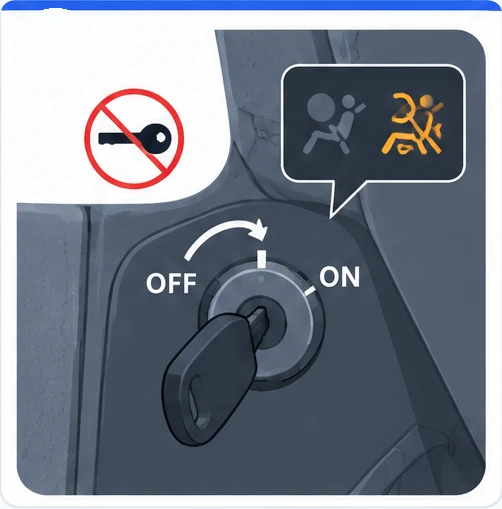
Deactivating the front passenger airbag
Where fitted, the switch is inside the glove box. With the ignition off:
Deactivate: turn the key in the switch to the OFF position.
Reactivate: turn the key to the ON position.
When you switch on the ignition, a warning lamp comes on and stays on to show the airbag is deactivated. Otherwise, a warning lamp comes on for about 1 minute to show it is active.
Recommended child seats
These are secured with a three-point seat belt:
L1 RÖMER Baby-Safe: group 0+, from birth to 13 kg. Fitted rearward facing.
L5 RÖMER KIDFIX 2R: groups 2 and 3, from 15 to 36 kg. Can be fitted to the ISOFIX mountings, with the child held by the seat belt. Only for the side rear seats, and the head restraint on the car seat must be removed.
L6 GRACO Booster: groups 2 and 3, from 15 to 36 kg. The child is held by the seat belt. Only for the front passenger seat or the rear side seats.
Where to fit seat belt child seats
This table shows where universally approved child seats secured with the seat belt can go, by the child's weight and the seat position.
Scroll the table sideways.
Weight of the child/indicative age
Row 1 passenger seat, airbag OFF
Row 1 passenger seat, airbag ON
Row 2 rear seats
Under 13 kg (groups 0 and 0+), up to about 1 year old
U
X
U
From 9 to 18 kg (group 1), from about 1 to 3 years old
U
UF
U
From 15 to 25 kg (group 2), from about 3 to 6 years old
U
UF
U
From 22 to 36 kg (group 3), from about 6 to 10 years old
U
UF
U
U: suitable for a child seat secured with the seat belt and universally approved for rearward-facing and/or forward-facing use.
UF: suitable for a child seat secured with the seat belt and universally approved for forward-facing use.
X: not suitable for a child seat for that weight group.
A universal child seat is one that can be fitted in all vehicles using the seat belt.
Group 0 is from birth to 10 kg. Carrycots and car infant carriers cannot be fitted on the front passenger seat.
For row 1 and the rear seats, check the law in your country before seating your child there.
On a passenger seat with height adjustment, use the maximum height position. Without height adjustment, straighten the backrest.
For a rearward-facing or forward-facing child seat in the rear, move the front seat forward and straighten its backrest to leave room for the child seat and the child's legs.
Never fit a child seat with a support leg on the centre rear seat.
ISOFIX mountings
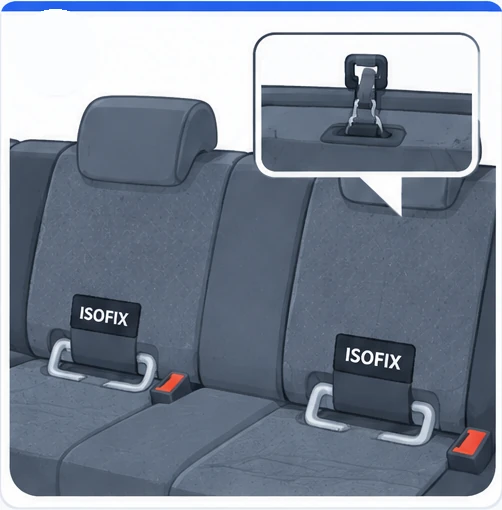
Some seats have ISOFIX mountings, depending on version and, for the front seat, depending on the country of sale. Each seat has three rings, shown by a marking:
Two rings A: between the seat backrest and cushion. The two latches on an ISOFIX child seat attach to these.
One ring B: behind the seat, called the TOP TETHER, for child seats with an upper strap. It stops the child seat tipping forward in a front impact.
The ISOFIX system gives fast, reliable and safe fitting of the child seat. To secure a child seat to the TOP TETHER:
Remove the head restraint: take it off and stow it before fitting the child seat. Refit it once the child seat has been removed.
Route the strap: pass the child seat strap behind the seat backrest, centred between the openings for the head restraint rods.
Attach: secure the upper strap hook to ring B.
Tighten: tighten the upper strap.
When fitting an ISOFIX child seat to the left-hand rear seat of the bench seat, first move the centre rear seat belt towards the middle of the car so the child seat does not get in its way. An incorrectly fitted child seat puts the child at risk in an accident, so always follow the fitting instructions in the child seat's own user guide.
Recommended ISOFIX child seats
RÖMER Baby-Safe and its ISOFIX base (size category E): group 0+, from birth to 13 kg. Fitted rearward facing on an ISOFIX base attached to rings A. The base has a height-adjustable support leg that rests on the floor. It can also be secured with a seat belt, using only the shell, held by the three-point seat belt.
RÖMER Duo Plus ISOFIX (size category B1): group 1, from 9 to 18 kg. Forward facing only, attached to rings A and to ring B (TOP TETHER) with an upper strap. It has three angles: sitting, reclining and lying down. It can also go on seats without ISOFIX, secured with the three-point seat belt. Adjust the front seat so the child's feet do not touch its backrest.
Where to fit ISOFIX child seats
For universal and semi-universal ISOFIX seats, the size category letter, from A to G, is shown on the child seat next to the i-Size logo. The table below applies. In this table, the row 2 centre rear seat is Not ISOFIX.
Scroll the table sideways.
Seat
Carrycot (F, G), under 10 kg (group 0), up to about 6 months old
Rearward facing (C, D, E), under 10 kg / under 13 kg (groups 0 and 0+), up to about 1 year old
Row 1 passenger seat, with or without height adjustment, airbag OFF
X
IL
Row 1 passenger seat, with or without height adjustment, airbag ON
X
X
Row 2 outer rear seats
IL (b)
IL
Scroll the table sideways.
Seat
Rearward facing (C, D), from 9 to 18 kg (group 1), from about 1 to 3 years old
Forward facing (A, B, B1, B2, B3), from 9 to 18 kg (group 1), from about 1 to 3 years old
Row 1 passenger seat, with or without height adjustment, airbag OFF
IL
IUF/IL
Row 1 passenger seat, with or without height adjustment, airbag ON
X
IUF/IL
Row 2 outer rear seats
IL
IUF/IL
A second table includes row 3. In this table, the row 1 passenger seat (airbag OFF or ON) and the row 3 outer rear seats are Not ISOFIX. For the carrycot on the seats behind the driver and behind the passenger, there are two values, given here in the same order. For the row 2 centre rear seat, the values are X, IL, IL and IUF/IL.
Scroll the table sideways.
Seat
Carrycot (F, G), under 10 kg (group 0), up to about 6 months old
Rearward facing (C, D, E), under 10 kg / under 13 kg (groups 0 and 0+), up to about 1 year old
Row 2 rear seat behind the driver's seat
X, IL (b)
IL
Row 2 rear seat behind the passenger seat
IL (b), X
IL
Scroll the table sideways.
Seat
Rearward facing (C, D), from 9 to 18 kg (group 1), from about 1 to 3 years old
Forward facing (A, B, B1, B2, B3), from 9 to 18 kg (group 1), from about 1 to 3 years old
Row 2 rear seat behind the driver's seat
IL
IUF/IL
Row 2 rear seat behind the passenger seat
IL
IUF/IL
IUF: suitable for an ISOFIX Universal seat, forward facing, secured with the upper strap.
IL: suitable for an ISOFIX Semi-Universal seat: rearward facing with an upper strap or support leg, forward facing with a support leg, or a carrycot with an upper strap or support leg.
X: not suitable for an ISOFIX seat or carrycot for that weight group.
(a): for row 1, check the law in your country before placing a child in this seat position.
(b): fitting a carrycot on this seat may stop you using one or more of the other seats in the row.
i-Size child seats
i-Size child seats have two latches that attach to the two rings A. They also have either an upper strap attached to ring B, or a support leg that rests on the floor and is compatible with the approved i-Size seat position. These stop the child seat tipping forward in a collision.
There are two i-Size restraint system columns. They are shown here in the same order.
Scroll the table sideways.
Seat
i-Size restraint system (first column)
i-Size restraint system (second column)
Row 1 passenger seat, with or without height adjustment, airbag OFF
i-U
Not i-Size
Row 1 passenger seat, with or without height adjustment, airbag ON
i-UF
Not i-Size
Row 2 rear side seats
i-U
i-U
Row 2 rear central seat
Not i-Size
i-U
Row 3 rear side seats
-
Not i-Size
i-U: suitable for Universal i-Size restraint systems, forward facing and rearward facing.
i-UF: only suitable for Universal i-Size restraint systems that are forward facing.
X: not suitable for Universal i-Size restraint systems.
(a): for row 1, check the law in your country before seating a child there.
Manual child lock
The manual child lock stops a rear door being opened with its interior handle. The red control is on the edge of each rear door, marked by a label.
Activate on the left-hand rear door: turn the built-in key in the red control as far as it will go to the right.
Activate on the right-hand rear door: turn the built-in key in the red control as far as it will go to the left.
Deactivate: turn the key the opposite way.
Do not mix up the red child lock control with the black back-up locking control.
Electric child lock
The electric child lock stops the rear doors being opened with their interior handles and stops the rear electric windows being used.
Switch on the ignition: the child lock only works with the ignition on.
Press the button: press the child lock button to activate or deactivate it.
When the indicator lamp is on, the child lock is active. The system works on its own and never replaces the central locking control. Check its status every time you switch on the ignition, and always take the electronic key with you when you leave the car, even for a short time. In a serious impact, the electric child lock switches off automatically so rear passengers can get out.
Frequently Asked Questions
How do I turn off the passenger airbag in my Peugeot 3008?
Where fitted, the switch is inside the glove box. With the ignition off, turn the key in the switch to OFF. When you switch the ignition back on, a warning lamp comes on and stays lit to show the airbag is deactivated.
Can I put a rearward-facing child seat in the front of the 3008?
Only if you deactivate the front passenger airbag first. If your car has no deactivation control, fitting a rearward-facing child seat on the front passenger seat is strictly prohibited.
Why does my 3008 keep beeping about the seat belt?
If a front belt is not fastened, or any belt is unfastened, the warning lamps flash with an audible signal for approximately two minutes above 12 mph (20 km/h). The lamps then stay on until the belt is fastened.
Where are the ISOFIX points on the Peugeot 3008?
Each ISOFIX seat has two rings A between the backrest and cushion, and one ring B, the TOP TETHER, behind the seat. Which seats have them depends on the version, and the front seat depends on the country of sale.
Correctly worn seat belts, well-fitted child seats and a clear space around the airbags give everyone in your 3008 the best protection. If anything looks damaged or a warning lamp stays on, have it checked by a PEUGEOT dealer or a qualified workshop.
Don't forget to follow us on Instagram for more Peugeot guides!
This is an independent guide, not an official Peugeot publication. If in doubt, contact a PEUGEOT dealer or a qualified workshop before carrying out any work.
Hello and welcome. In this article we look at the 12 V battery on the Peugeot 3008 II (2016-present). We will cover jump starting, charging with a battery charger, and disconnecting and reconnecting t
Hello and welcome. In this article we look at tyre pressures and the under-inflation detection system on the Peugeot 3008 II (2016-present). We will cover how the system works, what to do when the ale
Hello and welcome. In this article we look at the technical specifications of the Peugeot 3008 II (2016-present). We will cover engine figures, towed loads, hybrid motor and battery details, and where