Peugeot 208Updated 24 min read

Peugeot 208 II Start-Stop, Parking Brake and Gearbox

How to start, drive and park your Peugeot 208 II (2019-2023): electric parking brake, EAT6, EAT8, electric drive selector and Stop & Start explained.

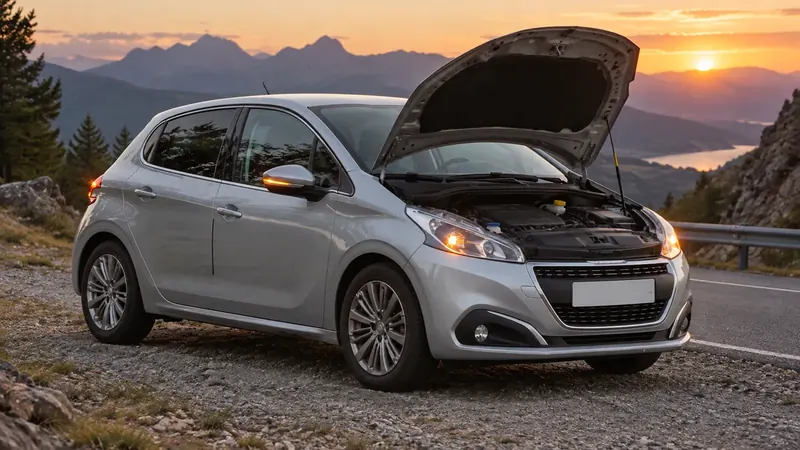
Peugeot 208 (2019-2023) driving along a lakeside road in the morning
Image adapted from a photo by Vauxford, CC BY-SA 4.0.

Hello and welcome. In this post, we'll look at starting the engine, the electric parking brake, the gearbox and Stop & Start on the Peugeot 208 II (2019-2023). It also covers driving on flooded roads and towing a trailer. It applies to the second-generation Peugeot 208 (208 II) from 2019 to 2023, including vehicles produced from 01/12/2020. Some sections only apply to certain versions, engines or equipment, so not everything here will match your 208.

How do you switch off Stop & Start on a Peugeot 208 II?

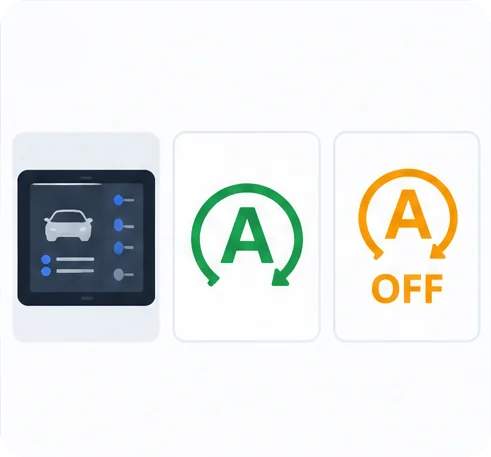
Use the Stop & Start control on the dashboard or touchscreen; an amber A OFF tell-tale confirms the system is off until you switch it back on.

Peugeot 208 II Stop & Start control and the green A and amber A OFF tell-tales

Quick Reference

Scroll the table sideways.

SectionIn short
Driving recommendationsSafe driving, flooded roads, electric noises and towing
Starting/Switching off the engine with Keyless Entry and StartStarting and stopping with the START/STOP button
Electric parking brakeApplying, releasing and automatic mode of the parking brake
Automatic gearbox (EAT6)Using the 6-speed EAT6 gear selector and modes
Automatic gearbox (EAT8 - Type 1)Using the EAT8 push selector, buttons and paddles
Automatic gearbox (EAT8 - Type 2)EAT8 push selector, auto Park, back-up mode
Drive selector (Electric - Type 2)Electric drive selector, regenerative braking and driving modes
Stop & StartHow Stop & Start works, conditions and exceptions

Driving recommendations

A few general points for driving your 208:

  • Follow the driving regulations and stay alert whatever the traffic conditions.
  • Watch your surroundings and keep your hands on the wheel so you can react at any time.
  • Drive smoothly, anticipate braking and keep a longer safety distance, especially in bad weather.
  • Stop the car before doing anything that needs your full attention, such as changing settings.
  • On long trips, take a break every 2 hours.

Important safety points:

  • Never leave the engine running in a closed space without enough ventilation. The exhaust gases, such as carbon monoxide, are toxic and there is a danger of poisoning and death.
  • In very severe wintry conditions (below -23°C), let the engine run for 4 minutes before moving off, to protect the engine and gearbox.
  • Never drive with the parking brake applied. The braking system can overheat and be damaged.
  • Never park or leave the engine running on a flammable surface such as dry grass or dead leaves. The exhaust stays very hot for several minutes after the engine stops, so there is a risk of fire.
  • Never drive over vegetation such as tall grass, piles of dead leaves, crops or debris, for example in a field, an overgrown country lane or on a grassy verge. It could touch the exhaust or other very hot systems and start a fire.
  • Do not leave anything in the cabin that could act like a magnifying glass in sunlight. It could cause a fire or damage interior surfaces.
  • Never leave the car unattended with the engine running. If you have to, apply the parking brake and put the gearbox or drive selector into neutral or position N or P, depending on version.
  • Never leave children in the car unsupervised.

On flooded roads: avoid driving on them, as this can seriously damage the engine, the gearbox and the electrical systems. If you absolutely must drive through a flooded section:

  1. Check the depth: the water must not be deeper than 15 cm, allowing for waves from other road users.
  2. Turn off Stop & Start: deactivate the Stop & Start function.
  3. Drive slowly: go as slowly as possible without stalling, and never faster than 6 mph (10 km/h).
  4. Keep moving: do not stop and do not switch off the engine.
  5. Dry the brakes: once you are out, and as soon as it is safe, brake lightly several times to dry the discs and pads.

If you are unsure about the condition of your car afterwards, contact a PEUGEOT dealer or a qualified workshop.

Noise (Electric): the electric 208 is quiet when driving, so pay particular attention and always check around the car when manoeuvring. At speeds up to 19 mph (30 km/h), the pedestrian horn warns other road users that you are there. The cooling fan comes on during charging to cool the on-board charger and the traction battery. Inside the car, these noises are perfectly normal:

  • The traction battery relay when starting.
  • The vacuum pump when braking.
  • The tyres or aerodynamics when driving.
  • Jolting and knocking during hill starts.

Towing: a trailer places greater demands on your car, so take particular care.

  • Do not exceed the maximum towable weights.
  • At altitude, reduce the maximum load by 10% per 1,000 metres, because the thinner air reduces engine performance.
  • On a new car, do not tow a trailer until it has covered at least 620 miles (1,000 kilometres).
  • In high outside temperatures, let the engine idle for 1 to 2 minutes after stopping to help it cool.
  • Load the trailer with the heaviest items as close to the axle as possible, so the nose weight approaches the maximum permitted without exceeding it.
  • Check the tyre pressures of the car and the trailer against the recommended pressures.
  • Check the trailer's electrical signalling and your headlamp beam height.
  • With a genuine PEUGEOT towing device, the rear parking sensors are deactivated automatically so their audible signal does not sound.

Towing uphill makes the coolant temperature rise. The maximum towable load depends on the gradient and the outside temperature, and the fan's cooling capacity does not increase with engine speed. Reduce your road speed and engine speed, and keep a constant eye on the coolant temperature. If the coolant temperature warning lamp and the STOP warning lamp come on, stop and switch off the engine as soon as possible. Use engine braking to limit brake overheating, and remember that braking distances are longer when towing.

Starting/Switching off the engine with Keyless Entry and Start

The electronic key must be inside the passenger compartment, and it is also detected in the boot. If the key is not detected, a message appears: move the key so the engine can be started or switched off. If there is still a problem, follow the Key not detected – Back-up starting or Back-up switch-off steps below.

Starting a petrol or diesel engine:

  1. Manual gearbox: put the gear lever in neutral and fully depress the clutch pedal.
  2. Automatic gearbox: select mode P or N and depress the brake pedal.
  3. Press the button: press the START/STOP button, keeping your foot on the pedal until the engine starts.

On Diesel engines in negative temperatures or when the engine is cold, the engine only starts once the preheating warning lamp goes out. If this lamp comes on after you press START/STOP, keep the pedal fully depressed and do not press the button again until the engine is running. If any starting condition is not met, a message appears. Sometimes a message asks you to turn the steering wheel while pressing START/STOP to help unlock the steering column.

On Petrol engines, after a cold start, pre-heating the catalytic converter can cause noticeable engine vibration for up to 2 minutes (accelerated idle speed). If the engine stalls, release the clutch pedal and fully depress it again: the engine restarts automatically.

Switching off a petrol or diesel engine:

  1. Apply the parking brake: immobilise the car with the parking brake.
  2. Manual gearbox: ideally put the gear lever in neutral.
  3. Automatic gearbox: ideally select mode P or N.
  4. Press the button: press the START/STOP button.

Sometimes you need to turn the steering wheel to lock the steering column. If the car is not immobilised, the engine will not stop. Remember that with the engine off, braking and steering assistance are also cut off, so there is a risk of losing control. Never leave the car with the electronic key still inside.

Starting the electric motor: the drive selector must be in mode P.

  1. Press brake and button: fully depress the brake pedal and briefly press the START/STOP button.
  2. Wait for READY: keep your foot on the brake until the READY indicator lamp comes on and an audible signal sounds.
  3. Select a mode: with your foot on the brake, press the Unlock button and select mode D/B or R.
  4. Move off: release the brake pedal, then accelerate.

On starting, the instrument panel lights up and the power indicator needle or cursor moves to neutral. The steering column unlocks automatically, so you may hear a sound and feel the steering wheel move. To switch off, press the START/STOP button, then before getting out check that the drive selector is in mode P and the READY indicator lamp is off.

Electric parking brake

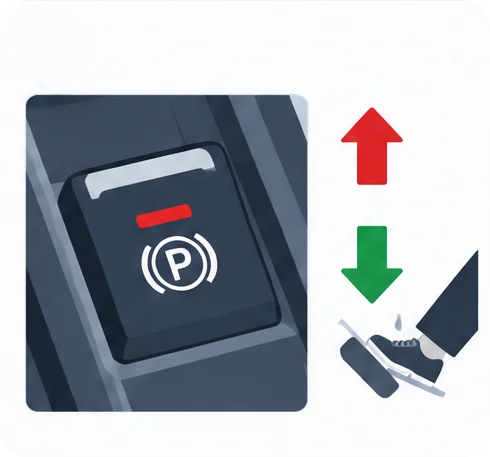
In automatic mode, which is on by default, the electric parking brake applies itself when you switch off the engine and releases when you move off. With the engine running, you can briefly pull the control to apply it, or briefly push the control while pressing the brake pedal to release it. Automatic operation can be deactivated in certain situations.

Peugeot 208 II electric parking brake: pull to apply, push with the brake pedal pressed to release

Indicator lamp: the lamp on the instrument panel and on the control comes on with the message 'Parking brake applied', and goes out with the message 'Parking brake released'. It flashes when you make a manual request to apply or release the brake.

  • If the battery fails, the electric parking brake will not work. With a manual gearbox, engage a gear. With an automatic gearbox or drive selector, place the supplied chock against one of the wheels. Then contact a PEUGEOT dealer or a qualified workshop.
  • Before leaving the car, check the parking brake indicator lamps on the instrument panel and the control are on fixed. If the brake is not applied, an audible signal sounds and a message appears when you open the driver's door.
  • Never leave a child alone in the car, as they could release the parking brake.
  • On a steep slope, when heavily loaded or when towing, turn the wheels towards the pavement and engage a gear (manual gearbox) or select mode P (automatic gearbox or drive selector).
  • When towing, the car is approved for parking on slopes of up to 12%.

Manual release (ignition on or engine running):

  1. Brake: press the brake pedal.
  2. Push the control: keep pressing the brake pedal and briefly push the control.

If the brake pedal is not pressed, the parking brake stays on and a message appears. For manual application, with the car stationary, briefly pull the control: its indicator lamp flashes to confirm the request.

Automatic release: first make sure the engine is running and the driver's door is closed. The brake then releases gradually as you move off.

With a manual gearbox:

  1. Select a gear: fully depress the clutch pedal and engage first gear or reverse.
  2. Move off: press the accelerator and release the clutch pedal.

With an automatic gearbox:

  1. Brake: depress the brake pedal.
  2. Select a mode: select mode D, M or R.
  3. Move off: release the brake pedal and press the accelerator.

With a drive selector:

  1. Brake: depress the brake pedal.
  2. Select a mode: select mode D, B or R.
  3. Move off: release the brake pedal and press the accelerator.

With an automatic gearbox or drive selector, if the brake does not release automatically, check that the front doors are properly closed. When stationary with the engine running, do not press the accelerator unnecessarily, as the parking brake could release.

Automatic application: with the car stationary, the brake applies when you switch off the engine. It does not apply automatically if the engine stalls or enters STOP mode with Stop & Start. In automatic mode you can still apply or release it manually at any time with the control.

Special cases: to hold the car with the engine running, briefly pull the control. In very cold, icy conditions, applying the parking brake is not recommended: engage a gear or place the chocks against one of the wheels instead.

Automatic gearbox (EAT6)

The EAT6 is a 6-speed automatic gearbox. You can let it change gear automatically, or change gear sequentially yourself in manual operation.

Scroll the table sideways.

PositionUse
PPark: car immobilised, parking brake applied or released. Engine starting.
RReverse: reversing manoeuvres, car stationary, engine at idle.
NNeutral: car immobilised, parking brake applied. Engine starting.
DAutomatic operation.
M +/-Manual operation: push the control backwards to shift up, forwards to shift down.

The selected position lights up on the instrument panel: P, R, N, D, the gear engaged in manual operation (1 to 6), or a dash (-) if an instruction is not accepted in manual operation.

Starting the car:

  1. Select P or N: with your foot on the brake pedal, select position P or N.
  2. Start the engine: if the conditions are not met, an audible signal sounds and a message appears.
  3. Brake: with the engine running, depress the brake pedal.
  4. Release the parking brake: do this unless it is set to automatic mode.
  5. Select a position: select R, D or M.
  6. Move off: gradually release the brake pedal. The car moves off immediately.

If you select N by mistake while driving, let the engine return to idle, then select D to accelerate. With the engine at idle and the brakes released, the car moves off in R, D or M even without the accelerator. Never leave children unattended in the car with the engine running, and when carrying out maintenance with the engine running, apply the parking brake and select P.

Automatic operation: in position D the gearbox changes through the six gears by itself, choosing the best gear for your driving style, the road profile and the load. For maximum acceleration, press the accelerator fully down (kick-down): the gearbox changes down or holds the gear until maximum engine speed. When braking, it changes down to give effective engine braking. If you release the accelerator sharply, it will not shift up, for safety reasons. Never select N while moving, and never select P or R unless the car is completely stationary.

Automatic gearbox (EAT8 - Type 1)

This EAT8 is an 8-speed automatic gearbox with a push selector and a manual mode using paddles behind the steering wheel.

Scroll the table sideways.

PositionUse
PPark: for parking, the front wheels are blocked.
RReverse gear.
NNeutral: for moving the car with the ignition off, or to let it free-wheel.
DAutomatic mode: gear changes based on driving style, road profile and load.
MManual mode: you change gear with the steering-mounted controls.

The push selector has these controls:

  • Button P: puts the gearbox into Park.
  • Unlock button: unlocks the gearbox to come out of P or change to R, with your foot on the brake. Press and hold it before pushing the selector.
  • Button M: changes from D to permanent manual mode.
  • Indicator lamps: show the gearbox state (R, N, D).

Press the selector forwards (N or R) or rearwards (N or D) once or twice, passing the point of resistance if needed. It returns to its starting position when released. For example, to go from P to R while pressing Unlock, push forwards twice without crossing the point of resistance (P to N, then N to R), or push once crossing it (straight from P to R).

Steering-mounted controls (depending on equipment): in M or D, pull the + or - paddle towards you and release to shift up or down. The paddles cannot select neutral or engage or disengage reverse.

With the ignition on, the instrument panel shows P, R, N, D1 to D8 (automatic), M1 to M8 (manual), or a dash (-) if an instruction is not processed in manual mode. If you open the driver's door with the ignition on, a message prompts you to select P.

Only appropriate mode changes are accepted, and a message appears if you need to press the brake pedal and/or the Unlock button. Depending on version or engine, in D (except in Sport mode), gradually and fully releasing the accelerator lets the car free-wheel to save fuel; a drop in engine speed and noise is normal.

  • With the engine running and the brakes released, the car moves off in R, D or M even without the accelerator.
  • Never press the accelerator and brake pedals at the same time, as this can damage the gearbox.
  • If the battery is flat, place the chocks supplied with the tools against one of the wheels.

Unlocking the gearbox from P:

  1. Brake: fully depress the brake pedal.
  2. Unlock: press the Unlock button.
  3. Select: keep pressing both and select another mode.

From N, below 3 mph (5 km/h), fully depress the brake pedal and, keeping it pressed, select another mode.

Engaging reverse:

  1. Stop: slow down until you come to a stop.
  2. Brake and unlock: depress the brake pedal, then press the Unlock button.
  3. Select R: keep pressing and select mode R.

Permanent manual mode: with D selected, press button M and its green indicator lamp comes on. To leave it, push forwards once to return to D, or press M again so the lamp goes off. The car must be stationary to switch off the ignition. For free-wheeling, see the Free-wheeling section below.

Automatic gearbox (EAT8 - Type 2)

This EAT8 is an 8-speed automatic gearbox with a push selector and a manual mode using paddles behind the steering wheel.

Scroll the table sideways.

PositionUse
PAuto Park: press this button to park. The front wheels are blocked.
RReverse.
NNeutral: to free-wheel and move the car with the ignition off.
DAutomatic mode: gear changes based on driving style, road profile and load.
MManual mode: press this button, then change gear with the steering-mounted controls.

In mode N, with your foot on the brake, push the selector without passing the point of resistance: forwards selects R, backwards selects D. Release it fully after each push so it returns to its starting position.

To switch quickly between D and R without going through N:

  • In R, push backwards past the point of resistance to select D.
  • In D, push forwards past the point of resistance to select R.
  • To return to N, push without passing the point of resistance.

Steering-mounted controls (depending on equipment): in M or D, pull the + or - paddle towards you and release to shift up or down. They cannot select neutral or engage or disengage reverse.

With the ignition on, the instrument panel shows P, R, N, D1 to 8 (automatic forward gear) or M1 to 8 (manual forward gear). The gearbox state stays displayed for a few seconds after you switch off the ignition.

Only appropriate mode changes are accepted, and a message appears if you need to press the brake pedal to change mode.

  • With the engine running and the brakes released, the car moves off in R, D or M even without the accelerator.
  • Never press the accelerator and brake pedals at the same time, as this can damage the gearbox.
  • If you open the driver's door in N, an audible signal sounds and P is engaged. The signal stops when you close the door.
  • Below 3 mph (5 km/h), opening the driver's door engages P, so there is a risk of sudden braking.
  • If the battery fails, place the chock(s) from the tool kit against one of the wheels.

In automatic mode, the gearbox picks the gear for optimal performance based on ambient temperature, road profile, load and driving style. Kick-down (accelerator fully down) gives maximum acceleration by changing down or holding the gear until maximum engine speed. The paddles let you select a gear temporarily if road speed and engine speed allow. In manual mode, the gearbox only changes gear if road speed and engine speed allow.

Starting the car:

  1. Brake: fully depress the brake pedal.
  2. Start: start the engine.
  3. Select a mode: with your foot on the brake, push once or twice backwards for D, or forwards for R.
  4. Release the brake: take your foot off the brake pedal.
  5. Accelerate: accelerate gradually so the electric parking brake releases automatically. The car moves off immediately.

Never try to start the engine by pushing the car.

Switching off: P engages automatically when you switch off the ignition, whatever the mode. In N, P engages after 5 seconds to allow free-wheeling. Check that P is engaged and the electric parking brake has applied, and apply it manually if not. The indicator lamps on the selector, the parking brake control and the instrument panel must all be on.

Gearbox malfunction: the warning lamp comes on with an audible signal and a message. Go to a PEUGEOT dealer or a qualified workshop, and do not drive faster than 62 mph (100 km/h), keeping to the speed limit. In back-up mode, D locks in third gear, the paddles do not work and M is not available.

Drive selector (Electric - Type 2)

On the electric 208, the drive selector is a pulse selector with a regenerative braking function. It manages traction based on your driving style, the road profile and the load, and with regenerative braking on it also manages engine braking when you lift off the accelerator.

Scroll the table sideways.

PositionUse
PPark: button for parking, the front wheels are locked. The button lights up when active.
RReverse: engage with your foot on the brake pedal.
NNeutral: to move the car with the ignition off and let it free-wheel.
DDrive: automatic forward gear.
BBrake: regenerative braking. The button lights up when active.

With the ignition on, the instrument panel shows P, R, N, D or B.

In mode N, with your foot on the brake, push the selector without passing the point of resistance: forwards selects R, backwards selects D. Release it fully after each push. To switch quickly between D and R without going through N, push past the point of resistance (backwards from R for D, forwards from D for R). To return to N, push without passing the point of resistance.

Regenerative braking with the Brake function: the Brake function imitates engine braking, so the car slows more quickly when you release the accelerator, without using the brake pedal. The energy recovered partly recharges the traction battery and increases the driving range. To switch it on or off, move the selector backwards from D/B: D on the instrument panel changes to B. The setting is not saved when you switch off the ignition.

  • This deceleration does not switch on the brake lamps.
  • In some situations, such as a full battery or extreme temperatures, regenerative braking can be temporarily limited, so the car slows less.
  • Stay alert to the traffic and always be ready to use the brake pedal.

With the brake pedal: when you press the brake pedal, the intelligent braking system recovers some energy to recharge the traction battery, which also reduces brake pad wear. The brake pedal can feel different from a car without regenerative braking.

Driving modes: the modes available depend on the engine and equipment. Press the driving mode control to show the modes on the instrument panel and, depending on version, on the PEUGEOT Connect Nav screen. With an electric motor, you cannot select a mode until the READY indicator lamp appears. Once the message disappears, the chosen mode is active and stays shown on the instrument panel, except Normal mode, which is selected by default each time you switch on the ignition.

  • Normal: restores the default settings.
  • Eco: reduces energy use by lowering heating and air conditioning performance without switching them off, and reduces use of the traction battery's energy by limiting engine torque.
  • Sport: gives more dynamic driving through the power steering and accelerator (and gear changes with an automatic gearbox), with the option to show the car's dynamic settings on the instrument panel.

Stop & Start

Stop & Start puts the engine into standby (STOP mode) when the car is stationary, for example at red lights or in traffic jams, and restarts it (START mode) as soon as you show you want to move off. It is mainly designed for town driving, to cut fuel consumption, exhaust emissions and noise when stationary. It does not affect how the car works, in particular the braking.

Deactivation and reactivation: the function is on by default when you switch on the ignition. You change the setting in the Driving/Vehicle touch screen menu, and a message on the instrument panel confirms the change. If the engine is in standby when you deactivate the function, it restarts immediately. One indicator lamp shows the engine is in STOP mode, and another shows the function is deactivated or faulty.

  • Before doing anything under the bonnet, deactivate Stop & Start so the engine cannot restart automatically and injure you.
  • Before driving into a flooded area, it is strongly recommended to deactivate Stop & Start. See the Driving recommendations section above for flooded roads.

Main conditions for it to work:

  • The driver's door is closed.
  • The driver's seat belt is fastened.
  • The battery has enough charge.
  • The engine is within its nominal operating temperature range.
  • The outside temperature is between 0°C and 35°C.

Entering STOP mode: with a manual gearbox, put the gear lever in neutral and release the clutch pedal. With an automatic gearbox, have the selector in D or M and keep the brake pedal pressed until the car stops, or select N with the car stationary. A time counter adds up the time spent in standby during the journey and resets each time you switch on the ignition.

The engine will not go into standby if the conditions are not met, or:

  • On a steep slope, uphill or downhill.
  • If the car has not gone above 6 mph (10 km/h) since the engine was last started with the key or the START/STOP button.
  • If Sport mode is selected (depending on equipment).

Frequently Asked Questions

Can I drive my Peugeot 208 through a flood?

Avoid it where you can. If you must, the water must not be deeper than 15 cm, turn off Stop & Start, drive no faster than 6 mph (10 km/h) and do not stop or switch off the engine.

Why won't my Peugeot 208 electric parking brake release automatically?

The engine must be running and the driver's door closed. With an automatic gearbox or drive selector, also check that both front doors are properly closed.

Why doesn't Stop & Start switch the engine off on my 208?

It needs the driver's door closed, the seat belt fastened, enough battery charge, the engine at normal temperature and an outside temperature between 0°C and 35°C. It also stays off on steep slopes, in Sport mode, or if you have not exceeded 6 mph (10 km/h) since starting.

What does B mean on the Peugeot e-208 drive selector?

B is the Brake function, which slows the car more quickly when you release the accelerator and uses the recovered energy to partly recharge the traction battery. It is not saved when you switch off the ignition.

Knowing how your 208 starts, parks and changes gear makes everyday driving easier and safer. Keep this guide handy. If in doubt, ask a PEUGEOT dealer or a qualified workshop.

More Peugeot 208 Guides

If a lamp comes on while you are driving, see our guides to Peugeot 208 red warning lights, Peugeot 208 orange warning lights and Peugeot 208 green and blue indicator lamps.

Don't forget to follow us on Instagram for more Peugeot guides!

This is an independent guide, not an official Peugeot publication. If in doubt, contact a PEUGEOT dealer or a qualified workshop before carrying out any work.

Related guides: Peugeot 208 model guides.

Cover adapted from a photograph by Vauxford — Wikimedia Commons, CC BY-SA 4.0 (AI edited).
Related guides

Guide ·

Peugeot 208 AdBlue Refilling (2015-present)

BlueHDi Diesel engines on the Peugeot 208 use AdBlue to clean up their exhaust gases. This guide explains what the SCR system does, how far you can drive on a tank of AdBlue, how to store and handle the fluid s…

Guide ·

Peugeot 208 12 V Battery and Jump Starting (2015-present)

A flat 12 V battery is one of the most common reasons a car will not start. This guide explains how to reach the battery on your Peugeot 208, how to start the engine using another battery or a booster, how to c…