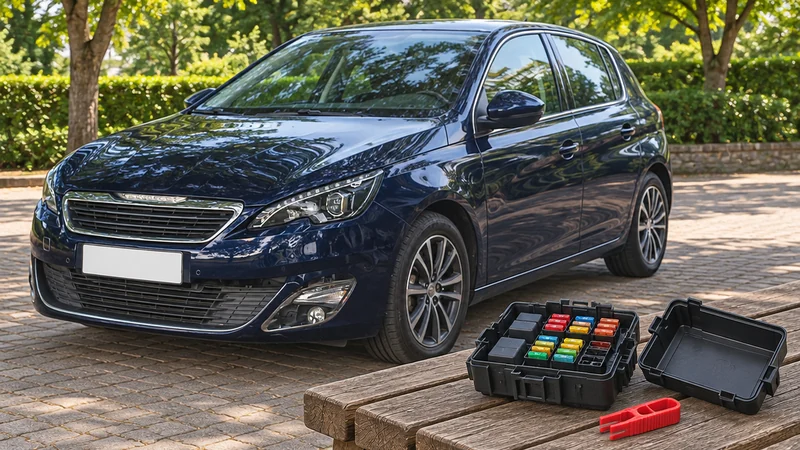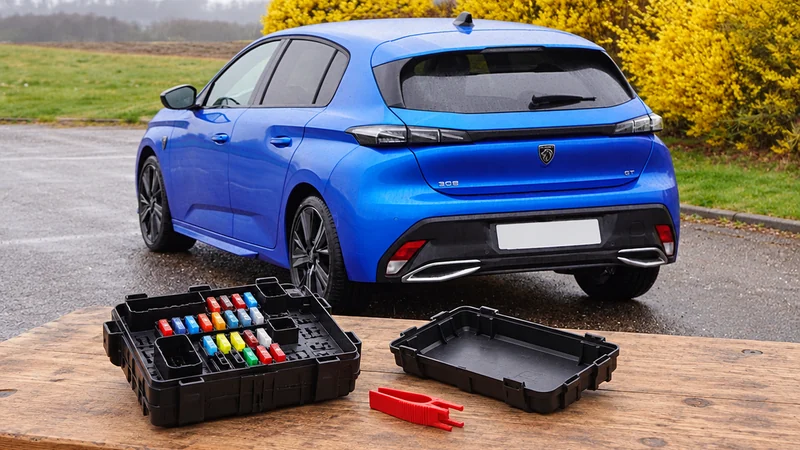
Peugeot 308 Fuse Box and Fuses (2021-2025)
Hello and welcome. In this article we look at the fuses on the Peugeot 308 III (2021-2025). We will cover who should change a fuse and what to know before fitting extra electrical equipment or accesso
Peugeot 308 II towing limits by engine and body, GTi restriction, nose weights, and where to find the VIN and manufacturer's label.
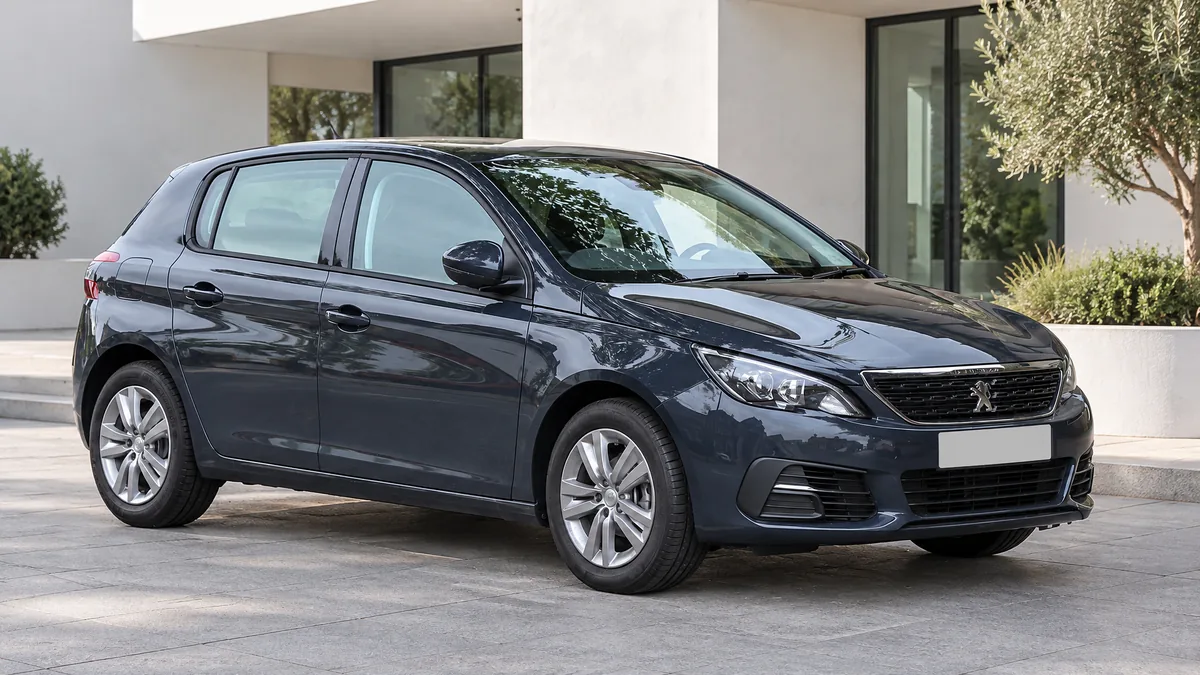
Technical figures for the Peugeot 308 II (2015-present)—including engine outputs, braked and unbraked trailer limits, maximum towbar nose weights, exterior dimensions in millimetres, and VIN/tyre label locations—depend on the exact engine and body style (hatchback, SW, or GTi). Weight figures are also stamped on the manufacturer's plate on the vehicle.
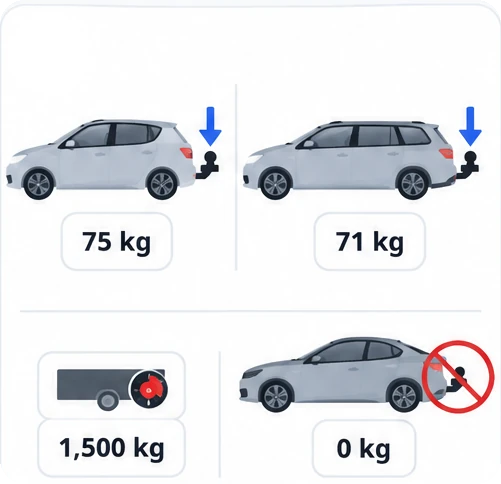
It depends on the engine and body style. Braked trailer figures range from 600 kg for the THP 165 EAT6 up to 1,500 kg for the BlueHDi 130 S&S BVM6 hatchback, within the GTW limit. The GTi cannot tow. Maximum nose weight is 75 kg on the hatchback and 71 kg on the SW.
Scroll the table sideways.
| Section | In short |
|---|---|
| Engine technical data and towed loads | Where to find data, plus towing rules and warnings |
| Engines and towed loads - PETROL | Petrol engine data and trailer weights by body style |
| Engines and towed loads - PETROL GTi | GTi engine data, with zero towed load values |
| Engines and towed loads - DIESEL | Diesel engine data and trailer weights by body style |
| Dimensions (mm) | Body dimensions and commercial version load space |
| Identification markings | Where to find the VIN and identification labels |
The engine characteristics are given in your car's registration document and in sales brochures. The maximum power shown is the value type-approved on a test bed, under conditions defined in European legislation (Directive 1999/99/EC).
The weights and towed loads are also shown on the registration document and in sales brochures, as well as on the manufacturer's plate or label. Keep these points in mind:
For more information, contact a PEUGEOT dealer or a qualified workshop.
These are the petrol engines listed below. All of them run on unleaded fuel.
Scroll the table sideways.
| Engine | Gearbox and code | Cubic capacity (cc) | Max. power, EC standard (kW) |
|---|---|---|---|
| PureTech 110 BVM5 | Manual 5-speed, EB2DTM BE5 | 1,199 | 81 |
| PureTech 110 BVM6 | Manual 6-speed, EB2ADT STT MB6E | 1,199 | 81 |
| PureTech 130 BVM6 | Manual 6-speed, EB2DTSM MCM | 1,199 | 96 |
| PureTech 130 S&S BVM6 | Manual 6-speed, EB2ADTS MB6E | 1,199 | 96 |
| PureTech 130 EAT6 | Automatic 6-speed, EB2DTSM AT6III | 1,199 | 96 |
| PureTech 130 S&S EAT8 | Automatic 8-speed, EB2ADTS ATN8 | 1,199 | 96 |
| THP 165 EAT6 | Automatic 6-speed, EP6FDTM AT6III | 1,598 | 121 |
The towed loads depend on the body style. The braked trailer value applies within the GTW limit, on a 10% or 12% gradient.
Scroll the table sideways.
| Engine, body style (model code) | Braked trailer (kg) | Unbraked trailer (kg) | Max. nose weight (kg) |
|---|---|---|---|
| PureTech 110 BVM5, Hatchback (LPHNVA) | 1,200 | 575 | 75 |
| PureTech 110 BVM5, SW (LRHNVA) | 1,100 | 630 | 71 |
| PureTech 110 BVM6, Hatchback (LPHNPJ) | 1,315 | 575 | 75 |
| PureTech 110 BVM6, SW (LRHNPJ) | 1,200 | 630 | 71 |
| PureTech 130 BVM6, Hatchback (LPHNWG) | 1,300 | 580 | 75 |
| PureTech 130 BVM6, SW (LRHNWG) | 1,200 | 630 | 71 |
| PureTech 130 S&S BVM6, Hatchback (LPHNSJ) | 1,300 | 570 | 75 |
| PureTech 130 S&S BVM6, SW (LRHNSJ) | 1,200 | 620 | 71 |
| PureTech 130 EAT6, Hatchback (LPHNWV) | 1,200 | 610 | 75 |
| PureTech 130 EAT6, SW (LRHNWV) | 1,100 | 635 | 71 |
| PureTech 130 S&S EAT8, Hatchback (LPHNSK) | 1,200 | 570 | 75 |
| PureTech 130 S&S EAT8, SW (LRHNSK) | 1,200 | 630 | 71 |
| THP 165 EAT6, Hatchback (L35GYV) | 600 | 600 | 75 |
| THP 165 EAT6, SW (L45GYV) | 600 | 600 | 71 |
The GTi is listed with one engine, available as a hatchback only.
With all three towing values at 0 kg, the GTi is not rated to tow a trailer.
These are the diesel engines listed below. All of them run on diesel.
Scroll the table sideways.
| Engine | Gearbox and code | Cubic capacity (cc) | Max. power, EC standard (kW) |
|---|---|---|---|
| BlueHDi 100 S&S BVM6 | Manual 6-speed, DV5RD STT MB6 | 1,499 | 75 |
| BlueHDi 130 S&S BVM6 | Manual 6-speed, DV5RC ML6C STT | 1,499 | 96 |
| BlueHDi 130 S&S EAT8 | Automatic 8-speed, DV5RC STT ATN8 | 1,499 | 96 |
| HDi 92 BVM5 | Manual 5-speed, DV6D BE5 | 1,560 | 68 |
The braked trailer value applies within the GTW limit, on a 10% or 12% gradient.
Scroll the table sideways.
| Engine, body style (model code) | Braked trailer (kg) | Unbraked trailer (kg) | Max. nose weight (kg) |
|---|---|---|---|
| BlueHDi 100 S&S BVM6, Hatchback (LBYHYP) | 1,300 | 600 | 75 |
| BlueHDi 130 S&S BVM6, Hatchback (LBYHZJ) | 1,500 | 615 | 75 |
| BlueHDi 130 S&S BVM6, SW (LCYHZJ) | 1,400 | 680 | 71 |
| BlueHDi 130 S&S EAT8, Hatchback (LBYHZK) | 1,400 | 635 | 75 |
| BlueHDi 130 S&S EAT8, SW (LCYHZK) | 1,300 | 690 | 71 |
| HDi 92 BVM5, Hatchback (LB9HPA) | 1,300 | 580 | 75 |
| HDi 92 BVM5, SW (LC9HPA) | 1,200 | 620 | 71 |
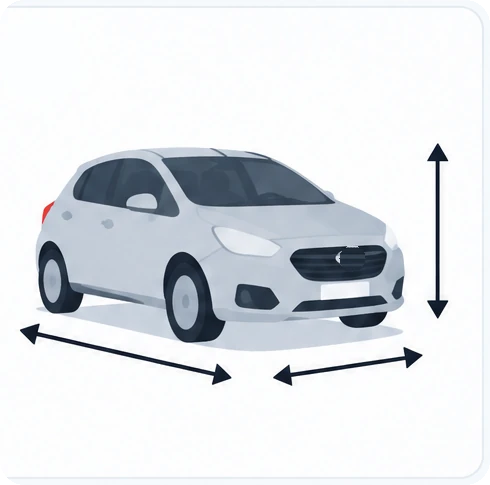
All dimensions were measured on an unladen car. shows the dimensions of the Hatchback, SW and GTi hatchback in its illustrations.
For the commercial version, gives 2 seats and an effective boot volume of 1.31 m3. The load space measures:
Scroll the table sideways.
| Load space | In metres (m) |
|---|---|
| Effective floor length | 1.458 |
| Effective width at the wheel arches | 1.036 |
| Effective width at the centre | 1.077 |
| Effective height (at the centre) | 0.916 |
| Effective height (at the roof threshold) | 0.831 |
| Effective height (below the load space cover) | 0.5 |
Your car carries several visible markings that identify it.
The manufacturer's label shows:
The tyres/paint code label shows:
Your car may have been fitted from new with tyres that have higher load and speed indices than those on the label. This does not change the tyre pressures (on cold tyres).
It depends on the engine and body style. Braked trailer values range from 600 kg for the THP 165 EAT6 up to 1,500 kg for the BlueHDi 130 S&S BVM6 hatchback, within the GTW limit.
No. Official data specifies 0 kg for the braked trailer, the unbraked trailer and the maximum nose weight on the PureTech 263 S&S BVM6 GTi.
On the towing versions it is 75 kg for the hatchback and 71 kg for the SW. The nose weight is the weight permitted on the towball.
The VIN is stamped on the chassis near the right-hand front wheel arch, under the bonnet. It also appears on a label on the dashboard that you can see through the windscreen, and on the manufacturer's label on the centre pillar.
Your registration document and the manufacturer's label on your 308 are the first places to check for your car's exact figures. Use this guide alongside them, and if you are unsure about towing with your version, ask a PEUGEOT dealer or a qualified workshop.
For help with what your dashboard is telling you, see our guides to Peugeot 308 red warning lights, Peugeot 308 orange warning lights and Peugeot 308 green and blue indicator lamps.
Don't forget to follow us on Instagram for more Peugeot guides!
This is an independent guide, not an official Peugeot publication. If in doubt, contact a PEUGEOT dealer or a qualified workshop before carrying out any work.
Related guides: Peugeot 308 model guides; Peugeot 308 ii 2015 current 12v battery and jump starting.
Cover adapted from a photograph by Vauxford — Wikimedia Commons, CC BY-SA 4.0 (AI edited).
Hello and welcome. In this article we look at the fuses on the Peugeot 308 III (2021-2025). We will cover who should change a fuse and what to know before fitting extra electrical equipment or accesso
Hello and welcome. In this article we look at the fuseboxes and fuses on the Peugeot 308 II (2015-present). We will cover where the fuseboxes are, how a fuse is changed and which functions each fuse p
Hello and welcome. In this article we look at bulb replacement on the Peugeot 308 III (2021-2025). We will cover which lamps are LED, where the front and rear lamps sit, the rear foglamp and reversing