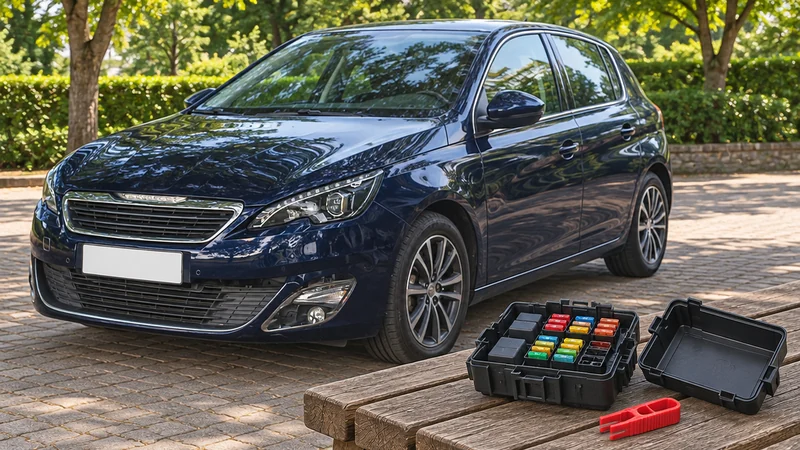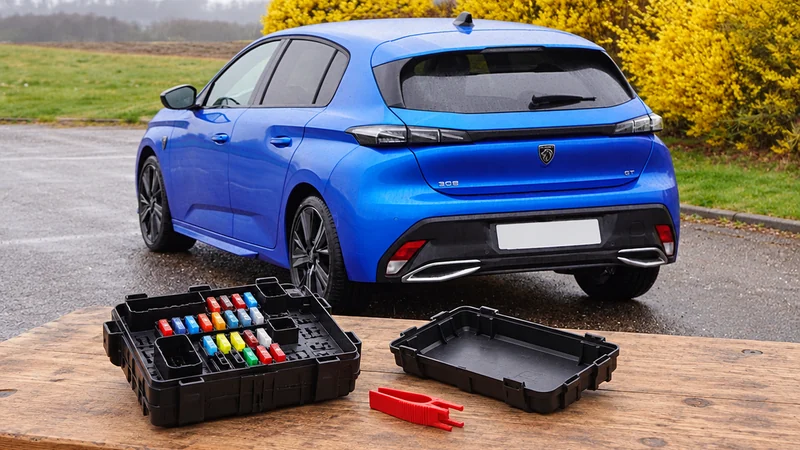
Peugeot 308 Fuse Box and Fuses (2021-2025)
Hello and welcome. In this article we look at the fuses on the Peugeot 308 III (2021-2025). We will cover who should change a fuse and what to know before fitting extra electrical equipment or accesso
Peugeot 308 II fuel tank capacity, the 6-litre reserve, which side the filler flap is on, and how to prime a diesel after running out of fuel.
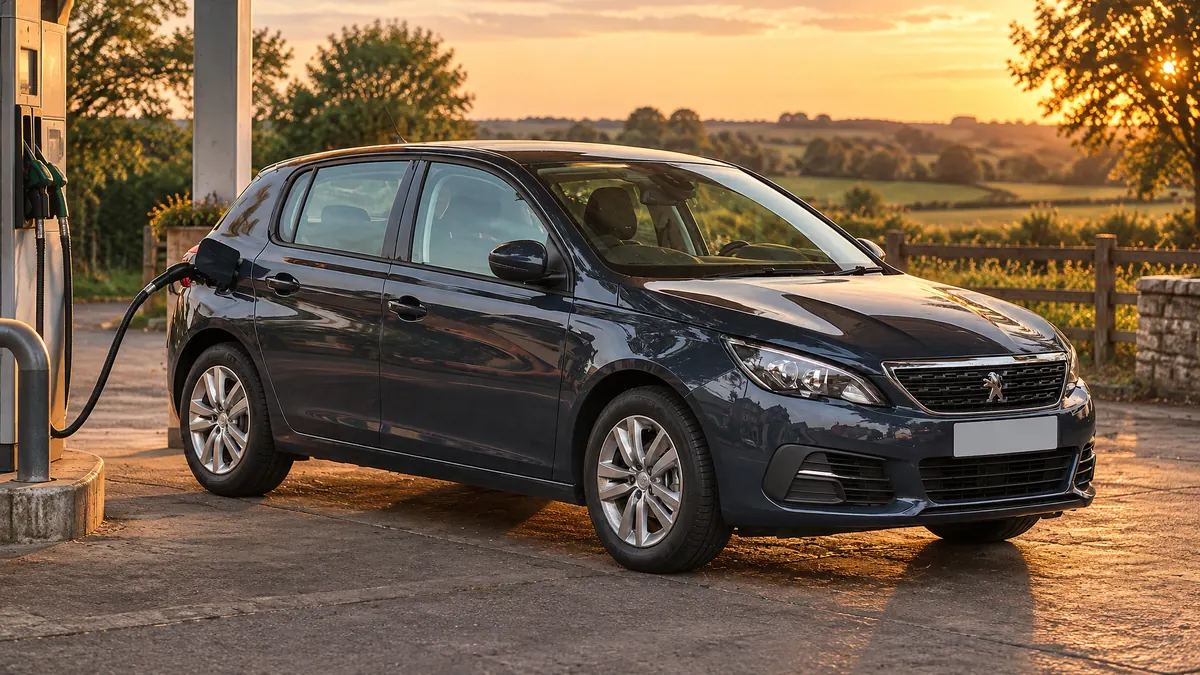
On the Peugeot 308 II (2015-present), the fuel tank holds approximately 53 litres, or 45 litres depending on the version, with a 6-litre reserve when the low fuel warning lamp lights up. Knowing the compatible petrol and diesel standards, stopping after the pump's third cut-out, and following the right priming method if a diesel runs dry helps avoid fuel-system damage.
The tank holds approximately 53 litres, or 45 litres depending on version. When the low fuel warning lamp first comes on, about 6 litres remain. A small arrow next to the lamp shows which side the filler flap is on.
Scroll the table sideways.
| Section | In short |
|---|---|
| Refuelling & fuel types | How to fill up and which fuel standards apply |
| Low fuel level | Warning lamp, 53/45 L tank capacity and 6 L reserve |
| Diesel misfuel prevention | Device that stops petrol going into a Diesel tank |
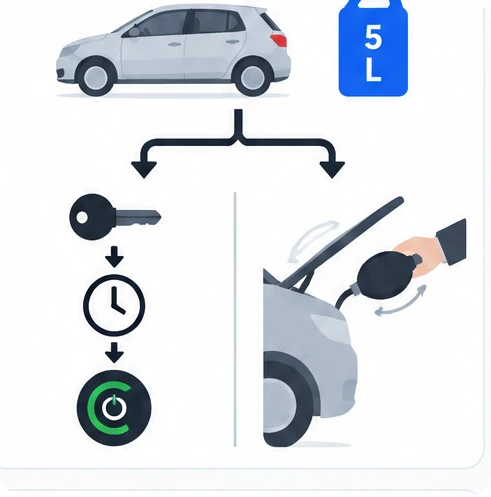
| Priming a dry diesel | Ignition vs under-bonnet priming after running out |
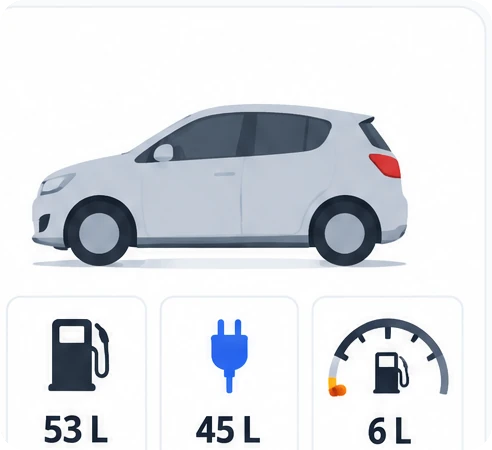
You must add at least 6 litres of fuel for the fuel gauge to register it. When you open the filler cap you may hear a noise as air rushes in. This is entirely normal and comes from the sealing of the fuel system.
Your car has a catalytic converter, which helps to reduce harmful emissions in the exhaust gases. Petrol engines must use unleaded fuel, and the filler neck is narrower so that it only accepts petrol nozzles. For the THP 225 S&S EAT8 engine, RON98 unleaded petrol is recommended for optimum engine performance.
Wrong fuel: if you have put the wrong fuel in your car, do not start the engine. Have the fuel tank drained and filled with the correct fuel first.
When the fuel level gets low, a warning lamp lights up on the instrument panel, together with a message and an audible signal.
When the lamp first comes on, about 6 litres of fuel remain. Until you add enough fuel, the lamp, message and audible signal appear every time you switch on the ignition. While you are driving, the message and audible signal repeat more and more often as the fuel level drops towards 0. Refuel as soon as possible so you do not run out. If you run out of fuel with a Diesel engine, see the Running out of fuel (Diesel) section below.
A small arrow next to the warning lamp shows which side of the car the fuel filler flap is on.
Stop & Start: never refuel while the engine is in STOP mode. Always switch off the ignition first.
Diesel versions have a mechanical device that stops you filling the tank with petrol, which avoids the risk of engine damage from the wrong fuel. Your car also has a safety system that cuts off the fuel supply in the event of an impact.
The misfuel prevention device sits in the filler neck and you can see it once the filler cap is removed. If you put a petrol nozzle into the filler neck of a Diesel car, it touches the flap, the system stays closed and you cannot fill the tank. Do not force it: use a Diesel nozzle instead.
If you run out of fuel in a Diesel car, you must prime the fuel system before the engine will run again. For diesel versions with an under-bonnet priming pump, remove the engine cover to reach the pump and follow the priming steps below. If the engine does not start first time, do not keep trying: start the procedure again from the beginning.
BlueHDi 100 S&S BVM6 and BlueHDi 130 S&S engines
If the engine does not start, repeat the procedure.
Other engines
When the low fuel warning lamp first comes on, about 6 litres of fuel remain. Refuel as soon as possible to avoid running out.
Look at the low fuel warning lamp on the instrument panel. A small arrow next to it shows which side of the car the fuel filler flap is on.
Diesel versions have a misfuel prevention device in the filler neck that stays closed when a petrol nozzle is inserted. If you do put in the wrong fuel, have the tank drained and refilled with the correct fuel before starting the engine.
Add at least 5 litres of Diesel and prime the fuel system. On BlueHDi 100 S&S BVM6 and BlueHDi 130 S&S engines you do this with the ignition, while other engines use the priming pump under the bonnet.
Refuelling your Peugeot 308 is simple once you know the steps, and the low fuel warning gives you plenty of notice. Keep this guide handy, especially if you drive a Diesel, so you know exactly what to do if you ever run out.
For more help with your 308, see our guides to the Peugeot 308 red warning lights, the Peugeot 308 orange warning lights and the Peugeot 308 green and blue indicator lamps.
Don't forget to follow us on Instagram for more Peugeot guides!
This is an independent guide, not an official Peugeot publication. If in doubt, contact a PEUGEOT dealer or a qualified workshop before carrying out any work.
Related guides: Peugeot 308 model guides; Peugeot 308 ii 2015 current 12v battery and jump starting.
Cover adapted from a photograph by Vauxford — Wikimedia Commons, CC BY-SA 4.0 (AI edited).
Hello and welcome. In this article we look at the fuses on the Peugeot 308 III (2021-2025). We will cover who should change a fuse and what to know before fitting extra electrical equipment or accesso
Hello and welcome. In this article we look at the fuseboxes and fuses on the Peugeot 308 II (2015-present). We will cover where the fuseboxes are, how a fuse is changed and which functions each fuse p
Hello and welcome. In this article we look at bulb replacement on the Peugeot 308 III (2021-2025). We will cover which lamps are LED, where the front and rear lamps sit, the rear foglamp and reversing