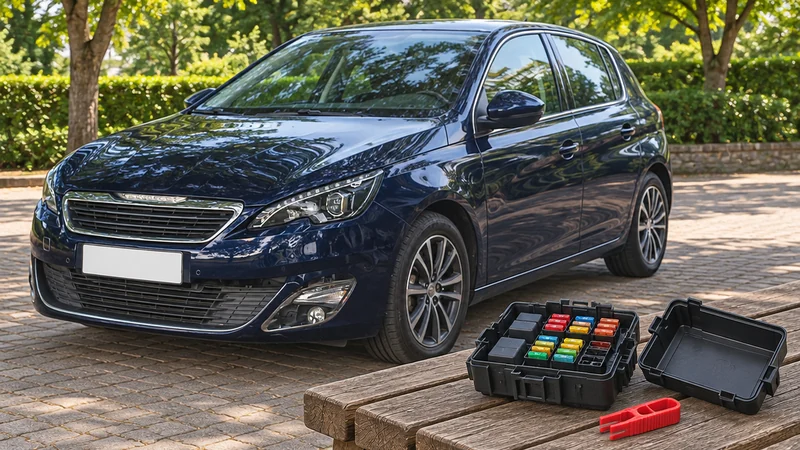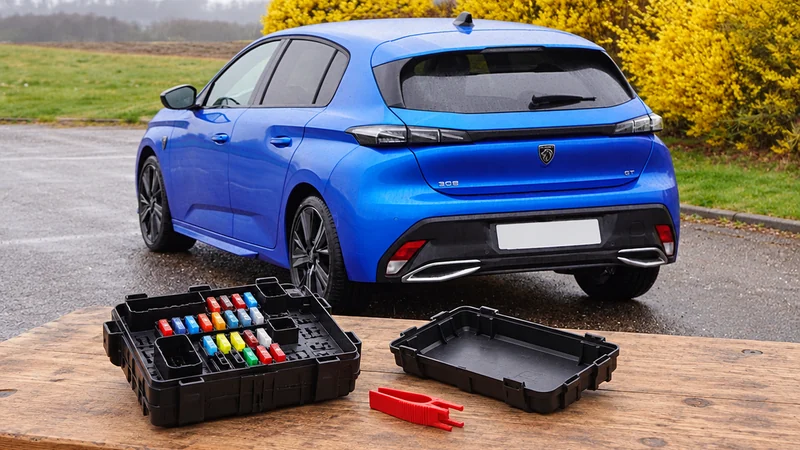
Peugeot 308 Fuse Box and Fuses (2021-2025)
Hello and welcome. In this article we look at the fuses on the Peugeot 308 III (2021-2025). We will cover who should change a fuse and what to know before fitting extra electrical equipment or accesso
How to start, drive and park your Peugeot 308 II: Keyless starting, parking brakes, hill start assist, EAT6 and EAT8 gearboxes and Stop & Start.
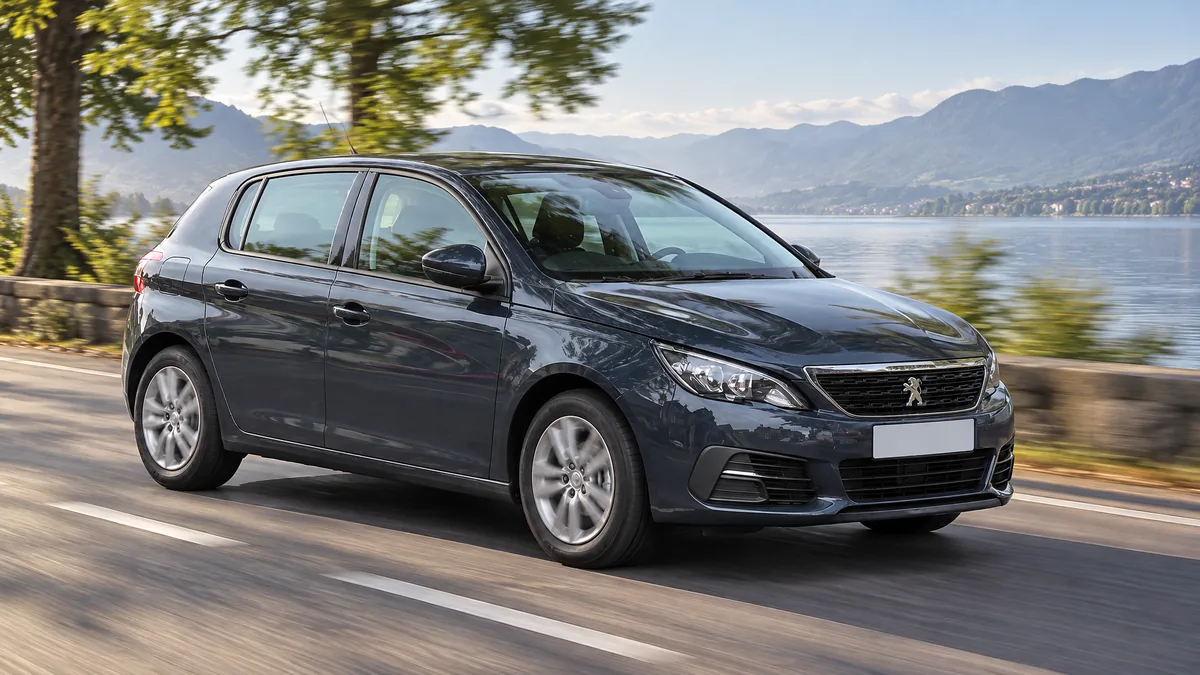
Hello and welcome. In this post, we'll look at starting, the gearbox and Stop & Start on the Peugeot 308 II (2015-present). It explains how to start and switch off the engine with Keyless Entry and Starting, use the manual or electric parking brake, rely on hill start assist, drive with the EAT6 or EAT8 automatic gearbox and get the best from Stop & Start. It also covers the on general driving, flooded roads and towing. Some features depend on the version or equipment fitted, so not everything here will apply to your 308.
Insert the electronic key in the reader, select neutral and press the clutch (manual) or select P and press the brake (automatic), then press START/STOP. The engine starts.
Scroll the table sideways.
| Section | In short |
|---|---|
| Driving recommendations | Safe driving habits, flooded roads and towing advice |
| Starting/switching off the engine,Keyless Entry and Starting | Keyless starting, switching off and back-up starting |
| Manual parking brake | Applying and releasing the lever-type parking brake |
| Electric parking brake | Automatic and manual use of the electric parking brake |
| Hill start assist | Brief hold on slopes, plus manual gearbox tips |
| EAT6 automatic gearbox | Selector positions, programmes and manual mode on EAT6 |
| EAT8 automatic gearbox | Push selector, paddles, starting and stopping on EAT8 |
| Stop & Start | How Stop & Start works and when it stays off |
Here are some basic habits for driving your 308 safely
Important safety points:
On flooded roads: strongly advises against driving on flooded roads, as this can seriously damage the engine, the gearbox and the electrical systems. If you have no choice:
If you are unsure about the state of your car afterwards, contact a PEUGEOT dealer or a qualified workshop.
Towing: a trailer puts greater demands on your car, so take particular care.
With Keyless Entry and Starting, you start the engine with the "START/STOP" button while the electronic key is inside the car.
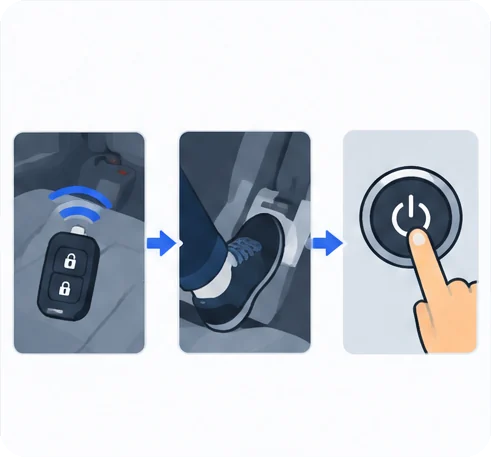
Starting:
On certain versions with an automatic gearbox, the steering column does not lock.
Switching off:
If the car is not at a standstill, the engine will not stop.
Ignition on without starting: with the key inside the car, pressing "START/STOP" without touching the pedals switches on the ignition and lets you use accessories such as the radio and lighting.
With the ignition on, the system goes into energy economy mode automatically to keep enough charge in the battery.
Back-up starting: if the key is in the recognition zone but the car does not start when you press "START/STOP":
If your 308 has a manual parking brake, you apply and release it with the lever.
If the parking brake warning lamp comes on while you are driving, with an audible signal and a message, the parking brake is still on or not fully released. When parking on a slope, turn your wheels against the kerb, apply the parking brake, engage a gear and switch off the ignition.
The electric parking brake applies itself when you switch off the engine and releases itself as you move off. You can also take over at any time with the control lever.
Safety points:
Automatic release: make sure the engine is running and the driver's door is properly closed. The brake then releases gradually as you move off.
Full release is confirmed when the brake lamp and the P lamp in the lever go off, with a message. When stationary with the engine running, do not press the accelerator unnecessarily, as you could release the parking brake.
Automatic application: with the car stationary, the brake applies when you switch off the ignition. The brake lamp and the P lamp in the lever come on, with a message. Automatic application does not take place if the engine has stalled or is in Stop & Start STOP mode.
Manual release: with the ignition on or the engine running:
The brake lamp and the P lamp go off, with a message and an audible signal until the doors are closed. If you push the lever without pressing the brake pedal, the brake stays on and a message appears.
Manual application: with the car stationary, pull the lever briefly. The lamp in the lever flashes to confirm, then the brake lamp and P lamp come on with a message. Use the same method to hold the car with the engine running.
Before leaving the car: check that the lamps on the instrument panel and the lever are on steadily. If the brake is not applied, an audible signal sounds and a message appears when you open the driver's door.
Parking with the brake released: in very cold conditions (risk of ice), when being towed and in a car wash tunnel, recommends not applying the parking brake. Hold the car by engaging a gear or P, or by putting a chock against a wheel.
With the EAT8 gearbox, P is engaged automatically when you switch off the ignition and the wheels are blocked. see the EAT8 section below for leaving the car in free-wheeling mode.
Deactivating automatic operation: in some situations, such as extreme cold or towing a caravan or broken-down vehicle, you may need to switch off automatic operation. The procedure begins like this:
Follow the rest of this procedure.
Hill start assist holds your 308 for approximately 2 seconds when you start on a gradient, giving you time to move your foot from the brake to the accelerator. It cannot be deactivated.
It only works when:
Do not leave the car while hill start assist is holding it. If you need to leave it with the engine running, apply the parking brake manually and check that its warning lamp is on steadily, not flashing. If a fault occurs, warning lamps come on with a message: contact a PEUGEOT dealer or a qualified workshop.
5-speed manual gearbox, engaging reverse:
Only engage reverse with the car stationary and the engine at idle. For safety and easier starting, always select neutral and press the clutch pedal. On the 6-speed manual gearbox, move the lever fully to the right to engage 5th or 6th gear.
The EAT6 is a 6-speed automatic gearbox. You can let it change gear automatically, or change gear yourself in sequence.
Scroll the table sideways.
| Position | What it does |
|---|---|
| P (Park) | Car immobilised, parking brake applied or released, engine starting |
| R (Reverse) | Reversing, with the car stationary and the engine at idle |
| N (Neutral) | Car immobilised, parking brake applied, engine starting |
| D | Automatic operation |
| M +/- | Manual operation: push backwards to go up, forwards to go down |
The selector module also has Sport and Snow programme buttons. On cars with the Driver Sport Pack, steering-mounted controls let you change gear: press behind the right control to go up and behind the left to go down. They cannot select neutral or engage or disengage reverse.
Instrument panel: it shows P, R, N, D, S (Sport), the Snow symbol, 1 to 6 for the gear in manual operation, and - when an instruction is not accepted in manual operation.
Starting off:
If you select N by mistake while driving, let the engine return to idle, then select D to accelerate. With the engine at idle and the brakes released, the car moves in R, D or M even without the accelerator. Never leave children unattended with the engine running, and for maintenance with the engine running, apply the parking brake and select P.
Automatic operation: select D. The gearbox picks the best gear for your driving style, the road and the load.
Sport and Snow: press the button once the engine has started. Sport shows "S" and favours dynamic driving. On cars with the Driver Sport Pack, the "S" button is replaced by "SPORT". Snow shows its symbol and adapts the gearbox to slippery roads, improving starting and traction when grip is poor. Press the same button again to return to auto-adaptive mode.
Manual operation: select M to change through the six gears in sequence.
To save fuel during a long standstill with the engine running, such as a traffic jam, select N and apply the parking brake.
The EAT8 is an 8-speed automatic gearbox with a push selector. It also has a manual mode using paddles behind the steering wheel.
Scroll the table sideways.
| Position | What it does |
|---|---|
| P (Park) | Parks the car, front wheels blocked |
| R | Reverse gear |
| N (Neutral) | Moving the car with the ignition off, or free-wheeling |
| D | Automatic mode |
| M | Manual mode with the steering-mounted controls |
Push selector: it has a P button, an Unlock button (press and hold it before pushing the selector, with your foot on the brake), an M button and P, R, N, D status indicators. Push the selector forwards (N or R) or rearwards (N or D) once or twice, passing the point of resistance if needed. It returns to its starting position when released. For example, from P, pushing forwards twice without passing the resistance goes P to N to R, while one push past the resistance goes straight to R.
Paddles: in M or D, pull "+" or "-" towards you and release to change up or down. They cannot select neutral or engage or disengage reverse.
Instrument panel: it shows P, R, N, D1 to D8, S (Sport programme or Driver Sport Pack), M1 to M8 and - when an instruction is not processed in manual mode. If you open the driver's door with the ignition on, a message prompts you to select P.
Unlocking the gearbox: from P, fully depress the brake, press Unlock and, holding both, select another mode. From N, below 3 mph (5 km/h), fully depress the brake and, holding it, select another mode.
Engaging reverse:
Manual mode: from D, press M and its green lamp comes on. To leave, push forwards once to return to D, or press M so the lamp goes off. The gearbox only changes gear if vehicle and engine speed allow it. In automatic mode, kick-down gives maximum acceleration, and the paddles let you select a gear temporarily.
Starting off from P:
From N, fully depress the brake, start the engine, then push rearwards for D, or forwards while pressing Unlock for R. Never try to start the engine by pushing the car.
Stopping: the car must be stationary to switch off the ignition. P engages automatically and immediately when you switch off, except from N, where it engages after 5 seconds to allow free-wheeling. Opening the driver's door in N sounds a signal until you close it. Check that P is engaged and the electric parking brake is applied, and apply it manually if not. The lamps in the selector, the parking brake lever and the instrument panel must be on.
Driver Sport Pack: press the front of the SPORT/ECO control with the engine running and its lamp comes on. The gearbox delays changing up for more dynamic driving. Press again to switch it off. It switches off with the ignition and has no effect when towing a connected trailer. does not recommend it with ASR deactivated, low fuel or low AdBlue level.
Stop & Start puts the engine into standby (STOP mode) when the car is stopped, for example at red lights or in queues. It restarts automatically (START mode) when you want to move off. It is designed mainly for town driving to cut fuel use, emissions and noise, and it does not affect the car's functions, including braking.
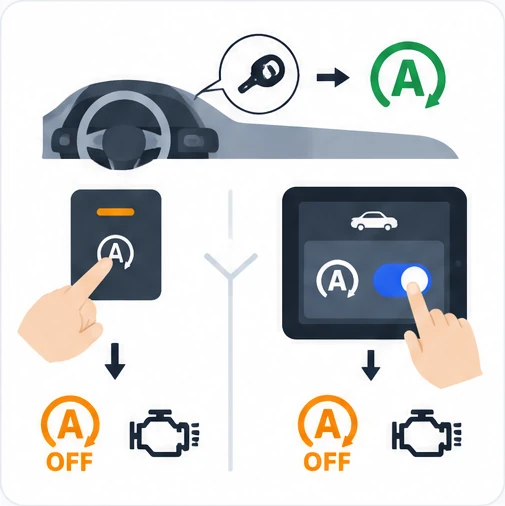
Switching it off or on: it is active by default when you switch on the ignition.
Always switch off Stop & Start before working under the bonnet, so the engine cannot restart and injure you. It is also strongly recommended before driving into a flooded area.
Main conditions:
STOP mode: with a manual gearbox, the engine stops when you select neutral and release the clutch, below 2 mph (3 km/h) with the BlueHDi 130 S&S engine or at a standstill with other engines. With an automatic gearbox, it stops at a standstill when you press the brake or select N. A time counter adds up standby time and resets each time you switch on the ignition.
The engine does not go into standby on a steep slope, if the car has not exceeded 6 mph (10 km/h) since the last start, with the electric parking brake applied or being applied, when needed for cabin comfort, with demisting active, or while braking assistance is in use. The lamp then flashes for a few seconds and goes off. After a restart, STOP mode may not be available until 5 mph (8 km/h), and during parking it is unavailable for a few seconds after leaving reverse or turning the wheel.
START mode:
The engine also restarts by itself when the electric parking brake is being applied or the speed goes above 2 mph (3 km/h).
Insert the electronic key in the reader, select neutral and press the clutch (manual) or select P and press the brake (automatic), then press "START/STOP". The engine starts.
Avoid it where you can. If you have no choice, the water must be no deeper than 15 cm, Stop & Start must be off and you must not exceed 6 mph (10 km/h) or stop the engine.
All the conditions must be met, including a closed driver's door, a fastened driver's seat belt, enough battery charge and an outside temperature between 0°C and 35°C. It also stays off on steep slopes, with demisting active or if you have not exceeded 6 mph (10 km/h) since starting.
Come to a stop, press the brake pedal and then the Unlock button, and while holding both, select R.
Knowing how the parking brake, gearbox and Stop & Start behave makes everyday driving in your Peugeot 308 easier and safer. Keep this guide handy, and check for any procedure covered only in part here.
If a lamp comes on while you drive, see our guides to Peugeot 308 red warning lights, Peugeot 308 orange warning lights and Peugeot 308 green and blue indicator lamps.
Don't forget to follow us on Instagram for more Peugeot guides!
This is an independent guide, not an official Peugeot publication. If in doubt, contact a PEUGEOT dealer or a qualified workshop before carrying out any work.
Related guides: Peugeot 308 model guides.
Cover adapted from a photograph by Vauxford — Wikimedia Commons, CC BY-SA 4.0 (AI edited).
Hello and welcome. In this article we look at the fuses on the Peugeot 308 III (2021-2025). We will cover who should change a fuse and what to know before fitting extra electrical equipment or accesso
Hello and welcome. In this article we look at the fuseboxes and fuses on the Peugeot 308 II (2015-present). We will cover where the fuseboxes are, how a fuse is changed and which functions each fuse p
Hello and welcome. In this article we look at bulb replacement on the Peugeot 308 III (2021-2025). We will cover which lamps are LED, where the front and rear lamps sit, the rear foglamp and reversing