Hello and welcome. In this post, we’ll look at driving your Peugeot 3008 III: starting and switching off, the electric parking brake, the gearboxes and drive selector, the driving modes and Stop & Start. Some features depend on your engine, version or equipment, so you may not see all of them on your 3008.
Quick Reference
Scroll the table sideways.
Section
In short
Driving recommendations
Safe driving rules, flooded roads and electric vehicle noises
Starting/switching off the engine
How to start and switch off each version
Electric parking brake
Applying, releasing and automatic parking brake operation
Automatic gearbox (EAT6)
Push selector, paddles and display for petrol cars
Electric dual-clutch automatic gearbox (e-DCS6/7)
Hybrid gearbox modes, electric motor and e-functions
Drive selector (Electric)
Electric drive selector modes and deceleration paddles
Driving modes
Normal, Eco, Sport, Electric, Hybrid and 4WD modes
Stop & Start (Petrol)
How Stop & Start works and when it stays off
Driving recommendations
This section starts with a few simple rules for driving your 3008 safely.
Observe the driving regulations and stay vigilant whatever the traffic conditions.
Watch your surroundings and keep your hands on the wheel, so you can react to anything at any time.
Drive smoothly, anticipate the need to brake and keep a longer safety distance, especially in bad weather.
Stop the car before doing anything that needs sustained attention, such as changing settings.
On long trips, take a break every 2 hours.
Important safety points:
Never leave the engine running in a closed space without enough ventilation. The engine gives off toxic exhaust gases such as carbon monoxide, with a danger of poisoning and death.
In very severe wintry conditions (below -23°C), let the engine run for 4 minutes before moving off. This protects the engine and gearbox.
Never drive with the parking brake applied. The braking system can overheat and be damaged.
Never park or leave the engine running on a flammable surface, such as dry grass or dead leaves. The exhaust system is very hot, even several minutes after the engine stops, so there is a risk of fire.
Never drive over surfaces covered with vegetation, such as a field, an overgrown country lane or a grassy verge. Tall grass, dead leaves, crops or debris could touch the very hot exhaust or other hot systems and start a fire.
Do not leave anything in the cabin that could act like a magnifying glass in the sun. It could cause a fire or damage the interior surfaces.
Never leave the car unattended with the engine running. If you have to, apply the parking brake and put the gearbox or drive selector into neutral or position N or P, depending on version.
Never leave children in the car unsupervised.
On flooded roads: driving through floodwater is strongly advised against, as it could seriously damage the engine or electric motor, the gearbox and the electrical systems. If you really must drive through a flooded section:
Check the depth: make sure the water is no deeper than 15 cm, allowing for waves from other road users.
Switch off Stop & Start: deactivate the Stop & Start function.
Drive slowly: go as slowly as possible without stalling, and never above 6 mph (10 km/h).
Keep going: do not stop and do not switch off the engine.
Dry the brakes: once you are out and it is safe, brake lightly several times to dry the brake discs and pads.
If you are unsure about the state of your car afterwards, contact a PEUGEOT dealer or a qualified workshop.
Noise (Electric): because the car is so quiet, you need to pay particular attention, and always check the area right around the car when manoeuvring. At speeds of up to 19 mph (30 km/h), the pedestrian horn warns other road users that you are there. The cooling fan comes on during charging to cool the on-board charger and the traction battery. Inside, you may also hear some perfectly normal noises:
The traction battery relay when starting.
The vacuum pump when braking.
Starting/switching off the engine
The electronic key must be inside the passenger compartment, although it is also detected in the boot. If the key is not detected, a message appears: move the key so the engine can be started or switched off. If there is still a problem, contact a PEUGEOT dealer or a qualified workshop.
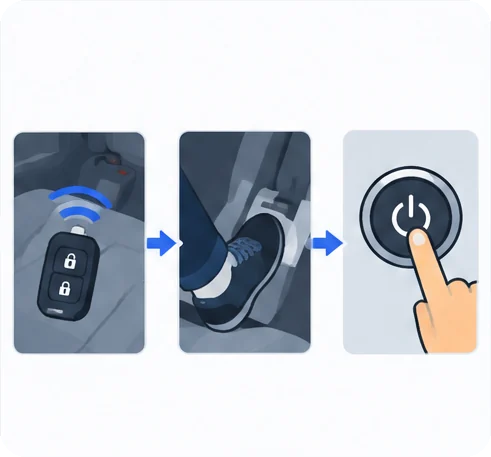
Starting:
Select P or N: select mode P or N on the automatic gearbox.
Brake: depress the brake pedal.
Press START/STOP: press the “START/STOP” button, keeping your foot on the pedal until the engine starts.
If one of the starting conditions is not met, a message is displayed. Sometimes a message tells you to turn the steering wheel while pressing “START/STOP” to help unlock the steering column.
Petrol engines: below -25°C, it is advisable to idle for at least 1 minute before driving off. After a cold start, pre-heating the catalytic converter can cause noticeable engine vibrations for up to 2 minutes (accelerated idle speed).
Hybrid engines: the car always starts with the petrol engine, so the catalytic converter works efficiently and brake assist is available. After a few moments, the petrol engine may stop if conditions allow (traction battery charge, outside temperature, torque demand, selected driving mode).
Starting rechargeable hybrid vehicles:
Brake and press: fully depress the brake pedal and press the START/STOP button for approximately 2 seconds.
Wait for READY: keep your foot on the pedal until the READY indicator lamp comes on, confirmed by an audible signal.
Wait for the READY lamp before leaving Park mode. The system starts in Electric mode by default, and decides whether to start the petrol engine depending on things like battery charge level or outside temperature. You can change the driving mode at any time with the mode selector. In Electric mode the car makes no noise, so take extra care with pedestrians and cyclists, who may not hear you coming despite the pedestrian horn.
Switching off:
Parking brake: immobilise the car with the parking brake.
Select P: select mode P on the automatic gearbox.
Press START/STOP: press the START/STOP button.
Check READY (rechargeable hybrid): before leaving the car, check that the READY indicator lamp has gone off.
The automatic gearbox locks in mode P. If the car is not immobilised, the engine will not stop. With the engine off, braking and steering assistance are also cut off, so there is a risk of losing control. Never leave your car with the electronic key still inside.
Starting electric vehicles: the drive selector must be in mode P.
Brake and press: fully depress the brake pedal and briefly press the START/STOP button.
Wait for READY: keep your foot on the brake until the READY indicator lamp comes on and an audible signal sounds. The car is now ready to drive.
Select a mode: with your foot on the brake, select mode D or R.
How to use the electric parking brake
In automatic mode, the electric parking brake applies itself when you switch off the engine and releases when you move off. Automatic mode is on by default, but it can be deactivated in certain situations. At any time with the engine running:
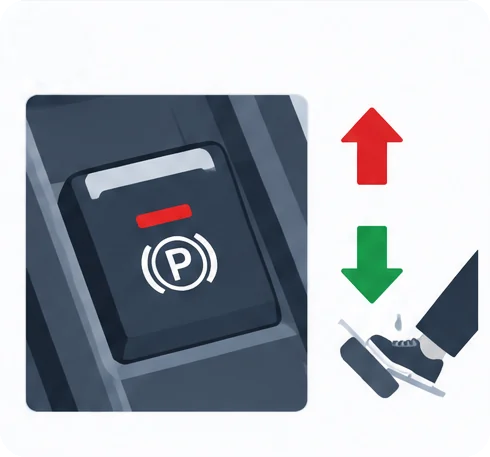
To apply the parking brake, briefly pull the control.
To release it, briefly push the control while pressing the brake pedal.
You must apply the electric parking brake whenever the car is stationary.
Indicator lamp: the lamp on the instrument panel and on the control comes on, with the message “Parking brake applied”, when the brake is applied. It goes out, with the message “Parking brake released”, when the brake is released. It flashes when you make a manual request to apply or release the brake.
Safety points:
If the battery fails, the electric parking brake will not work. As a safety measure, with an automatic gearbox or drive selector, if the parking brake is not applied, place the supplied chock against one of the wheels to immobilise the car. Then contact a PEUGEOT dealer or a qualified workshop.
Before leaving the car, check the parking brake is applied: the lamps on the instrument panel and the control must be on fixed.
If the parking brake is not applied, an audible signal sounds and a message appears when you open the driver's door.
Never leave a child alone in the car, as they could release the parking brake.
When parking on a steep slope, heavily loaded or when towing, turn the wheels towards the pavement and select mode P.
When towing, the car is approved for parking on slopes of up to 12%.
Manual release: with the ignition on or the engine running:
Brake: press the brake pedal.
Push the control: keeping your foot on the brake, briefly push the control.
If you do not press the brake pedal, the parking brake stays applied and a message is displayed.
Manual application: with the car stationary, briefly pull the control. The control lamp flashes to confirm the request.
Automatic release: first make sure the engine is running and the driver's door is closed. The brake then releases gradually as you move off.
Brake: depress the brake pedal.
Select a mode: select D, M or R with an automatic gearbox, or D or R with a drive selector.
Move off: release the brake pedal and depress the accelerator pedal.
If the brake does not release automatically, check that the front doors are properly closed. When stationary with the engine running, do not press the accelerator unnecessarily, as the parking brake could release.
Automatic application: with the car stationary, the parking brake applies automatically when you switch off the engine. It does not apply automatically if the engine stalls or goes into STOP mode with Stop & Start. In automatic mode, you can still apply or release the brake manually at any time with the control.
Special cases: to hold the car with the engine running, briefly pull the control. In very cold conditions (ice), applying the parking brake is not recommended: place the chock against one of the wheels instead.
Automatic gearbox (EAT6)
Petrol versions use a 6-speed automatic gearbox with a push selector. It also has a manual mode, with gear changes using paddles behind the steering wheel.
Scroll the table sideways.
Position
What it does
P
Auto Park: press this button to park. The front wheels are blocked.
R
Reverse.
N
Neutral: to free-wheel and move the car with the ignition off.
D
Automatic mode: the gearbox changes gear according to your driving style, the road profile and the load. It also manages braking when you release the accelerator.
M
Manual mode: press this button, then change gear with the steering-mounted controls.
Using the selector: in mode N, with your foot on the brake, push the selector without passing the point of resistance. Forwards selects R, backwards selects D. Let go of the selector fully after each push so it returns to its starting position.
Quick change between D and R (avoiding N):
In mode R, push backwards past the point of resistance to select D.
In mode D, push forwards past the point of resistance to select R.
To return to N, push without passing the point of resistance.
Steering-mounted paddles (depending on equipment): in mode M or D, pull the “+” or “-” paddle towards you and release it to shift up or down a gear. The paddles cannot select neutral or engage or disengage reverse.
Scroll the table sideways.
Display
Meaning
P
Parking
R
Reverse
N
Neutral
D1...6
Automatic forward gear
M1...6
Manual forward gear
The gearbox status appears when you switch on the ignition and stays for a few seconds after you switch it off.
Operation: only appropriate mode changes are accepted. If you need to press the brake pedal to change mode, a message appears on the instrument panel.
With the engine running and the brakes released, the car moves off in R, D or M even without pressing the accelerator.
Never press the accelerator and brake pedals at the same time, as this can damage the gearbox.
If you open the driver's door in mode N, an audible signal sounds and mode P is engaged. The signal stops when you close the door.
Below 3 mph (5 km/h), opening the driver's door engages mode P, so there is a risk of sudden braking.
If the battery fails, you must place the chock(s) from the tool kit against one of the wheels to hold the car.
Automatic mode: the gearbox picks the best gear for the outside temperature, road profile, load and driving style. For maximum acceleration, press the accelerator fully down (kick-down): the gearbox changes down or holds the gear until maximum engine speed. You can use the paddles to select a gear temporarily if vehicle and engine speeds allow.
Manual mode: the gearbox only changes gear if vehicle and engine speeds allow.
Electric dual-clutch automatic gearbox (e-DCS6/7)
Hybrid versions use a 6-speed and rechargeable hybrid versions a 7-speed electrified dual-clutch automatic gearbox, both with a push selector and a manual mode using the paddles. It includes an electric motor, which improves the petrol engine's performance, reduces fuel consumption and allows all-electric driving.
Scroll the table sideways.
Position
What it does
P
Auto Park: press this button to park. The front wheels are blocked.
R
Reverse.
N
Neutral: to free-wheel and move the car with the ignition off.
D
Automatic mode: gear changes follow your driving style, the road profile and the load.
M (Hybrid)
Manual mode: press this button, then change gear with the steering-mounted controls.
B (Rechargeable hybrid)
Automatic mode with regenerative braking: press this button to activate it. The gearbox also manages braking when you release the accelerator.
Using the selector: in mode N, with your foot on the brake, push without passing the point of resistance. Forwards selects R, backwards selects D. Let go fully after each push.
In mode R, push backwards past the point of resistance to select D.
In mode D, push forwards past the point of resistance to select R.
To return to N, push without passing the point of resistance.
Paddles (depending on equipment): in mode M or D, pull the “+” or “-” paddle towards you and release it to shift up or down a gear. They cannot select neutral or engage or disengage reverse.
Scroll the table sideways.
Display
Meaning
P
Parking
R
Reverse
N
Neutral
D
Automatic forward gear
M1...6
Manual forward gear (Hybrid)
B
Automatic forward gear with regenerative braking (Rechargeable hybrid)
The gear engaged is shown in Manual and Sport modes, but not during all-electric driving. The gearbox status stays on the instrument panel for a few seconds after you switch off the ignition.
Electric motor (Hybrid): it is used for the first start, provides the 12 V supply through the DC/DC converter and gives electric assistance to the petrol engine. It can:
Add torque to the gearbox, optimising the petrol engine's performance.
Recover energy when slowing down and turn it into electricity for driving or for the car's electrical accessories.
Recharge the 48 V traction battery when its charge is too low.
Provide all-electric driving.
This is done through the e-Boost, e-Creeping, e-Launch, e-Queueing and e-Parking functions. A manual mode, e-Auto, lets you activate or deactivate the restart of the petrol engine while driving. In mode P or N, engine compartment noise may increase as the traction battery starts charging: this is normal and not a fault.
Operation: only appropriate mode changes are accepted, and a message tells you if you need to press the brake pedal.
With the engine running and the brakes released, the car moves off in R, D or M even without pressing the accelerator.
Never press the accelerator and brake pedals at the same time, as this can damage the gearbox.
If you open the driver's door in mode N, an audible signal sounds and mode P is engaged. It stops when you close the door.
Below 3 mph (5 km/h), opening the driver's door engages mode P, so there is a risk of sudden braking.
If the battery fails, you must place the chock(s) from the tool kit against one of the wheels to hold the car.
Hybrid automatic mode functions: these use the electric motor for extra power or zero-emission driving. They only work if the traction battery is sufficiently charged, and none of the five can be deactivated.
e-Launch: with the petrol engine off, the car drives in electric mode without affecting performance. It moves off as soon as you press the accelerator with D or R selected.
e-Creeping: with the petrol engine off, releasing the brake pedal moves the car forwards or backwards in electric mode with D or R selected, without pressing the accelerator.
e-Queueing: follows a queue with several stops and restarts, using e-Creeping, e-Launch and electric driving.
e-Parking: carries out parking manoeuvres at reduced speed with the electric motor, with D or R selected.
e-Boost: runs the petrol engine and electric motor together. With the traction battery fully charged, pressing the accelerator fully (kick-down) gives more torque than the petrol engine alone.
Repeated use of the brake pedal makes the petrol engine restart to provide braking assistance.
Rechargeable hybrid automatic mode: the gearbox picks the best gear for the outside temperature, road profile, load and driving style. Kick-down gives maximum acceleration, and the paddles can select a gear temporarily if vehicle and engine speeds allow.
Manual mode: the gearbox only changes gear if vehicle and engine speeds allow.
Drive selector (Electric)
Electric versions use a pulse drive selector with regenerative braking. It manages traction based on your driving style, the road profile and the load, and manages engine braking when you release the accelerator.
Scroll the table sideways.
Position
What it does
P
Park: the front wheels are locked and the button lights up.
R
Reverse: engage it with your foot on the brake pedal.
N
Neutral: to move the car with the ignition off and let it free-wheel.
D
Drive (automatic forward gear) with regenerative braking.
Paddles: with the brake level selection, the paddles change the deceleration level. Pull the “+” paddle towards you and release it to decrease deceleration, or the “-” paddle to increase it.
When you switch on the ignition, the instrument panel shows P, R, N or D.
Using the selector: in mode N, with your foot on the brake, push without passing the point of resistance. Forwards selects R, backwards selects D. Let go fully after each push.
In mode R, push backwards past the point of resistance to select D.
In mode D, push forwards past the point of resistance to select R.
To return to N, push without passing the point of resistance.
Regenerative braking: the Brake level function emulates engine braking with three deceleration levels, slowing the car without you pressing the brake pedal. The car slows more quickly when you release the accelerator.
Driving modes
The modes available depend on your engine and equipment. To choose one:
Open the modes: press the driving mode control to show the modes on the touch screen.
Choose: select the mode you want on the left side of the window.
Close: close the window by clicking the cross.
The selected mode works straight away and stays shown on the instrument panel, except Normal mode. On an electric car, you cannot select a mode until the READY lamp is displayed. Cars with Advanced Grip Control have extra modes.
Petrol and hybrid versions (Normal is selected each time you switch on the ignition):
Normal: restores the default settings.
Eco: reduces energy use by reducing heating and air conditioning performance, without switching them off.
Sport: with an automatic gearbox, gives more dynamic driving through the power steering, accelerator and gear changes, and can show the car's dynamic settings and change the display colour (depending on version). Sport mode deactivates Stop & Start / e-Auto mode.
Coasting mode (Petrol): depending on version and engine, in mode D with Eco or Normal, gradually and fully releasing the accelerator lets the car free-wheel, which can save fuel. A drop in engine speed and noise is normal.
Rechargeable hybrid versions (Electric is selected each time you switch on the ignition):
Electric: drives on 100% electrical energy, with a maximum speed of approximately 84 mph (135 km/h). If conditions do not allow it, “Electric mode currently unavailable” appears and the car switches to Hybrid mode.
Hybrid: optimises fuel consumption by running the two types of engine alternately or together. You can drive on 100% electric if battery charge is sufficient and acceleration is moderate.
Sport: for maximum performance. Electric power supplements the petrol engine while there is energy left in the battery.
Electric mode needs an adequate battery charge level, so charging after each drive is recommended, and an outside temperature between approximately -5°C and 45°C. To leave it manually, press the accelerator fully or select another mode. If the car is unused for several months, the petrol engine may restart even with a charged battery.
After several engine starts without the engine warming up enough, Electric mode may be temporarily unavailable because of fuel diluting in the oil, and “Electric mode unavailable: automatic operation in progress” appears. To restore it, drive approximately 50 miles (80 km) in motorway conditions or approximately 125 miles (200 km) in town. This causes no mechanical or electrical damage and can happen several times in the car's life.
Electric versions (Normal is selected each time you switch on the ignition):
Normal: optimises driving range and dynamic performance.
Eco: optimises energy use by reducing heating and air conditioning output (without switching them off) and limiting motor torque and power.
Sport: more dynamic driving through the power steering, accelerator and gear changes, with the option of showing dynamic settings on the instrument panel.
4WD: on some electric cars, drives all 4 wheels continuously for better grip at low and moderate speeds. It suits snow-covered roads, difficult terrain such as mud or sand, and ford crossings at moderate speed.
In Normal and Eco, you can always get maximum torque and power by pressing the accelerator fully (kick-down).
How to switch off Stop & Start
Stop & Start puts the engine on standby (STOP mode) when the car is stationary, for example at red lights or in traffic jams. It restarts automatically (START mode) as soon as you show you want to move off. It is designed mainly for town use, to reduce fuel consumption, exhaust emissions and noise when stationary. It does not affect the car's functions, in particular the braking.
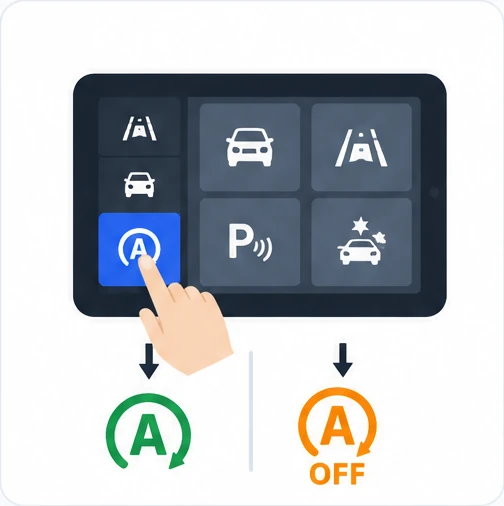
Deactivation/Reactivation: the function is on by default when you switch on the ignition. You can change it in the ADAS touch screen application or through the Shortcuts for driving aids. A message on the instrument panel confirms the change. If you switch it off while the engine is in STOP mode, the engine restarts immediately.
Indicator lamps: one lamp shows the function is active with the engine on standby (STOP mode). Another shows the function is deactivated or faulty.
Before doing anything under the bonnet, deactivate Stop & Start so the engine cannot restart and injure you.
Before driving into a flooded area, it is strongly recommended to deactivate Stop & Start. See the flooded roads advice above.
Main conditions for operation:
The driver's door is closed.
The driver's seat belt is fastened.
The battery charge is sufficient.
The engine temperature is within its normal operating range.
The outside temperature is between 0°C and 35°C.
STOP mode: the engine goes on standby as soon as you show you want to stop:
In mode D, or with button M pressed, when you press the brake pedal until the car stops.
In mode N, with the car stationary.
A time counter adds up the time spent on standby during the journey. It resets to zero each time you switch on the ignition.
When the engine stays running: as well as when the conditions above are not met, the engine does not go on standby:
On a steep slope, going up or down.
With Sport mode selected (depending on equipment).
When needed to keep the cabin at a comfortable temperature.
When demisting is active.
In these cases, the indicator lamp flashes for a few seconds, then goes off.
Frequently Asked Questions
How do I start my Peugeot 3008 with an automatic gearbox?
With the electronic key in the car, select mode P or N and depress the brake pedal. Then press the “START/STOP” button, keeping your foot on the pedal until the engine starts.
Why won't my 3008 parking brake release automatically?
The engine must be running and the driver's door closed for automatic release. If it still does not release, check that the front doors are properly closed.
Why is Stop & Start not stopping the engine on my 3008?
The engine stays running if a condition is not met, such as the driver's door open, seat belt unfastened or outside temperature outside 0°C to 35°C. It also stays running on a steep slope, in Sport mode, when needed for cabin comfort or when demisting is active.
Why does my plug-in hybrid 3008 say Electric mode is unavailable?
Electric mode needs enough battery charge and an outside temperature between approximately -5°C and 45°C. After several engine starts without warming up, it can also be temporarily unavailable until you drive approximately 50 miles (80 km) on the motorway or approximately 125 miles (200 km) in town.
Knowing how your 3008 starts, parks and changes modes makes every journey easier and safer. Keep this guide handy, and for full details on any system, ask a PEUGEOT dealer or a qualified workshop.
Don't forget to follow us on Instagram for more Peugeot guides!
This is an independent guide, not an official Peugeot publication. If in doubt, contact a PEUGEOT dealer or a qualified workshop before carrying out any work.
Hello and welcome. In this article we look at the 12 V battery on the Peugeot 3008 II (2016-present). We will cover jump starting, charging with a battery charger, and disconnecting and reconnecting t
Hello and welcome. In this article we look at tyre pressures and the under-inflation detection system on the Peugeot 3008 II (2016-present). We will cover how the system works, what to do when the ale
Hello and welcome. In this article we look at the technical specifications of the Peugeot 3008 II (2016-present). We will cover engine figures, towed loads, hybrid motor and battery details, and where