Hello and welcome. In this post, we'll look at starting, the gearbox and Stop & Start on the Peugeot 208 I (2015-present). It covers starting and switching off the engine, the parking brake, the manual and EAT6 automatic gearboxes, the gear shift indicator, hill start assist and the Stop & Start system. It covers the Peugeot 208 I (2015-present), including vehicles produced from 06/08/2018. Some features depend on the engine, version or equipment, so not everything here will apply to your 208. Some features depend on the engine, version or equipment, so not everything here will apply to your 208.
Why does my Peugeot 208 vibrate after a cold start?
On petrol engines, the engine runs at an accelerated idle speed for up to about 2 minutes after a cold start to preheat the catalytic converter. You will clearly feel vibrations when stationary during this time.
Quick Reference
Scroll the table sideways.
Section
In short
Starting - Switching off the engine
Ignition positions, starting, immobiliser and switching off
Parking brake
Releasing and applying the lever, and parking on slopes
Manual gearbox
Engaging top gears and reverse on 5 and 6-speed
Automatic gearbox (EAT6)
Selector positions, modes, programmes, parking and back-up mode
Gear shift indicator
Recommends the best gear to save fuel
Hill start assist
Holds the car briefly when moving off on slopes
Stop & Start
How STOP and START modes work, and switching off
Starting - Switching off the engine
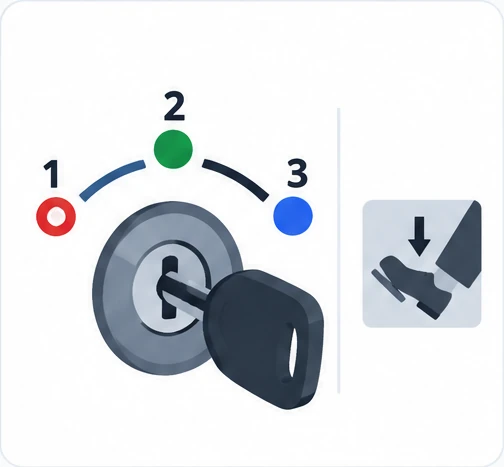
The ignition switch has three positions:
1: Stop position.
2: Ignition on position.
3: Start position.
Do not hang heavy objects on the key or the remote control. Their weight pulls on the key blade in the ignition switch and could cause a malfunction.
To start the engine:
Prepare the gearbox: with a manual gearbox, put the gear selector in neutral and fully depress the clutch pedal. With an automatic gearbox, put the selector at P or N and fully depress the brake pedal.
Insert the key: put the key into the ignition switch. The system recognises the starting code.
Unlock the steering column: turn the steering wheel and the key at the same time. You may need to use some force on the steering wheel, for example if the wheels are on full lock against a kerb.
Start: turn the key all the way towards the dashboard to position 3 (Starting).
Release the key: let go of the key as soon as the engine starts.
On Petrol engines, after a cold start you will clearly feel engine vibrations when stationary with the engine running, for anything up to 2 minutes. This is the accelerated idle speed that preheats the catalytic converter.
Electronic immobiliser: the original key contains a coded electronic chip. When you switch on the ignition, the engine only starts if the code is detected and recognised. A few moments after you switch off the ignition, the system locks the engine management system, which stops the engine being started after a break-in. If there is a fault, a warning lamp comes on in the instrument panel, you hear an audible signal and a message is displayed. Your car will not start, so contact a PEUGEOT dealer as soon as possible.
To switch off the engine:
Stop the car: bring the vehicle to a complete stop and immobilise it.
Turn the key: turn the key towards you to position 1 (Stop).
Remove the key: take the key out of the ignition switch.
Lock the steering: turn the steering wheel until the steering column locks.
For safety reasons, never free-wheel with the engine switched off, because some vehicle functions will no longer be active. Switching off the engine also means you lose braking assistance. To make it easier to unlock the steering column next time, straighten the front wheels before you switch off.
If you leave the key in the ignition switch at position 2 (Ignition on), the ignition switches off automatically after one hour. To switch it back on, turn the key to position 1 (Stop), then back to position 2 (Ignition on).
Parking brake
Your 208 has a manual parking brake lever.
To release: pull the lever up slightly, press the release button, then lower the lever fully.
To apply: pull the lever up to immobilise your car.
If the parking brake warning lamp and the STOP warning lamp come on while you are driving, with an audible signal and a message on the screen, the parking brake is still on or has not been fully released. Make sure you lower the lever fully.
When you park on a steep slope, turn your wheels against the kerb, apply the parking brake, engage a gear opposite to the direction the car is facing and switch off the ignition. When you come back, remember that a gear is engaged before you start the engine.
If you notice excessive lever travel or the parking brake is less effective, have it checked, even between two services. Checks on this safety-related system must be carried out by a PEUGEOT dealer or a qualified workshop.
Manual gearbox
How you engage the top gears and reverse depends on whether your 208 has a 5-speed or a 6-speed manual gearbox.
Scroll the table sideways.
Gearbox
Top gears
Reverse gear
5-speed
Move the gear lever fully to the right to engage 5th gear.
Move the gear lever to the right, then pull it back.
6-speed
Move the lever fully to the right to engage 5th or 6th gear.
Raise the collar below the gear lever knob, push the lever fully to the left, then forward.
Only engage reverse gear when the car is stationary with the engine at idle. As a safety precaution and to help the engine start, always select neutral and press the clutch pedal before starting. The gear shift indicator is shown on the instrument panel.
Automatic gearbox (EAT6)
The EAT6 automatic gearbox selector has these positions:
P: Parking.
R: Reverse.
N: Neutral.
D: Drive, AUTO driving mode.
M: Manual mode.
S: Sport, for more dynamic driving.
Snow: for driving on snowy roads (depending on engine).
When you select a position with the lever, the matching lamp appears in the instrument panel. If the foot on the brake warning comes on, press the brake pedal. If a gear is not engaged correctly because the selector is between two positions, an invalid value symbol is displayed.
To move off, with the parking brake applied:
Start the engine: with the lever in position P or N.
Brake: fully depress the brake pedal.
Release the parking brake: lower the lever fully.
Select a direction: place the selector at D or R.
Move off: release the brake pedal and press the accelerator pedal progressively. The car moves off immediately.
Automatic mode: select D and the gearbox changes gear without any action from you. It works in auto-adaptive mode, choosing the most suitable gear for your driving style, the road profile and the load in the car. For maximum acceleration, press the accelerator fully down (kick-down): the gearbox changes down or holds the selected gear until maximum engine speed. When you brake, it shifts down automatically for effective engine braking. If you release the accelerator sharply, it will not shift up, for safety reasons.
Manual mode: move the lever to M for sequential gear changes. Push the lever forward to change up and pull it back to change down. You can switch between D and M at any time.
Sport and snow programmes: these supplement automatic operation in very specific conditions. Press button S after starting the engine and the gearbox favours a dynamic driving style, with S shown on the instrument panel. On engines that have it, press the snow programme button after starting the engine: the gearbox adapts to slippery roads, improving starting and traction when grip is poor, and its symbol appears in the instrument panel. Press the selected button again at any time to return to auto-adaptive mode.
To stop and park, before you switch off the engine:
Select P or N: engage position P or N.
Apply the parking brake: pull the lever up.
Immobilise the car: make sure the car is fully stopped.
If the lever is not at P, an alert message appears when you open the driver's door or about 45 seconds after you switch off the ignition. Move the lever to P and the message disappears.
Keep these safety points in mind:
With the engine at idle and the brakes released, the car moves in R, D or M even without pressing the accelerator.
Never leave children alone in the car with the engine running.
For maintenance with the engine running, apply the parking brake and select P.
Never select N while the car is moving. If you select it by mistake, let the engine return to idle, then select D to accelerate.
Never select P or R unless the car is completely stationary.
Pressing the accelerator and brake pedals at the same time risks damaging the gearbox.
With a flat battery, forcing the lever out of P risks damaging the gearbox.
Below -23°C, leave the engine at idle for 4 minutes to protect the engine and gearbox. On flooded roads or when crossing a ford, drive at walking pace. During long stops with the engine running, such as in a traffic jam, put the lever at N and apply the parking brake to reduce fuel consumption.
Gearbox fault: if the gearbox warning lamp comes on with the ignition on, with an audible signal and a message, the gearbox goes into back-up mode and stays in 3rd gear. You may feel a substantial jolt when changing from P to R or from N to R, but this does not damage the gearbox. Do not exceed 62 mph (100 km/h), local speed limits permitting, and contact a PEUGEOT dealer or a qualified workshop as soon as possible.
Gear shift indicator
Depending on engine, the gear shift indicator reduces fuel consumption by recommending the most suitable gear. It appears in the instrument panel as an up or down arrow with the recommended gear, and it cannot be deactivated.
It can advise you to skip one or more gears, and you can follow this without engaging the gears in between.
It adapts to driving conditions, such as slope and load, and to your demands, such as power, acceleration and braking.
It never suggests engaging first gear or reverse.
With a manual gearbox, it always recommends changing up when needed and, depending on engine, can also recommend changing down.
With an automatic gearbox, it only works in manual operation.
The recommendations are not compulsory: the road layout, traffic and safety come first, and you decide whether to follow them.
Hill start assist
Hill start assist holds your car for around 2 seconds, the time it takes to move your foot from the brake pedal to the accelerator. It cannot be deactivated, but using the parking brake to hold the car interrupts it.
Uphill: with the car stationary, it is held briefly when you release the brake pedal. With an automatic gearbox, this works in position D.
Downhill: with the car stationary and reverse gear engaged, it is held briefly when you release the brake pedal.
It only works when your foot on the brake pedal holds the car completely still, certain slope conditions are met and the driver's door is closed.
Never get out of the car while hill start assist is holding it. If you need to leave the car with the engine running, apply the parking brake by hand and check that the parking brake warning lamp is on fixed in the instrument panel.
If the system develops a fault, its warning lamps come on. Have it checked by a PEUGEOT dealer or a qualified workshop.
Stop & Start
Stop & Start puts the engine on standby (STOP mode) when you stop in traffic, such as at red lights or in jams. The engine restarts automatically (START mode), instantly and silently, as soon as you want to move off. It reduces fuel consumption, exhaust emissions and noise when stationary, which makes it ideal in town.
STOP mode: the indicator lamp comes on in the instrument panel and the engine goes on standby. With a BlueHDi Diesel and manual gearbox, this happens:
As soon as the car stops, or below 2 mph (3 km/h) with the 1.5 BlueHDi engine.
With the gear lever in neutral and the clutch pedal released.
With a PureTech petrol and manual or automatic gearbox, it happens:
As soon as the car stops, or below 2 mph (3 km/h) with a manual gearbox, depending on version.
With the gear lever in neutral and the clutch pedal released (manual gearbox).
With the brake pedal pressed or the gear lever at N (automatic gearbox).
STOP mode does not come on when:
the driver's door is open,
the driver's seat belt is not fastened,
the car has not gone above 6 mph (10 km/h) since the engine was last started with the key,
the engine is needed to keep the passenger compartment comfortable,
demisting is on,
temporary conditions, such as battery charge, engine temperature, braking assistance or outside temperature, require it to keep a system under control.
In these cases the indicator lamp flashes for a few seconds, then goes off. This is perfectly normal. STOP mode is also unavailable for a few seconds after you come out of reverse, to make parking easier. A time counter records time spent in STOP mode during a journey and resets every time you switch on the ignition with the key. Stop & Start does not affect functions such as braking. With a manual gearbox, if you engage a gear in STOP mode without fully depressing the clutch, a message asks you to press the clutch again to restart. Never refuel in STOP mode: always switch off the ignition with the key.
START mode: the indicator lamp goes off and the engine restarts. With a manual gearbox, this happens when you depress the clutch pedal. With an automatic gearbox, it happens:
with the lever at D or M and the brake pedal released,
with the lever at N and the brake pedal released, then the lever moved to D or M,
when you engage reverse gear.
For safety and comfort, START mode is triggered automatically if you open the driver's door, unfasten the driver's seat belt, or temporary conditions such as battery charge, engine temperature, braking assistance or the air conditioning setting require it. The indicator lamp flashes for a few seconds, then goes off. This is perfectly normal.
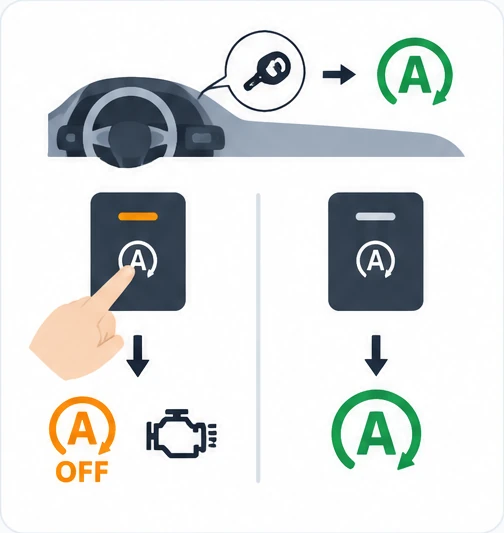
Deactivation and reactivation: you can switch the system off at any time once the ignition is on, for example to keep the passenger compartment at temperature. Press the Stop & Start button: the indicator lamp stays lit while the system is off. If the engine is in STOP mode, it restarts. The system switches back on automatically every time you switch on the ignition. Always deactivate it before working under the bonnet, to avoid injury from an automatic restart, and it is strongly recommended before driving through a flooded road. see the Driving advice section below for more on flooded roads.
Malfunction: if the system develops a fault, the ECO OFF switch warning lamp flashes and then stays on. Have it checked by a PEUGEOT dealer or a qualified workshop. If a fault occurs in STOP mode, the car may stall and all the instrument panel warning lamps come on. Switch off the ignition and restart the engine with the key.
Stop & Start needs a 12 V battery of a specific technology and specification. Any work on this battery must be done only by a PEUGEOT dealer or a qualified workshop. see the 12 V battery section below for more information.
Frequently Asked Questions
Why does my Peugeot 208 vibrate after a cold start?
On Petrol engines, the engine runs at an accelerated idle speed for anything up to 2 minutes after a cold start to preheat the catalytic converter. You will clearly feel vibrations when stationary during this time.
Why is Stop & Start not switching off my 208's engine?
STOP mode does not come on if the driver's door is open, the driver's seat belt is unfastened, you have not exceeded 6 mph (10 km/h) since starting with the key, demisting is on, or the engine is needed for temperature or system control. The indicator lamp flashes for a few seconds and goes off, which is normal.
How fast can I drive when the 208 automatic gearbox is in back-up mode?
In back-up mode the gearbox stays in 3rd gear, and you should not exceed 62 mph (100 km/h), local speed limits permitting. Contact a PEUGEOT dealer or a qualified workshop as soon as possible.
Can I turn off hill start assist on my Peugeot 208?
No, hill start assist cannot be deactivated. Using the parking brake to hold the car interrupts it.
Knowing how your 208's ignition, gearbox, hill start assist and Stop & Start behave makes everyday driving easier and safer. If anything here does not match what your car is doing, check or ask a PEUGEOT dealer or a qualified workshop.
Don't forget to follow us on Instagram for more Peugeot guides!
This is an independent guide, not an official Peugeot publication. If in doubt, contact a PEUGEOT dealer or a qualified workshop before carrying out any work.
BlueHDi Diesel engines on the Peugeot 208 use AdBlue to clean up their exhaust gases. This guide explains what the SCR system does, how far you can drive on a tank of AdBlue, how to store and handle the fluid s…
A flat 12 V battery is one of the most common reasons a car will not start. This guide explains how to reach the battery on your Peugeot 208, how to start the engine using another battery or a booster, how to c…
Your Peugeot 208 can warn you when one or more tyres lose pressure. This guide explains how the under-inflation detection system works, what to do when the alert comes on, how to reinitialise the system and whe…