Scroll the table sideways.
|
Earlier e-2008 (2020 handbook) |
Later e-2008 (2023 handbook) |
| Motor |
Synchronous, permanent magnets |
Synchronous, permanent magnets |
| Max power (EC) |
100 kW / 136 hp |
115 kW / 156 hp |
| Battery |
Lithium-ion, 50 kWh installed |
Lithium-ion, 54 kWh installed |
| Towing |
Not permitted |
Not permitted |
If you're buying used, check which version you're looking at: the later car has both more power and a bigger battery, which helps range.
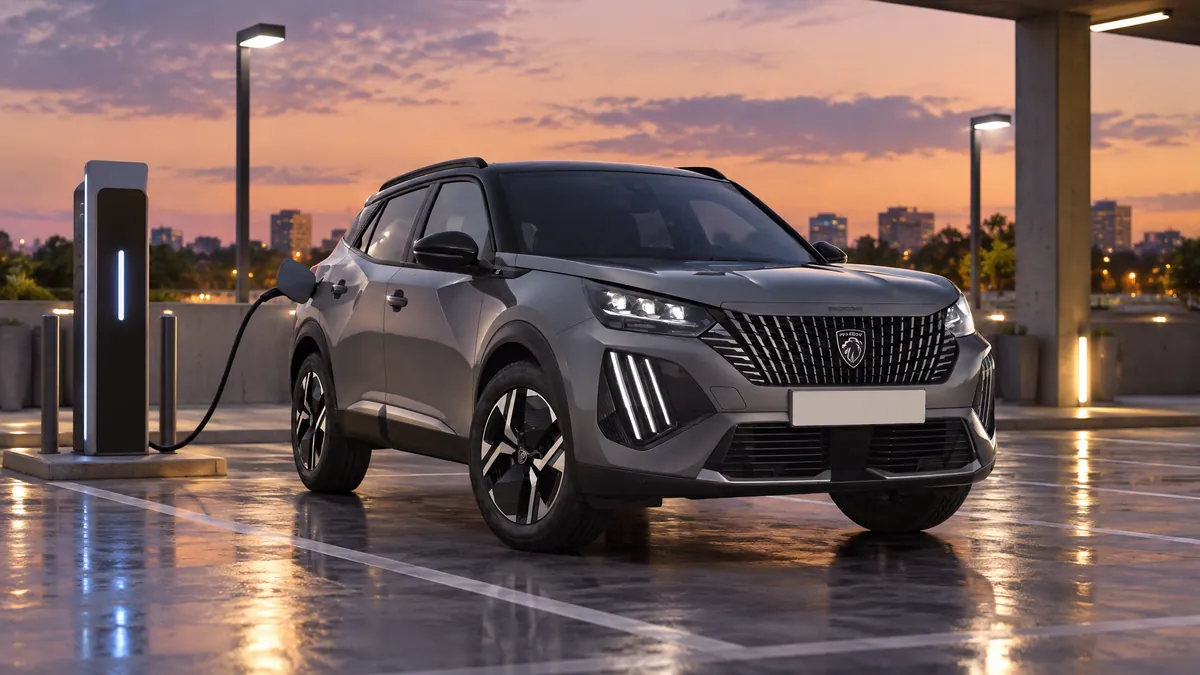
Charging the e-2008
The handbook lists three charging methods:
Scroll the table sideways.
| Charging type |
Mode |
Supply |
| Domestic |
Mode 2 |
230 V AC single-phase, 8 or 16 A |
| Accelerated (wallbox or public AC point) |
Mode 3 |
230 V AC single- or three-phase, 16 or 32 A |
| Superfast (rapid DC charger) |
Mode 4 |
400 V DC |
In practice, a 3-pin plug (Mode 2) is best kept as a backup or for topping up overnight. A home wallbox is the most convenient everyday option, and rapid DC chargers are for long journeys. Actual charging times depend on the car's on-board charger, the battery's state of charge and temperature, and the charger itself, so check the handbook for your car's specification.
Like any electric car, the e-2008 is quiet and smooth, and the instant torque makes it feel especially lively in town.
Peugeot 2008 Hybrid 136: The Mild Hybrid
The Hybrid 136 is not a plug-in. A 1.2-litre PureTech petrol engine works with an electric motor built into the gearbox, which is fed by a small 48-volt battery. The battery recharges when you slow down and brake. According to the 2023 handbook:
Scroll the table sideways.
| Component |
Specification |
| Petrol engine |
PureTech 136, 1,199 cc, 100 kW, unleaded |
| Gearbox |
6-speed electric dual-clutch automatic (e-DCS6) |
| Electric motor |
Synchronous, permanent magnets, 21 kW |
| Battery |
Lithium-ion, 48 V, 0.9 kWh installed |
| Braked trailer (10-12% gradient) |
1,200 kg |
| Unbraked trailer |
650 kg |
| Max nose weight |
55 kg |
The small battery means it can't cover long distances on electricity alone. Instead, the motor helps the engine when pulling away and in slow traffic, and lets it switch off more often, which is where most of the fuel saving comes from. It suits drivers who do lots of urban miles but have nowhere to charge.
Which Should You Choose?