Peugeot 5008 Fuse Box and Fuses (2017-present)
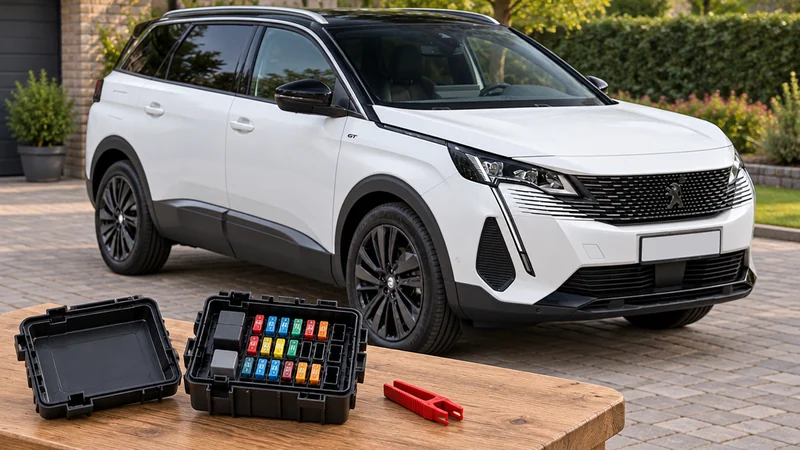
Hello and welcome. In this article we look at the fuseboxes and fuses on the Peugeot 5008 II (2017-present). We will cover where the two fuseboxes are, how a fuse is changed and which fuse protects wh
How to start, drive and park your Peugeot 5008 II: driving tips, electric parking brake, automatic gearboxes, driving modes and Stop & Start.
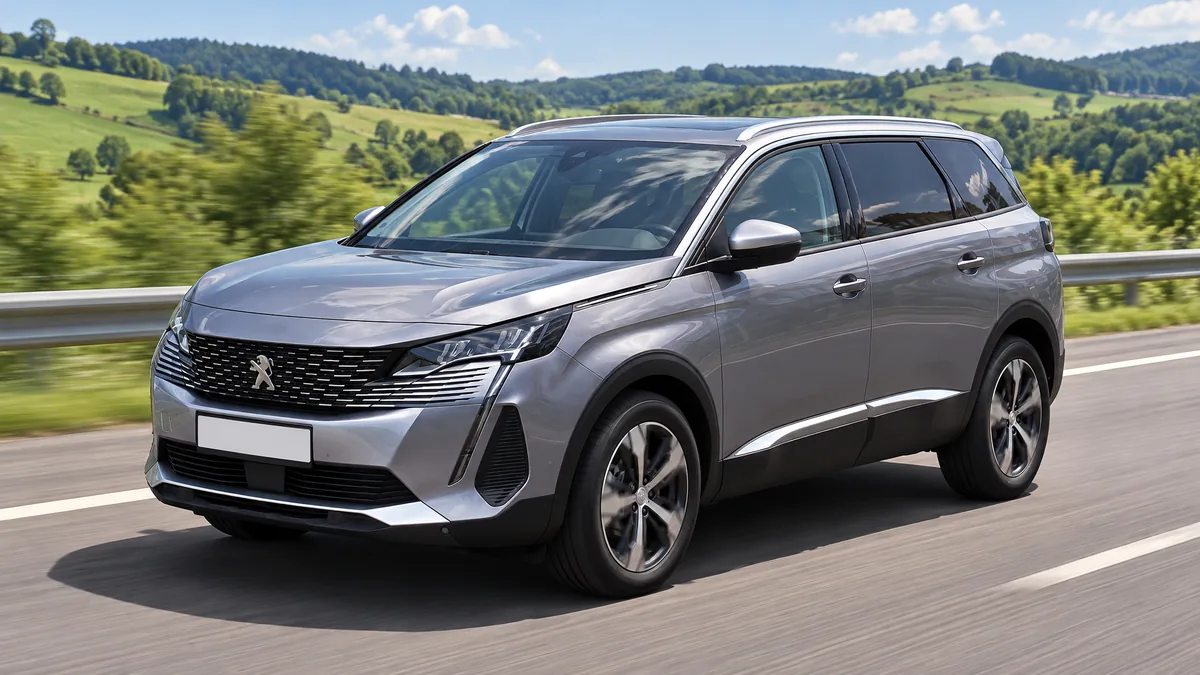
Hello and welcome. In this post, we'll look at starting the engine, the electric parking brake, the gearbox and Stop & Start on the Peugeot 5008 II (2017-present). It explains what each control does and what you need to do, step by step. It covers the Peugeot 5008 II (2017-present), including vehicles produced from 03/10/2023. Some features depend on the engine, gearbox, version or equipment of your car, so not everything here will apply to your 5008. Some features depend on the engine, gearbox, version or equipment of your car, so not everything here will apply to your 5008.
Press the Stop & Start control or switch it from the driving-assist menu; an amber A OFF tell-tale confirms the system is off.
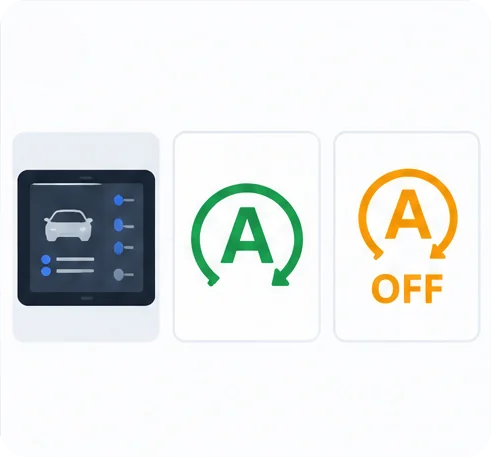
Scroll the table sideways.
| Section | In short |
|---|---|
| Driving recommendations | Safe driving advice, fire risks and flooded roads |
| Starting/switching off the engine | Using the START/STOP button with the electronic key |
| Electric parking brake | Applying and releasing the brake, manually or automatically |
| Automatic gearbox (type 1) | Push selector with P button, manual mode, regenerative braking |
| Automatic gearbox (type 2) | Push selector with Unlock button and manual mode |
| Automatic gearbox (type 3) | Hybrid dual-clutch gearbox with 48 V electric motor |
| Driving modes | Normal, Eco, Sport and Electric modes explained |
| Stop & Start (Petrol or Diesel) | How Stop & Start works and when it won't |
starts with some general advice for driving your 5008 safely.
Important safety points:
On flooded roads: avoid driving through floodwater, as it can seriously damage the engine or electric motor, the gearbox and the electrical systems. If you absolutely must drive through a flooded section of road:
You start and switch off your 5008 with the START/STOP button, and the electronic key must be inside the passenger compartment. If the key is not detected, a message appears: move the key so the engine can be started or switched off. If there is still a problem, follow the Key not detected – Back-up starting or Back-up switch-off steps below.
Starting:
Diesel engines: in low temperatures and/or when the engine is cold, the engine only starts once the preheating warning lamp goes out. If this lamp comes on after you press START/STOP, keep the pedal fully depressed and do not press the button again until the engine is running at a stable speed.
If one of the starting conditions is not met, a message appears. In some cases, a message tells you to turn the steering wheel while pressing START/STOP to help unlock the steering column.
Starting a rechargeable hybrid:
The system starts in Electric mode by default and decides, based on things like battery charge level or outside temperature, whether the petrol engine needs to start. You can change the driving mode at any time with the mode selector. In electric mode the car makes no noise, so take particular care with pedestrians and cyclists, who may not hear you coming despite the pedestrian horn.
Switching off:
In automatic mode, the electric parking brake applies itself when you switch off the engine and releases when you move off. Automatic mode is on by default, but it can be deactivated in certain situations. At any time with the engine running, briefly pull the control to apply the brake, or briefly push it while pressing the brake pedal to release it.
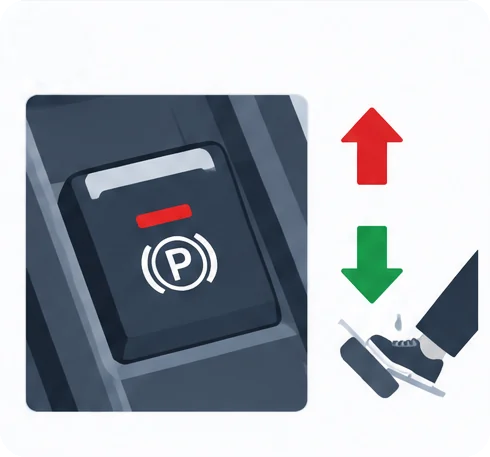
Indicator lamp: the lamp on the instrument panel and on the control comes on with the message 'Parking brake applied', and goes out with the message 'Parking brake released'. It flashes when you manually ask to apply or release the brake.
Manual release (ignition on or engine running):
If you do not press the brake pedal, the parking brake is not released and a message appears. For manual application, with the car stationary, briefly pull the control. The control indicator lamp flashes to confirm the request.
Automatic release: first make sure the engine is running and the driver's door is closed. The brake then releases gradually as you move off. With a manual gearbox:
With an automatic gearbox:
If the brake does not release automatically, check that the front doors are fully closed. When you are stationary with the engine running, do not press the accelerator unnecessarily, as the parking brake could release.
Automatic application: with the car stationary, the brake is applied automatically when you switch off the engine. It is not applied automatically if the engine stalls or goes into STOP mode with Stop & Start. In automatic mode you can still apply or release the brake manually at any time with the control.
Special cases: to immobilise the car with the engine running, briefly pull the control. In very cold conditions (ice), applying the parking brake is not recommended.
Safety points:
On petrol and Diesel versions, this is an automatic 6-speed or 8-speed gearbox with a push selector, plus a manual mode using paddles behind the steering wheel. Rechargeable hybrid versions have an automatic 8-speed gearbox with a push selector and a regenerative braking function. Apart from manual mode and regenerative braking, it works in the same way as other EAT8 gearboxes.
Scroll the table sideways.
| Button or position | What it does |
|---|---|
| P (Auto Park) | Press this button to switch to Parking mode. The front wheels are blocked for parking. |
| R | Reverse. |
| N | Neutral: to free-wheel and move the car with the ignition off. See the Free-wheeling section below. |
| D | Automatic mode: the gearbox manages gear changes according to your driving style, the road profile and the vehicle load. |
| M (Petrol / Diesel) | Press this button for manual mode. You change gear with the steering-mounted controls. |
| B (Rechargeable hybrid) | Press this button to activate regenerative braking. The gearbox also manages braking when you release the accelerator pedal. |
Using the selector: in mode N, with your foot on the brake pedal, push the selector without passing the point of resistance: forwards for R, backwards for D. Release it fully after each push and it returns to its starting position.
Quick change between D and R (to avoid mode N):
Steering-mounted paddles (depending on equipment): in mode M or D, pull the + or - paddle towards you and release it to change up or down a gear. You cannot use them to select neutral or to engage or disengage reverse.
Instrument panel display:
Scroll the table sideways.
| Display | Meaning |
|---|---|
| P | Parking |
| R | Reverse |
| N | Neutral |
| D1.6 / 8 | Automatic forward gear |
| B1.8 | Automatic forward gear with regenerative braking activated |
| M1.6 / 8 | Manual forward gear |
In all-electric driving, the gear engaged is not shown. The gearbox status stays on the instrument panel for a few seconds after you switch off the ignition.
Operation and safety:
Automatic mode: the gearbox chooses the gear for the best performance based on outside temperature, road profile, vehicle load and driving style. For maximum acceleration, press the accelerator fully down (kick-down): the gearbox changes down or holds the gear until maximum engine speed. You can use the paddles to select a gear temporarily if vehicle speed and engine speed allow. In manual mode, the gearbox only changes gear if vehicle speed and engine speed allow.
On petrol and Diesel versions, this is an automatic 6-speed or 8-speed gearbox with a push selector, plus a manual mode using paddles behind the steering wheel. Rechargeable hybrid versions have an automatic 8-speed gearbox with a push selector and a regenerative braking function. Apart from manual mode and regenerative braking, it works in the same way as other EAT8 gearboxes.
Scroll the table sideways.
| Button or position | What it does |
|---|---|
| P | Parking: the front wheels are blocked. |
| R | Reverse gear. |
| N | Neutral: to move the car with the ignition off, or to let it free-wheel. See the Free-wheeling section below. |
| D (Petrol / Diesel) | Automatic mode: the gearbox manages gear changes according to your driving style, the road profile and the vehicle load. |
| D/B (Rechargeable hybrid) | Automatic mode (D) or automatic mode with regenerative braking (B). With regenerative braking on, the gearbox also controls braking when you release the accelerator. |
| M (Petrol / Diesel) | Manual mode: you change gear with the steering-mounted controls. |
| Unlock | Press and hold before pushing the selector, with your foot on the brake, to come out of P or to change to R. |
Using the selector: push it forwards (N or R) or rearwards (N or D) once or twice, passing the point of resistance if needed. It returns to its starting position when you let go. For example, to go from P to R while pressing Unlock, either push forwards twice without crossing the point of resistance (P to N, then N to R), or push once crossing the point of resistance (straight from P to R).
Steering-mounted paddles (depending on equipment): in mode M or D, pull the + or - paddle towards you and release it to change up or down a gear. You cannot use them to select neutral or to engage or disengage reverse.
Instrument panel display:
Scroll the table sideways.
| Display | Meaning |
|---|---|
| P | Parking |
| R | Reverse |
| N | Neutral |
| D1.6 / 8 | Automatic forward gear |
| B1.8 | Automatic forward gear with regenerative braking activated |
| M1.6 / 8 | Manual forward gear |
In all-electric driving, the gear engaged is not shown. The gearbox status stays on the instrument panel for a few seconds after you switch off the ignition.
Operation and safety:
Unlocking from mode P:
Unlocking from N (below 3 mph (5 km/h)): fully depress the brake pedal and, keeping it pressed, select another mode.
Engaging reverse:
Manual mode: with mode D selected, press button M and the green indicator lamp in the button comes on. To leave manual mode, push forwards once to return to D, or press button M again so the lamp goes off.
Automatic mode: the gearbox chooses the gear for the best performance based on outside temperature, road profile, vehicle load and driving style. For maximum acceleration, press the accelerator fully down (kick-down): the gearbox changes down or holds the gear until maximum engine speed. You can use the paddles to select a gear temporarily if vehicle speed and engine speed allow.
Hybrid versions have a 6-speed electrified dual-clutch automatic gearbox with a push selector and a manual mode using paddles behind the steering wheel. It includes the 48 V electric motor, which improves the performance of the petrol engine, reduces fuel consumption and can drive the car on electric power alone.
Scroll the table sideways.
| Button or position | What it does |
|---|---|
| P (Auto Park) | Press this button to switch to Parking mode. The front wheels are blocked for parking. |
| R | Reverse. |
| N | Neutral: to free-wheel and move the car with the ignition off. See the Free-wheeling section below. |
| D | Automatic mode: the gearbox manages gear changes according to your driving style, the road profile and the vehicle load. It also manages braking when you release the accelerator. |
| M | Press this button for manual mode. You change gear with the steering-mounted controls. |
Using the selector: in mode N, with your foot on the brake pedal, push the selector without passing the point of resistance: forwards for R, backwards for D. Release it fully after each push and it returns to its starting position.
Quick change between D and R (to avoid mode N):
Steering-mounted paddles (depending on equipment): in mode M or D, pull the + or - paddle towards you and release it to change up or down a gear. You cannot use them to select neutral or to engage or disengage reverse.
Electric motor: the motor in the gearbox is used for the first start, provides the 12 V power supply via the DC/DC converter and gives electric assistance to the petrol engine. It can:
These features work through five automatic functions: e-Boost, e-Creeping, e-Launch, e-Queueing and e-Parking. A manual mode, e-Auto, lets you activate or deactivate the petrol engine restarting while driving. When you select P or N, you may hear more noise from the engine compartment as the traction battery starts charging. This is normal and is not a fault.
Instrument panel display:
Scroll the table sideways.
| Display | Meaning |
|---|---|
| P | Parking |
| R | Reverse |
| N | Neutral |
| D | Automatic forward gear |
| M1.6 | Manual forward gear |
The gear engaged is also shown in Sport mode, but not in all-electric driving. The gearbox status stays on the instrument panel for a few seconds after you switch off the ignition.
Operation and safety:
Automatic mode functions: these use the electric motor for extra power or zero-emission driving in everyday situations. They only work if the traction battery is charged enough, and they cannot be deactivated.
Scroll the table sideways.
| Function | What it does |
|---|---|
| e-Launch | With the petrol engine off, the car moves off in electric mode without losing performance when you press the accelerator in mode D or R. |
| e-Creeping | With the petrol engine off, the car moves forwards or backwards in electric mode when you release the brake pedal in mode D or R, without pressing the accelerator. |
| e-Queueing | Lets you follow a queue of traffic with several stops and restarts, using e-Creeping, e-Launch and electric driving. |
| e-Parking | Helps with parking manoeuvres at reduced speed using the electric motor in mode D or R. |
| e-Boost | Runs the petrol engine and electric motor together. With the traction battery fully charged, kick-down gives more torque than the petrol engine alone. |
Pressing the brake pedal repeatedly makes the petrol engine restart to provide braking assistance.
The driving modes available depend on your car's engine and equipment. Depending on version, you select them with one of these controls:
Petrol, Diesel or hybrid versions: Normal mode is selected by default every time you switch on the ignition.
Scroll the table sideways.
| Mode | What it does |
|---|---|
| Normal | Restores the default settings. |
| Eco | Reduces energy consumption by reducing the performance of the heating and air conditioning, without switching them off. |
| Sport (manual gearbox) | More dynamic driving, acting on the power steering and accelerator, with the option to show the car's dynamic settings on the instrument panel. |
| Sport (automatic gearbox) | More dynamic driving, acting on the power steering, accelerator and gear changes, with the option to show the car's dynamic settings on the instrument panel. |
Selecting Sport mode deactivates the Stop & Start function / e-Auto mode.
Coasting mode (Petrol or Diesel): depending on version or engine, with an EAT8 gearbox in mode D and outside Sport mode, gradually and fully releasing the accelerator lets the car free-wheel, which can save fuel. A drop in engine speed is normal (rev counter at idle and less engine noise).
Rechargeable hybrid versions: Electric mode is selected by default every time you switch on the ignition. It uses 100% electrical energy, with a maximum speed of approximately 84 mph (135 km/h). If conditions do not allow Electric mode when you start, the message 'Electric mode currently unavailable' appears and the car switches to Hybrid mode automatically. Depending on country of sale, an LED under the interior rear view mirror, visible from outside, confirms you are in Electric mode. You can deactivate this LED by inserting the tip of a paper clip or similar object into the hole underneath the mirror.
Electric mode needs:
To leave Electric mode manually, fully depress the accelerator pedal or select another mode. If the car has not been used for a long period (several months), the petrol engine may restart even if the battery is charged.
If the petrol engine starts many times without warming up enough, Electric mode may be temporarily unavailable because fuel dilutes in the oil, a natural effect. The message 'Electric mode unavailable: automatic operation in progress' appears. To get normal electric operation back, drive approximately 50 miles (80 km) in motorway conditions or approximately 125 miles (200 km) in urban conditions.
Stop & Start puts the engine into standby (STOP mode) when the car is stationary, such as at red lights or in traffic jams. The engine restarts automatically (START mode) as soon as you show you want to move off. It is designed mainly for town driving, to reduce fuel consumption, exhaust emissions and noise when stationary. It does not affect the car's functions, including the braking.
Deactivation and reactivation: the function is on by default when you switch on the ignition. You change the setting in the Driving/Vehicle touch screen menu, and a message on the instrument panel confirms the change. If you deactivate it while the engine is in standby, the engine restarts immediately.
Main conditions for operation:
When the engine goes into STOP mode:
A time counter adds up the time spent in standby during the journey and resets to zero each time you switch on the ignition.
The engine will not go into standby if the operating conditions are not met, or if:
With the electronic key inside the car, select mode P or N and depress the brake pedal. Then press the START/STOP button and keep your foot on the pedal until the engine starts.
The engine must be running and the driver's door closed for automatic release. If it still does not release, check that both front doors are fully closed.
The driver's door must be closed, the driver's seat belt fastened, the battery charge sufficient, the engine at its normal temperature and the outside temperature between 0°C and 35°C. It also will not work on a steep slope, in Sport mode, with the parking brake applied, or if you have not exceeded 6 mph (10 km/h) since the engine last started.
Electric mode needs enough battery charge and an outside temperature between approximately -5°C and 45°C. If the message 'Electric mode unavailable: automatic operation in progress' appears, drive approximately 50 miles (80 km) in motorway conditions or approximately 125 miles (200 km) in urban conditions to get normal electric operation back.
Knowing how your 5008's gearbox, parking brake and Stop & Start behave makes everyday driving smoother and safer. Keep this guide handy. If in doubt, ask a PEUGEOT dealer or a qualified workshop.
If a lamp comes on while you are driving, check our guides to the Peugeot 5008 red warning lights, the Peugeot 5008 orange warning lights and the Peugeot 5008 green and blue indicator lamps.
Don't forget to follow us on Instagram for more Peugeot guides!
This is an independent guide, not an official Peugeot publication. If in doubt, contact a PEUGEOT dealer or a qualified workshop before carrying out any work.
Related guides: Peugeot 5008 model guides.
Cover adapted from a photograph by © M 93 — Wikimedia Commons, CC BY-SA 3.0 de (AI edited).
Hello and welcome. In this article we look at the fuseboxes and fuses on the Peugeot 5008 II (2017-present). We will cover where the two fuseboxes are, how a fuse is changed and which fuse protects wh
Hello and welcome. In this article we look at the 12 V battery on the Peugeot 5008 II (2017-present). We will cover safe handling, jump starting, charging, and disconnecting and reconnecting it, along
Hello and welcome. In this post we gather the technical specifications for the Peugeot 5008 II (2017-present). We'll look at engine and gearbox data, towed loads and nose weights, hybrid motor and bat