Peugeot 408 Fuse Box and Fuses (2022-2026)
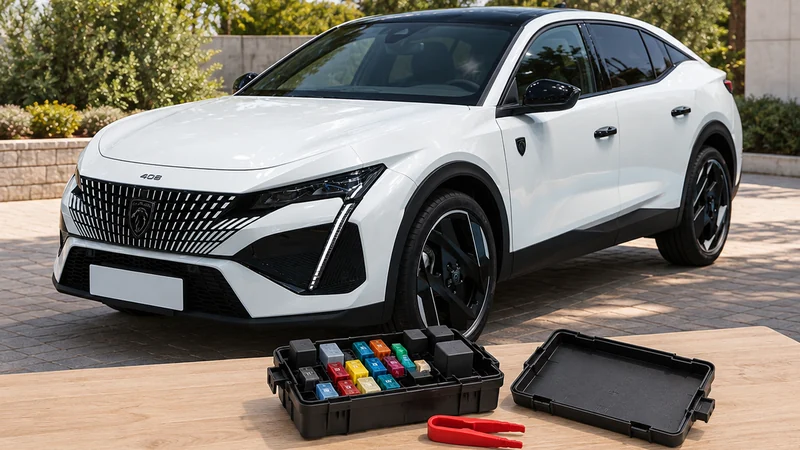
Hello and welcome. In this article we look at the fuses on the Peugeot 408 I (2022-2026). We will cover who should change a fuse and what to know before adding extra electrical equipment to the car.
How to charge your Peugeot 408 rechargeable hybrid or electric: control unit lamps, deferred charging, charging modes, safety rules and battery care tips.
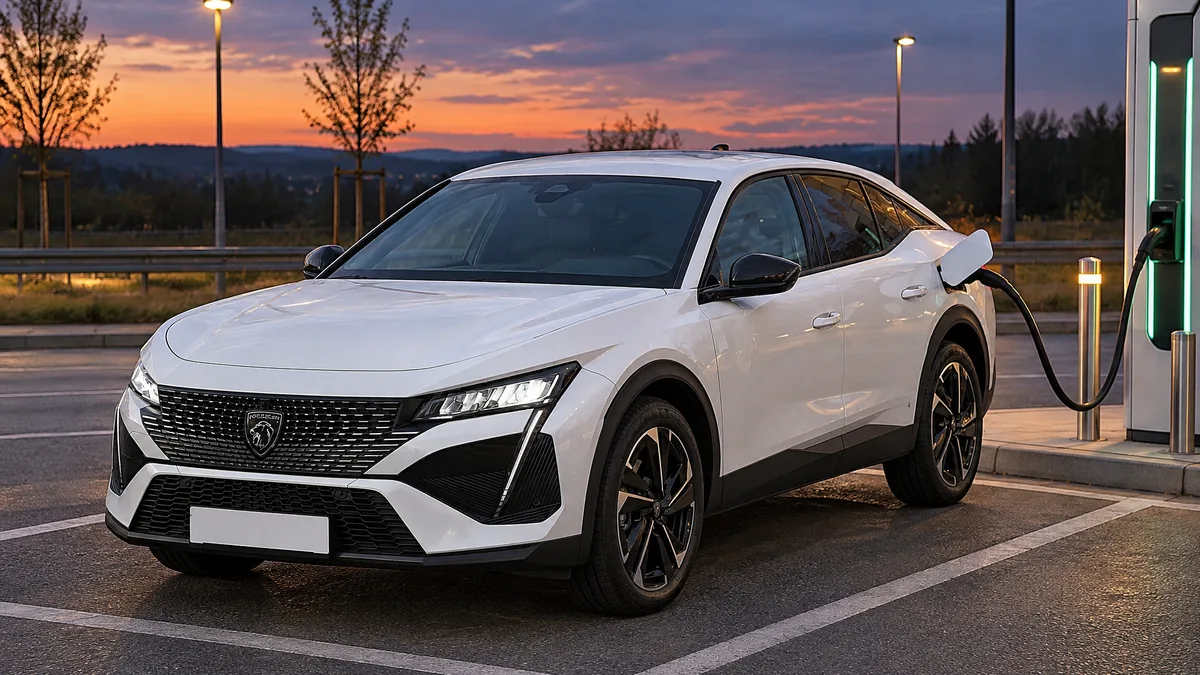
Hello and welcome. In this post, we'll look at how to charge the plug-in hybrid 408 and the e-408, including the charge flap and cable types on the Peugeot 408 I (2022-2026). It covers the safety rules, the mode 2 control unit and its indicator lamps, deferred charging, the charging modes and how to connect and disconnect the charging nozzle. The guide covers the Peugeot 408 I (2022-2026), including vehicles produced from 28/10/2024. Some items depend on the version or equipment, so not everything here may apply to your car. Some items depend on the version or equipment, so not everything here may apply to your car.
Open the charge flap, connect the matching cable until it locks, and use the lamp colours on the flap to confirm that charging has started.
Scroll the table sideways.
| Section | In short |
|---|---|
| Rechargeable hybrid or electric vehicles - Specific recommendations | Safety rules, battery care and the mode 2 control unit |
| Charging the traction battery (Rechargeable hybrid) | How to charge the rechargeable hybrid's traction battery |
| Charging system (Electric) | Electric 400 V system, flap lamps, cables and modes |
| Charging the traction battery (Electric) | How to charge the electric version at home or public |
These recommendations apply only to rechargeable hybrid and electric versions. They also introduce the control unit (mode 2) you need for standard charging at home.
Safety warnings:
Washing the car:
Looking after the traction battery: to preserve your car's mileage and the durability of the traction battery, PEUGEOT recommends that you:
Pacemakers: these vehicles have been developed in line with the maximum electromagnetic field limits recommended by the ICNIRP (International Commission on Non-Ionizing Radiation Protection, 1998 Guidelines). If you have a pacemaker or similar device, ask your doctor or the device's manufacturer about any precautions you should take, and make sure the device is guaranteed to work in an environment that meets the ICNIRP recommendations.
If you are in any doubt:
Control unit indicator lamps (mode 2):
When you plug the charging cable into a domestic socket, all of the indicator lamps come on briefly. If none come on, check the domestic socket's circuit-breaker:
Control unit label recommendations: read the label before use. The label tells you that:
States shown on the control unit label:
Scroll the table sideways.
| Lamps shown | Meaning |
|---|---|
| None | Not connected to the power supply, or no power available from the infrastructure. |
| POWER (green), CHARGE (green), FAULT (red) | The control unit is performing a self-test. |
| POWER (green) | Connected only to the infrastructure, or to the infrastructure and the car, but no charging in progress. |
| POWER (green), CHARGE (green) | Connected to the power supply and the car. The car is on charge or in a temperature pre-conditioning sequence. |
| POWER (green), CHARGE (green) | Connected to the power supply and the car. The car is waiting to charge, or charging is complete. |
| FAULT (red) | Control unit malfunction, no charging allowed. If an error lamp comes back after a manual reset, have the control unit checked by a PEUGEOT dealer before the next charge. |
| POWER (green), CHARGE (green), FAULT (red) | The control unit is in diagnostic mode. |
Manual reset of the control unit:
For a full charge, follow the charging procedure without interrupting it until it stops by itself. Charging can start immediately (the default) or be deferred. You set deferred charging on the touch screen or with the MYPEUGEOT APP.
When the car is connected, the instrument panel shows:
Once the instrument panel has gone into standby, you can show this information again by unlocking the car or opening a door. You can also follow charging progress in the MYPEUGEOT APP. In Lounge mode, with the car connected, you can switch on the ignition and use some functions, such as the audio and telematics system and the air conditioning, for several hours.
Low charge and storage warnings:
Before charging: depending on your situation, have a professional check that the electrical system complies with the applicable standards and is compatible with the car, or have a professional electrician install a dedicated domestic socket or accelerated charging unit (Wallbox). Use the charging cable supplied with the car. A PEUGEOT dealer or a qualified workshop can give you more information.
During charging:
After charging: check that the charging flap is closed. Do not leave the cable plugged into the domestic socket, as there is a risk of short-circuit or electrocution if it touches or sits in water.
Deferred charging: by default, the start time is set to around midnight. Depending on equipment, you can change it.
You can also programme deferred charging from a smartphone with the MYPEUGEOT APP.
Connecting the car:
Domestic charging (mode 2):
Accelerated charging (mode 3):
If charging does not start in either mode, restart the procedure and make sure every connection is made properly.
Disconnecting:
Finishing in mode 2: the end of charging is confirmed when the CHARGE lamp on the control unit and the light guides in the flap come on fixed green. Replace the nozzle's protective cover, close the charging flap, then unplug the control unit's cable from the domestic socket.
Finishing in mode 3: the Wallbox confirms the end of charging and the light guides in the flap come on fixed green. Put the nozzle back on the charging unit and close the charging flap.
The electric drive system works at approximately 400 V. You can recognise it by its orange cables, and its components carry a specific symbol. The power train can get hot during use and after you switch off the ignition, so follow the warning labels, particularly those inside the charging flap.
Traction battery: this battery stores the energy for the electric motor and the heating and cooling equipment in the passenger compartment. It discharges as you use the car, so you need to recharge it regularly. You do not need to wait for it to reach the reserve level before recharging. Range varies with your driving style, the route, use of the heating and cooling equipment and the ageing of the components. Battery lifespan depends on factors such as the climate, the distance travelled and how often you fast-charge.
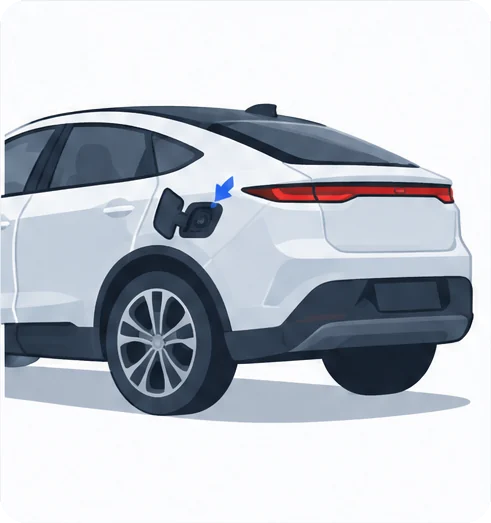
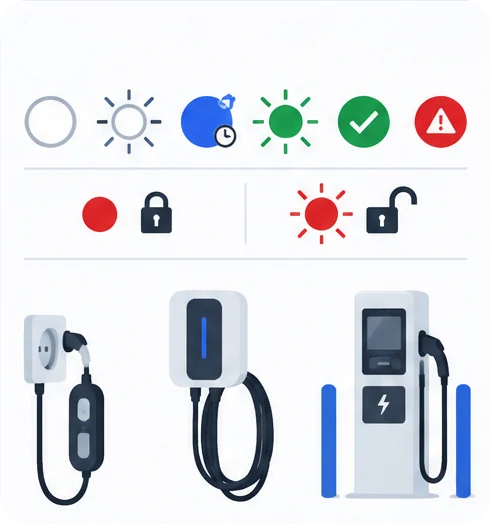
Charging flap: inside the flap you will find the charging connectors, the deferred charging activation button, the nozzle locking lamp and the charging indicator lamp. The nozzle locking lamp shows fixed red when the nozzle is positioned correctly and locked, and flashing red when the nozzle is positioned incorrectly or cannot be locked.
Scroll the table sideways.
| Charging indicator lamp | Meaning |
|---|---|
| Fixed white | Welcome lighting when you open the flap and disconnect the charging cable. |
| Flashing white | Charging initialisation. |
| Fixed blue | Deferred charging. |
| Flashing green | Charging in progress. |
| Fixed green | Charging complete. The lamp goes off after about 2 minutes as the car's functions go into standby. It comes on again to show the battery is fully charged when you unlock the car with the Keyless Entry and Start system or open a door. |
| Fixed red | Malfunction. |
If the charging flap takes an impact, even a light one, do not use it. Never dismantle or modify the charging connector, as there is a risk of electrocution or fire. Contact a PEUGEOT dealer or a qualified workshop.
Charging cables: the cable supplied with the car (depending on version) is compatible with the electrical systems in the country of sale. When travelling abroad, check that local electrical systems are compatible with it. A PEUGEOT dealer or a qualified workshop can supply a full range of suitable charging cables.
Identification labels: labels on the car, the charging cable and the charger tell you which device to use.
Scroll the table sideways.
| Location | Configuration | Power type/Voltage range |
|---|---|---|
| Charging connector (vehicle side) | TYPE 2 | AC < 480 Vrms |
| Charging socket (charger side) | TYPE 2 | AC < 480 Vrms |
| Charging connector (vehicle side) | COMBO 2 (FF) | DC 50 V - 500 V |
Charging modes:
Do not damage the mode 2 domestic charging cable. If it is damaged, stop using it and contact a PEUGEOT dealer or a qualified workshop for a replacement. Never take apart or modify an accelerated charging unit, as there is a risk of electrocution or fire, and follow its manufacturer's user manual.
To recharge, connect the car to a domestic electricity supply (domestic or accelerated charging) or to a fast public charger (superfast charging). For a full charge, follow the procedure without pausing until it ends by itself. Charging can be immediate or deferred, except on a fast public charger (mode 4).
You can stop domestic or accelerated charging at any time by unlocking the car and removing the nozzle. For superfast charging, follow the fast public charger's instructions. You can also follow charging progress in the MYPEUGEOT APP. For safety, the car will not start while the charging cable is plugged in, and a warning appears on the instrument panel. The cooling fan in the engine compartment runs during charging to cool the on-board charger and the traction battery.
Low charge and storage warnings:
Domestic or accelerated charging precautions:
Superfast charging precautions: check that the fast public charging station and its cable are compatible with the car. Below 0°C, charging times may be longer. Below -20°C, charging is still possible but may take even longer, because the battery has to be heated first. Afterwards, check that the charging flap is closed.
Deferred charging and the 80% limit: the default start time is around midnight and, depending on equipment, you can change it. You can also limit charging to 80% of the battery's capacity. 80% is recommended for daily use and may improve performance and durability. A full charge is recommended for a long trip and takes longer. The 80% limit and deferred charging only work in modes 2 and 3.
You can also programme deferred charging from a smartphone with the MYPEUGEOT APP.
Connecting the car:
Domestic charging, mode 2:
When charging is complete and the cable is still connected, opening the driver's door shows the charge level on the instrument panel for about 20 seconds.
Accelerated charging, mode 3:
Superfast charging, mode 4:
If charging does not start in any mode, restart the procedure and make sure the connection is made properly.
Disconnecting:
Finishing in mode 2: the end of charging is confirmed when the green CHARGE lamp on the control unit and the green charging lamp in the flap come on fixed. Replace the nozzle's protective cover, close the charging flap, then unplug the control unit end of the cable from the domestic socket.
Finishing in mode 3: the charging unit and a fixed green lamp in the flap show the end of charging. Hang the nozzle back on the charging unit and close the charging flap.
Finishing in mode 4: the charger and a fixed green lamp in the flap show the end of charging. In mode 4 only, you can also pause charging with the button in the flap. Hang the nozzle back on the charger, then, depending on version, replace the protective cover on the lower section and close the charging flap.
Once charging is complete, the green lamp in the flap goes out after about 2 minutes. When you disconnect the nozzle, the instrument panel says charging is complete, even if you disconnected before the battery was full.
POWER in green means the connection is established and charging can begin. CHARGE flashing green means charging is in progress, fixed green means it is complete, and a red FAULT lamp means charging is not permitted or must stop immediately.
As a safety measure, the car will not start while the charging cable is plugged into the connector, and a warning appears on the instrument panel. Disconnect the charging nozzle first.
If the car is locked, unlock it. If it is unlocked, lock it and then unlock it. When the red lamp in the flap goes out, remove the nozzle within 30 seconds.
No. For daily use, charge to about 80%, and keep a full charge for long trips.
Charging your Peugeot 408 is straightforward once you know what the lamps in the flap and on the control unit are telling you. Follow the safety rules, look after the traction battery, and if anything looks wrong, contact a PEUGEOT dealer or a qualified workshop.
If a lamp comes on while you are driving, see our guides to the Peugeot 408 red warning lights, the Peugeot 408 orange warning lights and the Peugeot 408 green and blue indicator lamps.
Don't forget to follow us on Instagram for more Peugeot guides!
This is an independent guide, not an official Peugeot publication. If in doubt, contact a PEUGEOT dealer or a qualified workshop before carrying out any work.
Related guides: Peugeot 408 model guides.
Cover adapted from a photograph by Alexander-93 — Wikimedia Commons, CC BY-SA 4.0 (AI edited).
Hello and welcome. In this article we look at the fuses on the Peugeot 408 I (2022-2026). We will cover who should change a fuse and what to know before adding extra electrical equipment to the car.
Hello and welcome. In this article we look at the tyre under-inflation detection system on the Peugeot 408 I (2022-2026): how it works, what to do when the alert comes on, how to reinitialise it and w
Hello and welcome. In this post we cover the lights on the Peugeot 408 I (2022-2026). We'll look at caring for the headlamp lenses, which LED lamps need a professional, the front and rear lamp layouts